What Is the LED Bulb Lifespan Calculator?
LED bulbs are sold with a rated lifespan printed in hours — commonly 15,000, 25,000, or even 50,000 hours. That number alone doesn't tell you much. This calculator converts those rated hours into something practical: how many years the bulb will actually last given how many hours per day you use it.
How to Use It
Enter the bulb's rated lifespan in hours (check the packaging) and the average number of hours you keep it switched on each day. The calculator returns the expected lifespan in years, along with months, total days of use, and the hours the bulb runs per year.
The Formula Explained
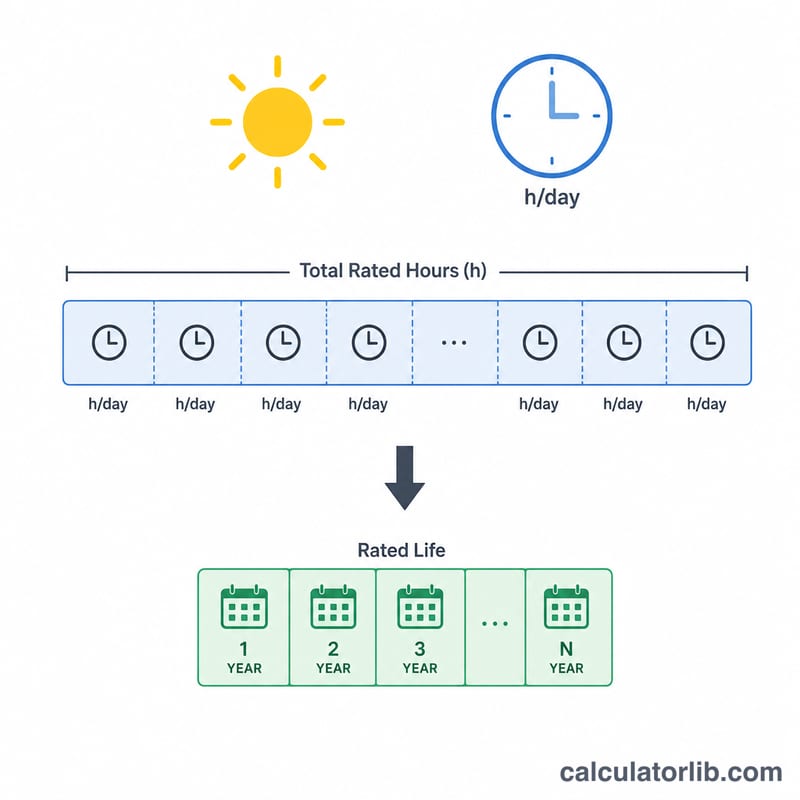
The math is simple. A year has 365 days, so a bulb used H hours per day burns H × 365 hours per year. Dividing the rated hours by that annual figure gives the lifespan in years:
$$\text{Years} = \frac{\text{Rated hours}}{\text{Hours per day} \times 365}$$
Worked Example
Suppose a bulb is rated for 25,000 hours and you use it 5 hours per day. Annual usage is \(5 \times 365 = 1{,}825\) hours. Lifespan = \(25{,}000 \div 1{,}825 \approx 13.7\) years. The same bulb left on 12 hours a day would last only about 5.7 years.
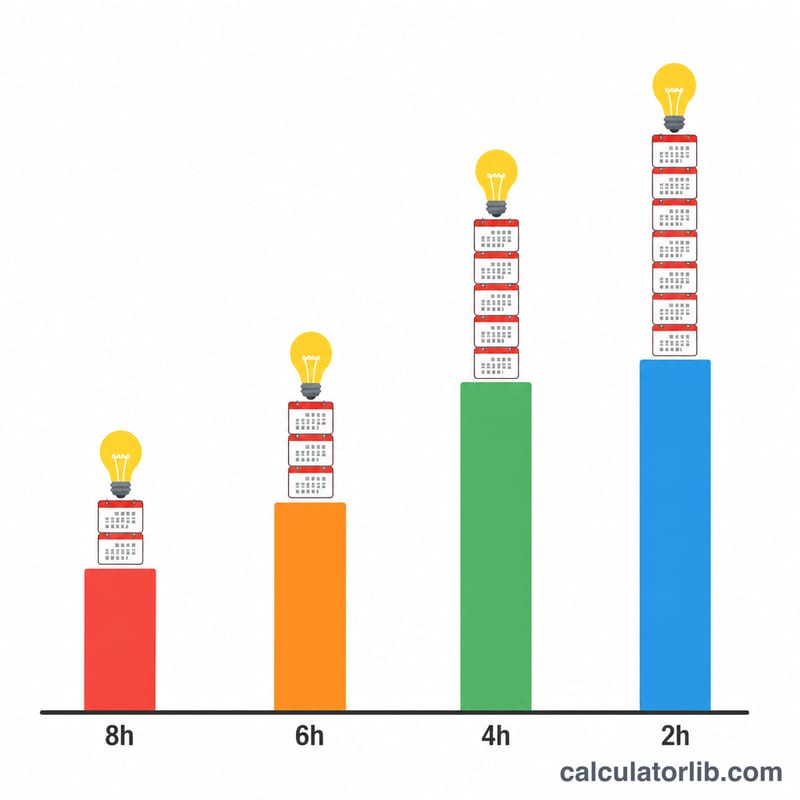
Lifespan in Years by Rated Hours and Daily Usage
Years are calculated as \(\text{years} = \frac{\text{rated hours}}{\text{hours per day} \times 365}\) and rounded to one decimal place. The table assumes the bulb runs the same number of hours every day of the year.
| Rated lifespan | 2 h/day | 4 h/day | 8 h/day | 12 h/day | 24 h/day |
|---|---|---|---|---|---|
| 15,000 hours | 20.5 years | 10.3 years | 5.1 years | 3.4 years | 1.7 years |
| 25,000 hours | 34.2 years | 17.1 years | 8.6 years | 5.7 years | 2.9 years |
| 50,000 hours | 68.5 years | 34.2 years | 17.1 years | 11.4 years | 5.7 years |
Worked example: a 25,000-hour bulb used 5 hours per day gives \(\frac{25{,}000}{5 \times 365} = \frac{25{,}000}{1{,}825} \approx\) 13.7 years.
Very long results (for example 68.5 years) are theoretical. Other components, such as the driver, or a change of fixture or home, will usually end the bulb's service life well before then.
Typical LED Rated Lifespan Ranges
| Bulb type | Typical rated life (hours) |
|---|---|
| Standard household LED (A19/A60) | about 15,000–25,000 |
| Premium or commercial LED | about 35,000–50,000 |
| CFL (for comparison) | about 8,000–10,000 |
| Halogen (for comparison) | about 2,000 |
| Incandescent (for comparison) | about 1,000 |
These are typical figures, and individual products vary. Always check the manufacturer's stated rating on the packaging or datasheet.
What the rating means: LED lifespan is most commonly given as L70, the number of hours until the bulb's light output falls to 70% of its initial lumens. An LED rarely burns out suddenly. It usually dims gradually, and L70 is the point where the dimming is generally considered noticeable.
Real-world caveats: Rated hours are laboratory estimates measured under controlled conditions. In practice, lifespan depends heavily on heat (enclosed fixtures and high ambient temperatures shorten it), on the quality of the driver and electronics, on voltage fluctuations, and on how often the bulb is switched on and off. A bulb from a reputable brand with a good warranty is more likely to reach its rating.
FAQ
Does the rated lifespan mean the bulb suddenly dies? Not usually. Most LED ratings (often called L70) mean the bulb still works but has dimmed to about 70% of its original brightness by that point.
What lifespan should I assume? Quality household LEDs are typically 15,000–25,000 hours; premium and commercial fixtures can reach 50,000 hours.
Why does frequent switching matter? Very frequent on/off cycling can shorten some LED drivers' life, though modern LEDs handle switching far better than fluorescent lamps.