
What this calculator does
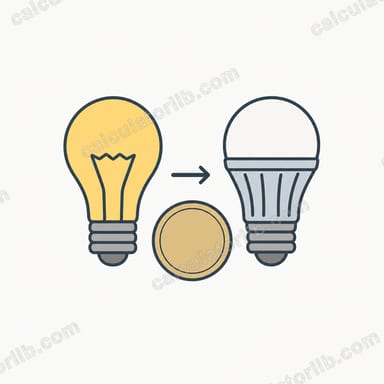
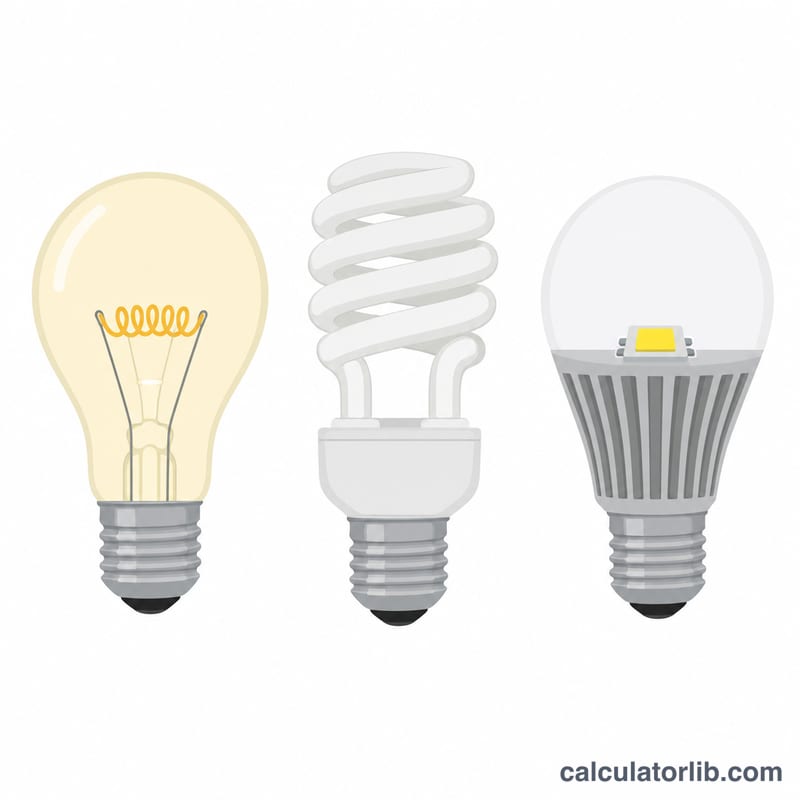
This tool compares the total running cost of three common light sources over a 15-year horizon: a traditional incandescent bulb, a compact fluorescent lamp (CFL) and an LED bulb. "Running cost" combines two parts: the money you spend buying lamps (each lamp type is re-purchased every time it burns through its rated lifetime) and the electricity it consumes. The currency is generic, so enter prices and the electricity rate in whatever currency you use locally.
How to use it
For each lamp type, enter its unit price, rated lifetime in hours and power draw in watts. Then set the shared parameters: your electricity rate per kilowatt-hour, how many bulbs are in use, and how many hours per day they are switched on. The calculator projects cumulative cost year by year for 15 years and reports how much LED and CFL save compared with incandescent.
The formula explained
Cumulative operating hours after \(Y\) years is \(H = \text{hoursPerDay} \times 365 \times Y\). The number of lamps bought so far is \(\left\lceil H / L \right\rceil\) (one lamp covers the first \(L\) hours, a second the next \(L\), and so on), with a minimum of one. Lamp cost is \(\text{price} \times \text{lamps} \times \text{quantity}\). Electricity cost is \(\left(\text{watts} / 1000\right) \times H \times \text{quantity} \times \text{rate}\), where dividing watts by 1000 converts to kilowatts so it matches a per-kWh rate. Running cost is the sum of both.
$$\text{Cost}_{15} = \left(\text{Price} \cdot \left\lceil \frac{H}{\text{Life}} \right\rceil + \frac{\text{Watts}}{1000} \cdot H \cdot \text{Rate}\right) \cdot \text{Qty}$$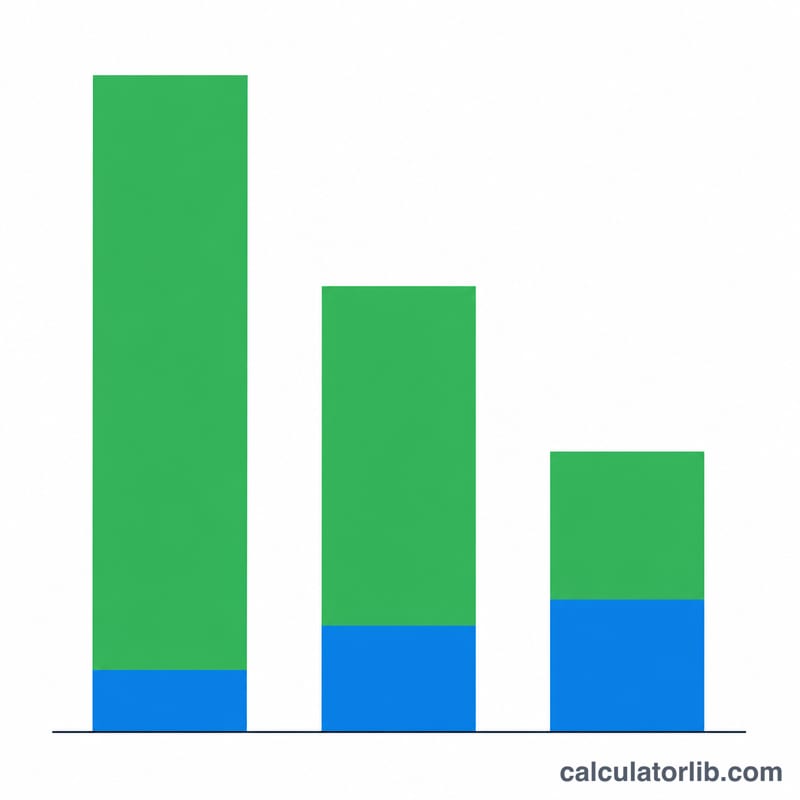
Worked example (defaults)
With \(\text{hoursPerDay} = 5.5\), the 15-year hours are $$5.5 \times 365 \times 15 = 30{,}112.5 \text{ h}.$$ Incandescent (100, 1000 h, 60 W) needs \(\left\lceil 30112.5/1000 \right\rceil = 31\) lamps \(= 3{,}100\) plus \(1{,}806.75 \text{ kWh} \times 22 = 39{,}748.5\), totaling about \(42{,}848.5\). CFL (800, 6000 h, 10 W) costs about \(11{,}424.75\) and LED (1600, 40000 h, 7.5 W) about \(6{,}568.56\). The LED is by far the cheapest to own and run.
FAQ
Why does the LED cost so little? Its long life means you almost never replace it, and its low wattage keeps electricity use tiny.
Does it account for leap years? No, it uses a flat 365 days per year for simplicity.
Can I model more than one bulb? Yes, set "Number of bulbs in use" and both lamp and electricity costs scale by that count.