
What Is the Debt-to-Income Ratio?
Your debt-to-income (DTI) ratio compares how much you pay toward debt each month with how much you earn before taxes. Lenders use it to judge whether you can comfortably take on more credit. This calculator focuses on credit card payments alongside any other recurring debt, so you can see exactly how much of your income is committed to repayment.

How to Use It
Enter your total monthly credit card payments, any other monthly debt payments (car loans, student loans, mortgage, personal loans), and your gross monthly income — the amount you earn before tax and deductions. The calculator returns your overall DTI percentage, your total debt payment, and the share of income consumed by credit cards alone.
The Formula Explained
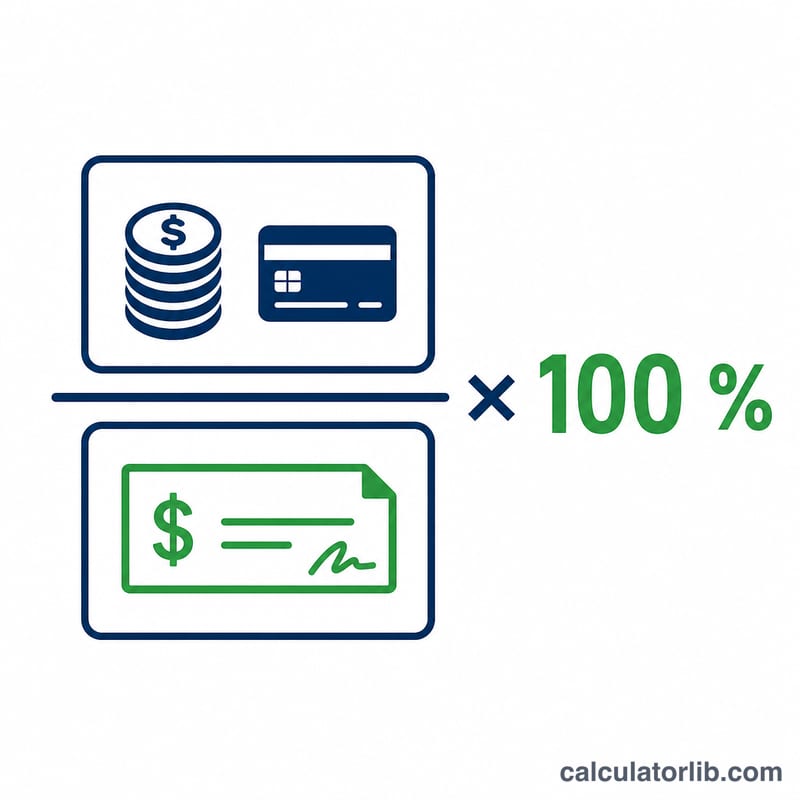
The math is simple:
$$\text{DTI} = \frac{\text{Credit Card} + \text{Other Debt}}{\text{Gross Income}} \times 100\%$$A lower percentage means more breathing room. As a general guide, a DTI under 36% is considered healthy, 36–43% is manageable but watched closely by lenders, and above 43% can make qualifying for new loans difficult.
Worked Example
Suppose you pay $300 per month on credit cards and $500 on a car loan, with a gross monthly income of $4,000. Total debt is $800.
$$\text{DTI} = \frac{800}{4000} \times 100 = 20\%$$The credit card share alone is
$$\text{CC DTI} = \frac{300}{4000} \times 100 = 7.5\%$$A 20% DTI is comfortably within the healthy range.
FAQ
Should I use gross or net income? Use gross (pre-tax) income — that is the standard lenders use for DTI.
Does it include rent? If rent or mortgage is a recurring obligation, include it under other debt payments for a full picture, though credit-card-focused checks may exclude rent.
What DTI do lenders prefer? Many prefer a total DTI of 36% or less, with some allowing up to 43% for qualified borrowers.