
What is the Watts to Lumens Calculator?
Watts measure how much electrical power a light source consumes, while lumens measure how much visible light it actually produces. This calculator converts watts into lumens using the luminous efficacy of the bulb, expressed in lumens per watt (lm/W). Because efficacy varies enormously by technology, the same wattage can produce wildly different brightness — which is why modern lighting is rated in lumens, not watts.
How to use it
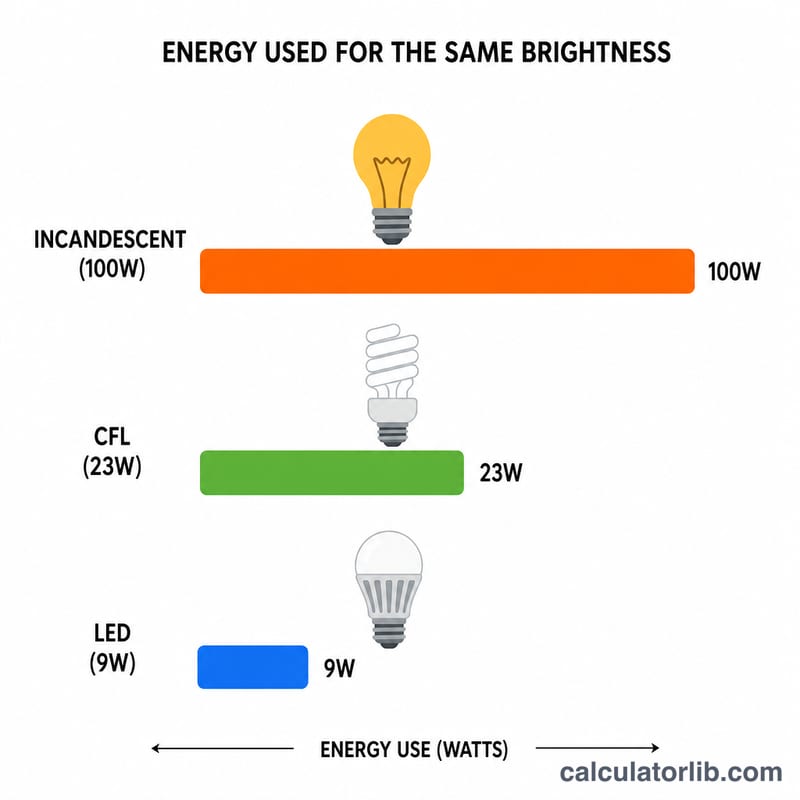
Enter the power of the bulb in watts and the luminous efficacy in lm/W. If you are not sure of the efficacy, pick one of the quick presets: roughly 15 lm/W for an old incandescent bulb, 60 lm/W for a CFL, and 100 lm/W for a typical LED (premium LEDs can exceed 150 lm/W). The calculator multiplies the two values to give the light output in lumens.
The formula explained
The relationship is simply $$\text{Lumens} = \text{Power (W)} \times \text{Efficacy (lm/W)}$$ Efficacy (\(\eta\)) is the ratio of visible light output to power input. A 10 W bulb at 100 lm/W produces 1,000 lumens, while the same 10 W at only 15 lm/W produces just 150 lumens — over six times dimmer for the same energy cost.
Worked example
Suppose you have a 9 W LED rated at 100 lm/W. Multiply: $$9 \times 100 = 900 \text{ lumens}$$ comparable to a traditional 60 W incandescent bulb. That illustrates why an LED can replace an incandescent at a fraction of the power.
FAQ
Why don't bulbs list lumens per watt? Many packages do under "luminous efficacy" or "efficiency"; otherwise divide the rated lumens by the rated watts.
Is efficacy constant? No — it depends on the technology, driver, temperature and color quality, so treat presets as approximations.
How do I convert lumens back to watts? Divide lumens by efficacy: \(\text{watts} = \text{lumens} \div \text{efficacy}\).