
What it does
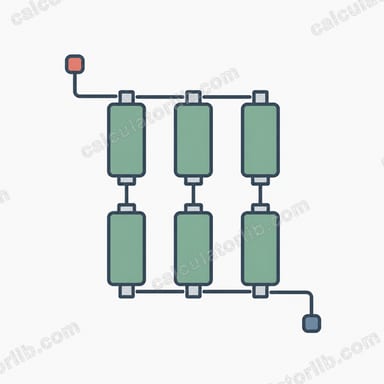
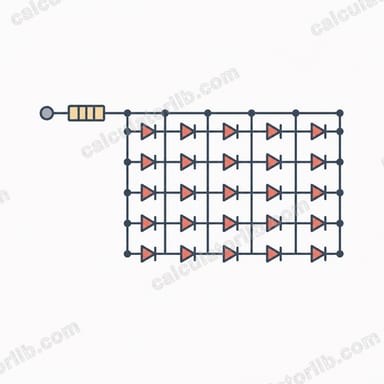
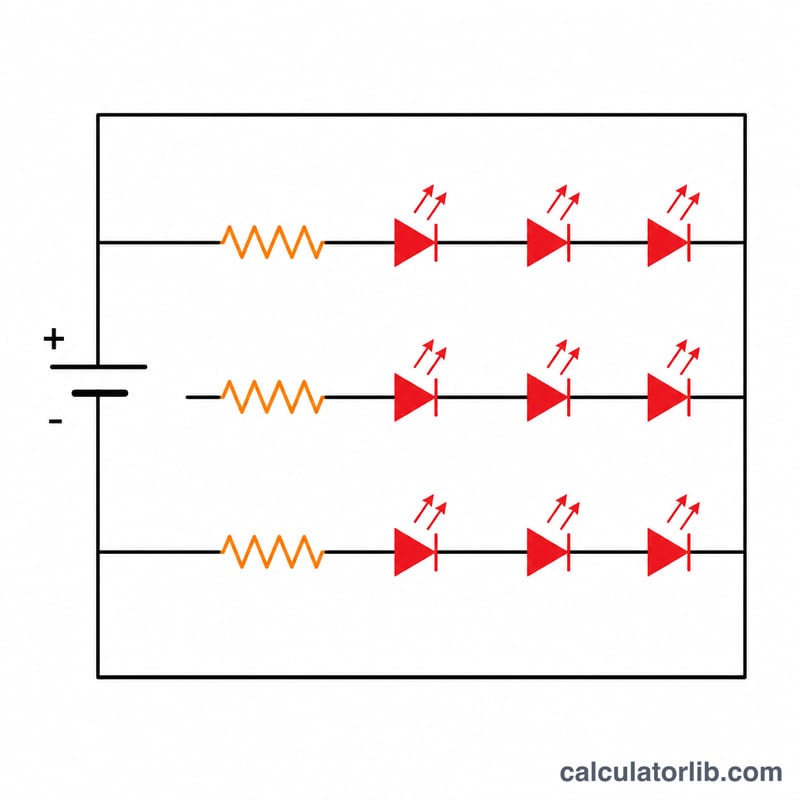
This calculator designs an LED array built from several identical series strings wired in parallel. Each string contains a number of LEDs in series plus one current-limiting resistor. It computes the resistor value, the voltage split between LEDs and resistor, the total current drawn by the whole array, and the power dissipated by each resistor and by the array.
How to use it
Enter the supply voltage, the forward voltage of one LED, the desired current per string in milliamps, how many LEDs are in each series string, and how many strings run in parallel. The tool returns the resistor each string needs and warns you if the supply is too low to drive the chosen number of LEDs.
The formula explained
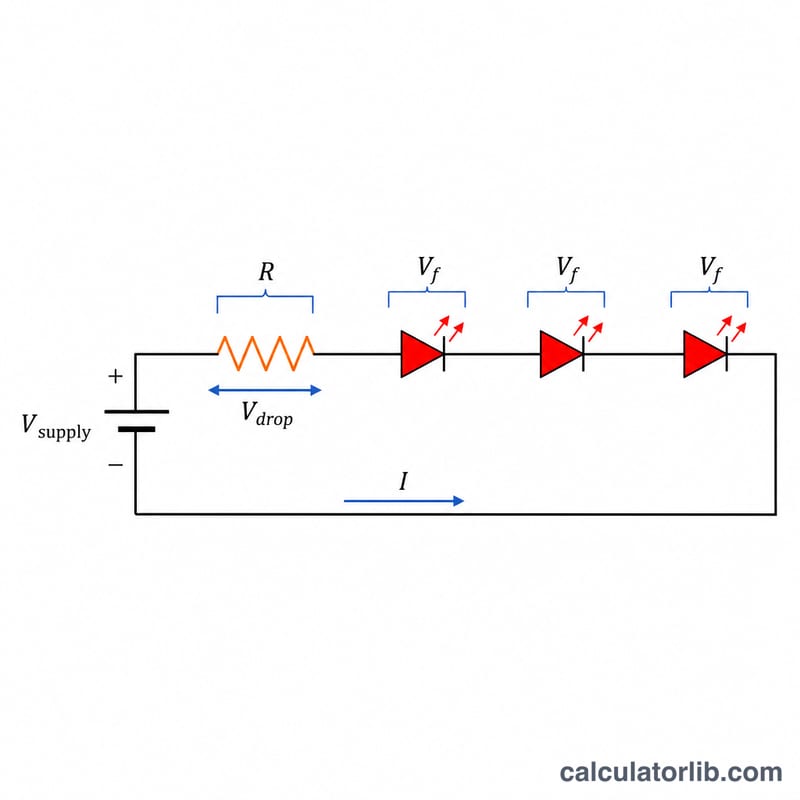
The LEDs in a string drop \(n \times V_f\) volts. The resistor must drop whatever is left over, \(V_{supply} - n\cdot V_f\), while carrying the string current \(I\). By Ohm's law $$R = \frac{V_{supply} - n\cdot V_f}{I}$$ Because every parallel string carries its own current, the total array current is simply \(\text{strings} \times I\), and total power is \(V_{supply} \times I_{total}\).
Worked example
Supply 12 V, 3 LEDs at 2 V each, 20 mA per string, 2 strings. LED drop = \(3 \times 2 = 6\) V. Resistor drop = \(12 - 6 = 6\) V. $$R = \frac{6}{0.02} = 300\ \Omega$$ Total current = \(20 \times 2 = 40\) mA. Power per resistor = \(6 \times 0.02 = 0.12\) W; total array power = \(12 \times 0.04 = 0.48\) W.
FAQ
Why one resistor per string? Giving each string its own resistor balances the current better than a single shared resistor, since LED forward voltages vary slightly.
What resistor wattage should I pick? Choose a resistor rated at least twice the calculated power per resistor for safe margin.
What if the resistor value is negative? The supply voltage is lower than the combined LED forward voltage — remove an LED or use a higher supply.