

What Is Cost Per View (CPV)?
Cost Per View (CPV) is a key video advertising metric that tells you how much you pay, on average, for each view of your ad. It is widely used on platforms like YouTube, TikTok, and other video ad networks where advertisers are billed when a viewer watches or engages with their video. A lower CPV generally means your campaign is reaching viewers more efficiently.
How to Use This Calculator
Enter your total ad spend (the full amount you paid for the campaign) and the total views your video received. The calculator divides spend by views to give your CPV, and also shows the equivalent Cost Per 1,000 Views (CPM) so you can benchmark against other campaigns.
The Formula Explained
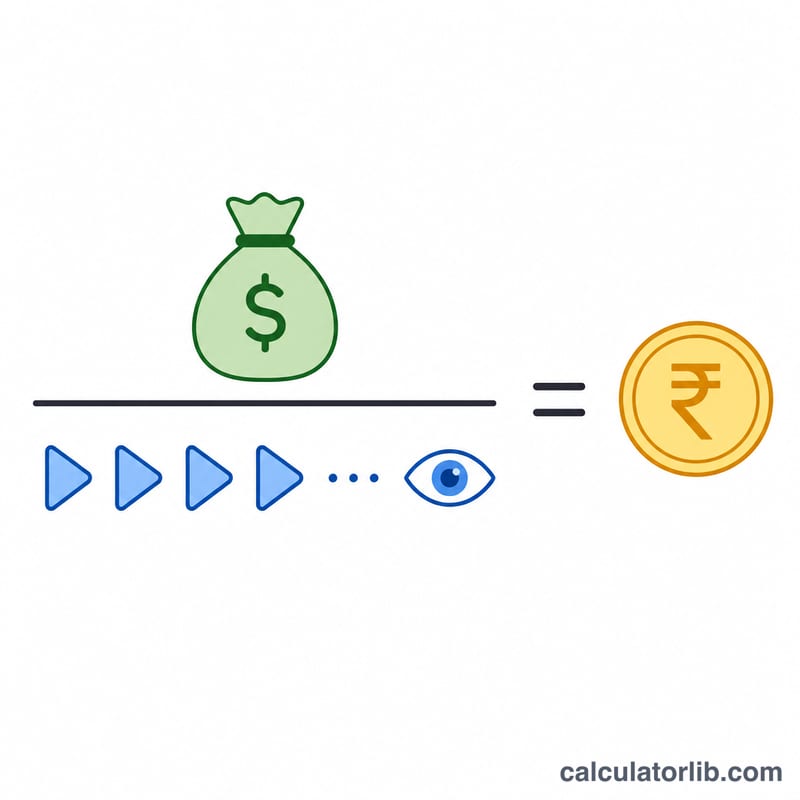
The formula is simple:
$$\text{CPV} = \frac{\text{Total Ad Spend (\$)}}{\text{Total Views}}$$For example, if you spent $500 and earned 20,000 views, your CPV is \($500 \div 20{,}000 = $0.025\) per view. Multiply by 1,000 to express it as a CPM of $25 per thousand views.
Worked Example
Suppose a campaign cost $1,200 and generated 48,000 views.
$$\text{CPV} = 1{,}200 \div 48{,}000 = \$0.025 \text{ per view}$$The CPM would be \($0.025 \times 1{,}000 = $25\). This means each view costs two and a half cents, and reaching a thousand viewers costs $25.
FAQ
What is a good CPV? It varies by platform and audience, but many YouTube campaigns see CPVs between $0.01 and $0.30. Lower is better for efficiency.
What counts as a "view"? Platforms define this differently — often a view is counted after a few seconds of watch time or a click. Use your platform's reported view count for accuracy.
How is CPV different from CPM? CPV is the cost of a single view; CPM is the cost per 1,000 views. CPM is handy for comparing reach-based campaigns.