
What is the SGPA to CGPA Calculator?
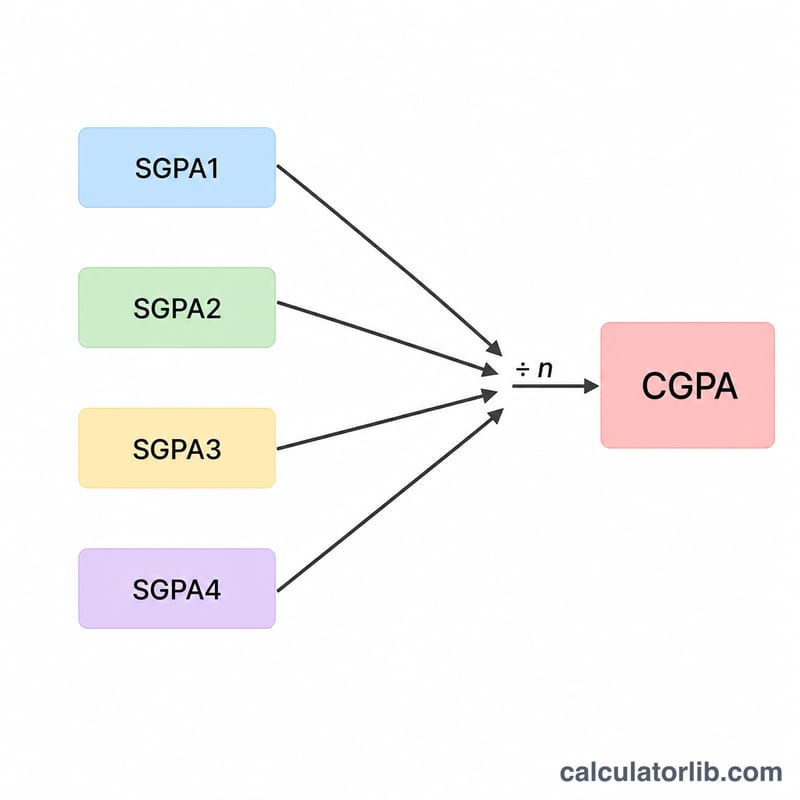
SGPA (Semester Grade Point Average) measures your performance in a single semester, while CGPA (Cumulative Grade Point Average) reflects your overall performance across all semesters. This calculator combines your individual semester SGPAs into one cumulative figure by taking their average. It assumes every semester carries equal credit weight, which is the standard assumption used by many universities for a quick CGPA estimate.
How to use it
Select how many semesters you have completed (2 to 10), then enter the SGPA you earned in each semester. Most institutions use a 10-point scale, so values typically range from 0 to 10. Click calculate to see your CGPA, the sum of your SGPAs, and an approximate percentage equivalent.
The formula explained
The core formula is simply: $$\text{CGPA} = \frac{\text{SGPA}_1 + \text{SGPA}_2 + \cdots + \text{SGPA}_n}{n}$$ where \(n\) is the number of semesters. Add up all your semester SGPAs and divide by the count of semesters. If your semesters have unequal credits, a credit-weighted average would be more accurate, but the equal-weight average is the most widely used quick method.
Worked example
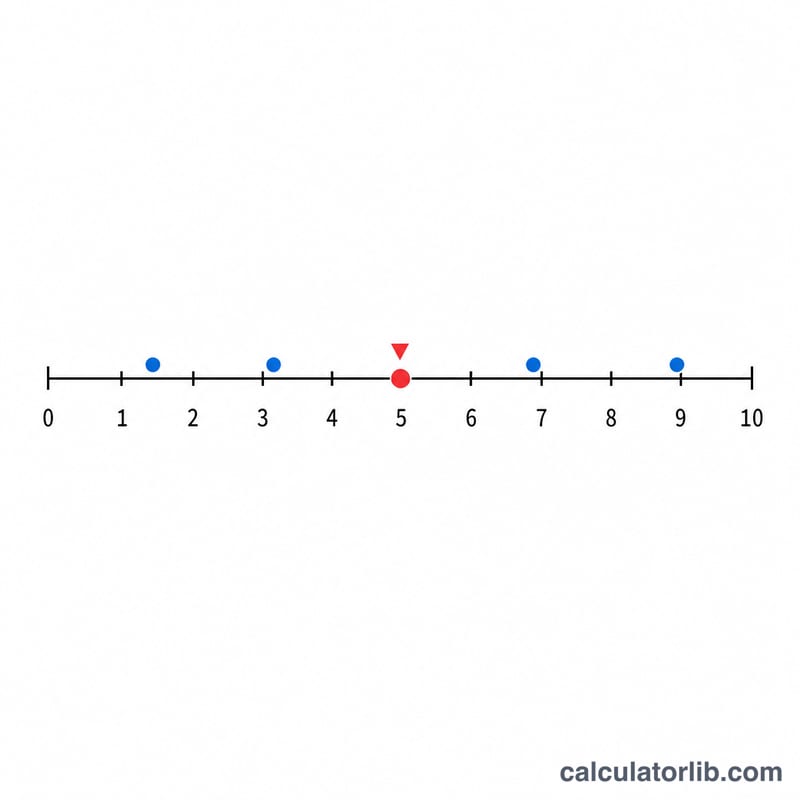
Suppose you finished 4 semesters with SGPAs of 8.0, 7.5, 9.0, and 8.5. Adding these gives 33.0. Dividing by 4 semesters yields a CGPA of 8.25. Multiplying by 9.5 gives an approximate percentage of 78.375%.
$$\text{CGPA} = \frac{8.0 + 7.5 + 9.0 + 8.5}{4} = \frac{33.0}{4} = 8.25$$
$$\text{Percentage} = 8.25 \times 9.5 = 78.375\%$$
FAQ
Does this account for different credits per semester? No — it assumes equal credits per semester. For credit-weighted accuracy, multiply each SGPA by its semester credits, sum them, and divide by total credits.
Is the percentage conversion exact? No. \(\text{CGPA} \times 9.5\) is a common approximation used by CBSE and several universities, but your institution may use a different formula.
What scale does this use? The inputs allow 0–10, matching the standard 10-point scale, but the average works for any scale.