
What is the Reading Level Score Calculator?
This calculator measures how easy a piece of text is to read using two classic readability metrics: the Flesch Reading Ease score and the Flesch-Kincaid Grade Level. Both are based on the same two inputs — the average sentence length (words per sentence) and the average word length (syllables per word). They are widely used in education, publishing, government writing standards, and content marketing to ensure text matches its audience.
How to use it
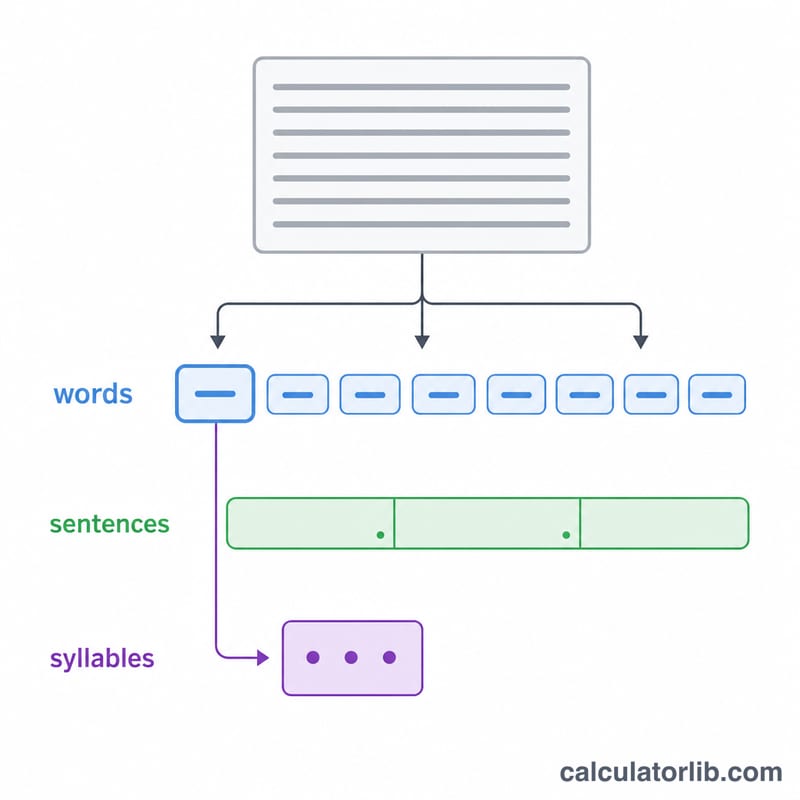
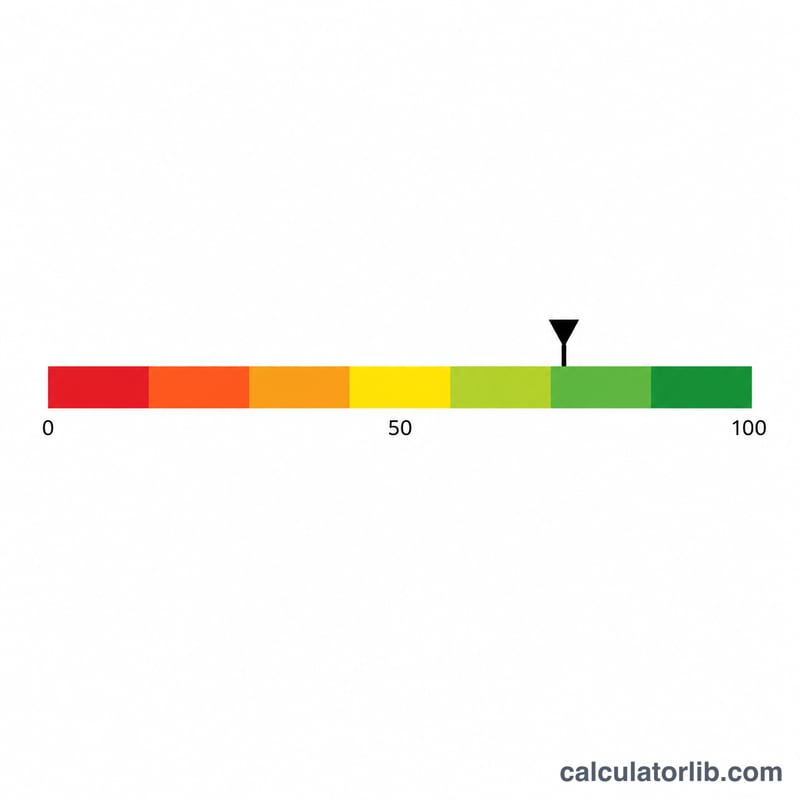
Count the total number of words, sentences, and syllables in your sample text and enter them. The calculator returns a Reading Ease score from 0 (very difficult) to 100 (very easy), and a U.S. grade level. A Reading Ease of 60–70 is plain English suitable for most adults; a grade level of 8 means roughly an eighth-grade reading ability is needed.
The formula explained
Flesch Reading Ease: $$\text{Ease} = 206.835 - 1.015 \cdot \frac{\text{Words}}{\text{Sentences}} - 84.6 \cdot \frac{\text{Syllables}}{\text{Words}}$$. Higher scores mean easier text. Flesch-Kincaid Grade Level: $$\text{Grade} = 0.39 \cdot \frac{\text{Words}}{\text{Sentences}} + 11.8 \cdot \frac{\text{Syllables}}{\text{Words}} - 15.59$$, giving the approximate U.S. school grade.
Worked example
For 100 words, 5 sentences, and 150 syllables: words/sentence = 20, syllables/word = 1.5. Reading Ease = $$206.835 - 1.015 \times 20 - 84.6 \times 1.5 = 206.835 - 20.3 - 126.9 = 59.635.$$ Grade = $$0.39 \times 20 + 11.8 \times 1.5 - 15.59 = 7.8 + 17.7 - 15.59 = 9.91.$$ This indicates fairly standard, late-middle-school-level text.
FAQ
What's a good Reading Ease score? 60–70 is plain English; below 30 is very difficult (academic/legal).
How do I count syllables? Count vowel sounds per word, or use an online syllable counter for accuracy.
Which score should I use? Use Reading Ease for a quick 0–100 gauge, and the grade level when you need to target a specific school grade or audience.