
What is the Fuel Tank Range Calculator?
This calculator estimates the maximum distance your vehicle can travel on a single full tank of fuel. By multiplying your tank's capacity by your vehicle's fuel economy, you get a quick range figure that helps with trip planning, deciding when to refuel, and comparing the efficiency of different vehicles.
How to use it
Choose your unit system. For miles, enter tank capacity in gallons and fuel economy in miles per gallon (MPG). For kilometers, enter capacity in liters and economy in kilometers per liter (km/L). Press calculate to see your estimated range.
The formula explained
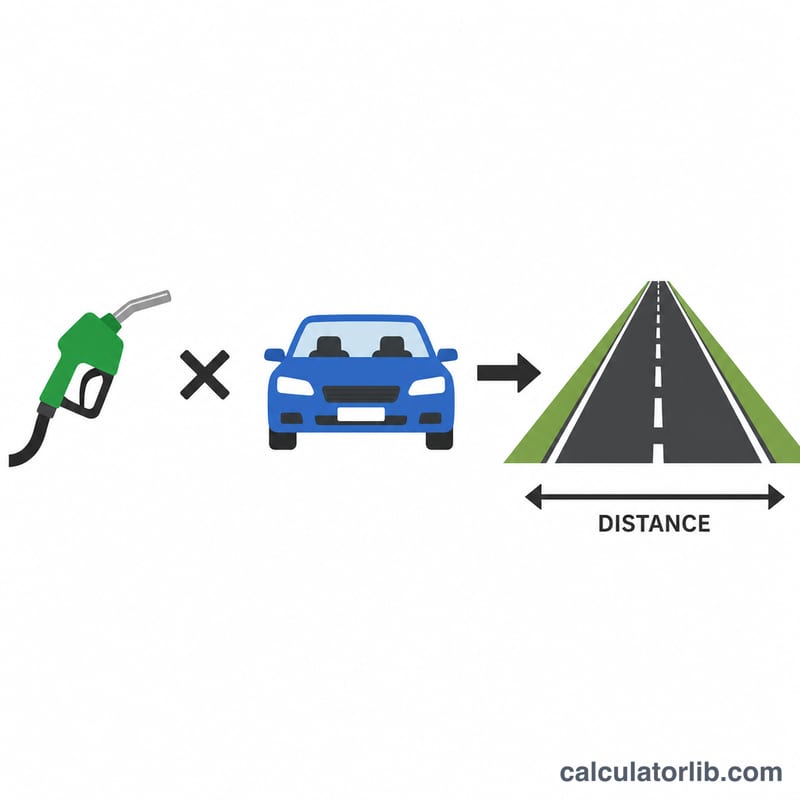
The calculation is straightforward: $$\text{Range} = \text{Tank Capacity} \times \text{Fuel Economy}$$. Fuel economy tells you how far one unit of fuel takes you (e.g. 30 miles per gallon), and capacity tells you how many of those units the tank holds. Multiplying them gives the total distance before the tank runs dry.
Worked example
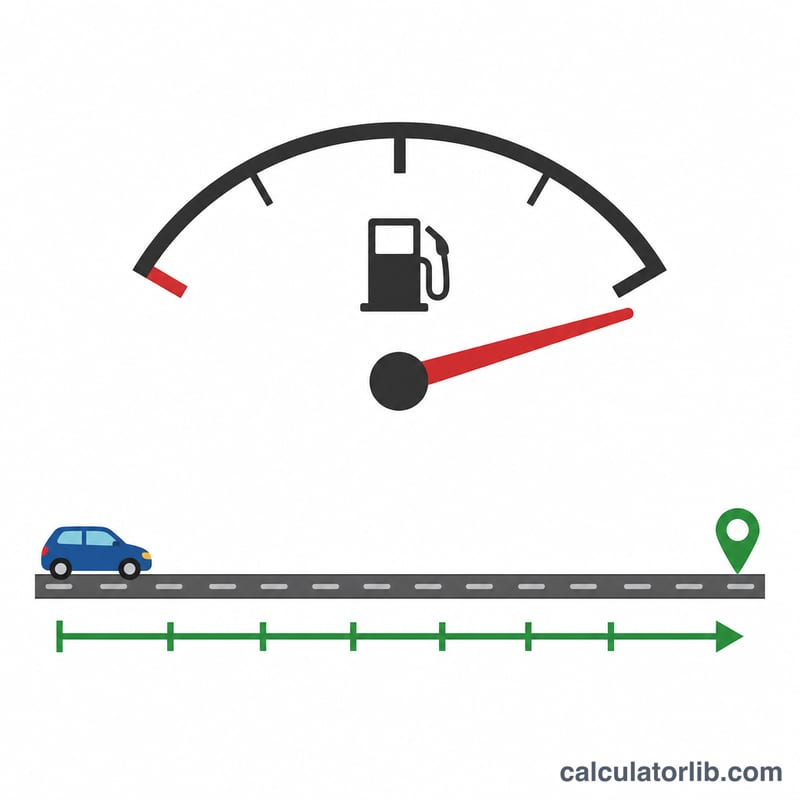
Suppose your car has a 15-gallon tank and averages 30 MPG. The range is $$15 \times 30 = \textbf{450 miles}.$$ If you switch to metric with a 50-liter tank and 12 km/L, the range is $$50 \times 12 = \textbf{600 km}.$$
FAQ
Is this exact? No — it's an estimate. Real-world range depends on driving style, speed, terrain, cargo, weather and traffic. Use it as a planning guide, not a guarantee.
Should I rely on this to run the tank empty? No. Most drivers refuel with a safety buffer of 10–15% remaining, since running completely dry can strain the fuel pump and leave you stranded.
What is km/L vs L/100km? This tool uses km/L (higher is better). If your figure is L/100km, convert it: \(\text{km/L} = 100 \div \text{L/100km}\). For example, \(8 \text{ L/100km} = 12.5 \text{ km/L}\).