
What is total stopping distance?
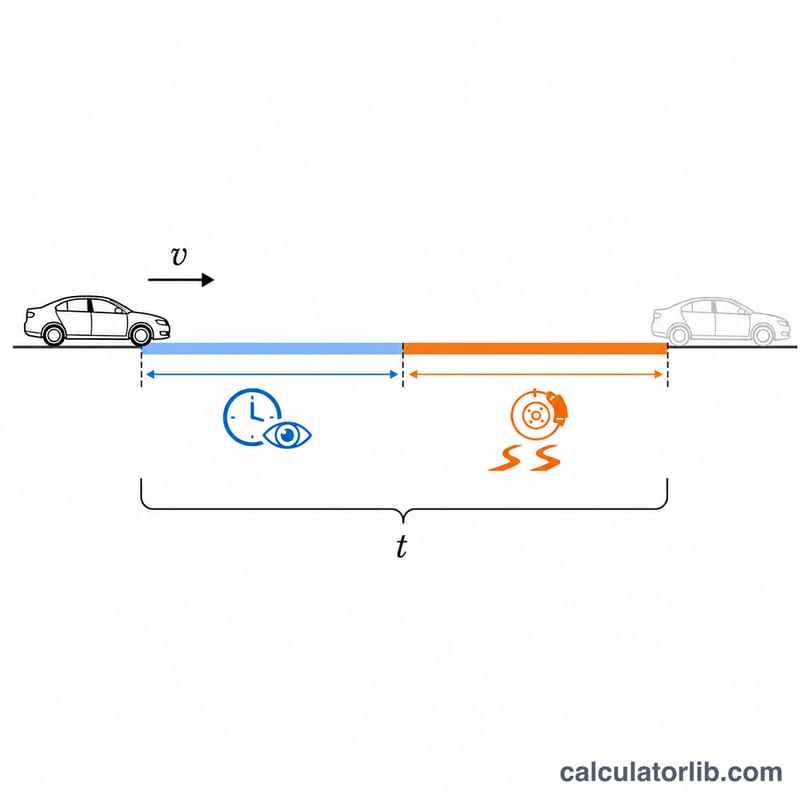
Total stopping distance is how far a vehicle travels from the moment a hazard appears to the moment it comes to a complete stop. It has two parts: the reaction distance (the ground covered while the driver perceives the hazard and moves to the brake) and the braking distance (the ground covered while the brakes decelerate the vehicle to rest). This calculator works in SI units and applies universally to any vehicle on any surface for which you know the friction coefficient.
How to use the calculator
Enter your travelling speed in km/h, the driver's reaction time in seconds (typical values are 1.0–1.5 s, longer if tired or distracted), and the tyre–road friction coefficient \(\mu\) (about 0.7 on dry asphalt, 0.4 on wet roads, and 0.1 on ice). The tool returns the total distance plus a breakdown of reaction and braking distances.
The formula explained
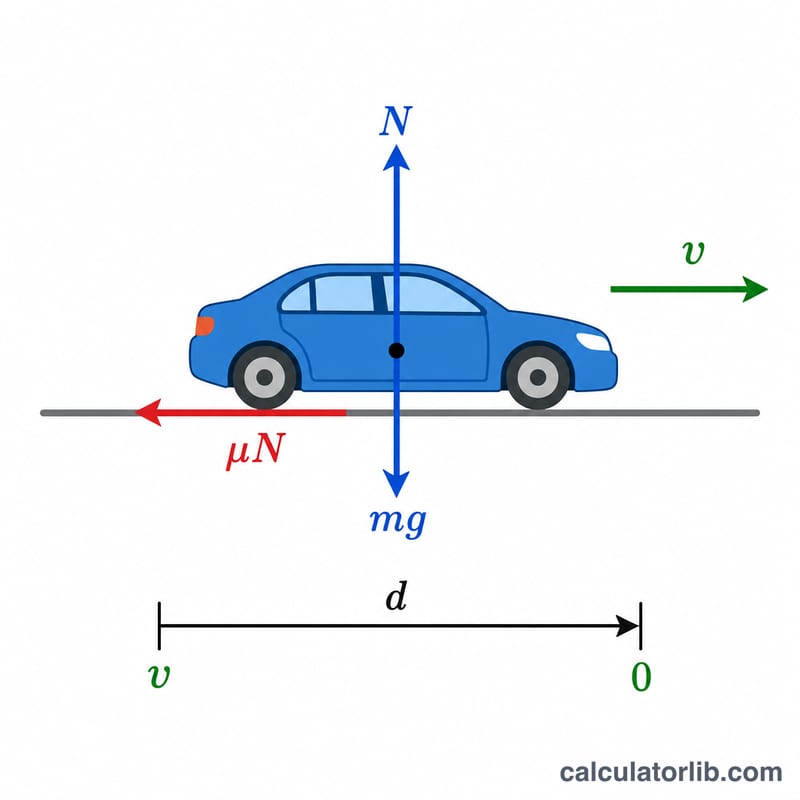
Speed is first converted to metres per second: \(v = v_{\text{km/h}} / 3.6\). Reaction distance is simply \(v \times t\). Braking distance comes from energy: the kinetic energy \(\tfrac{1}{2}mv^2\) is dissipated by the friction force \(\mu m g\) over the braking distance, giving \(d_{\text{brake}} = v^2 / (2\mu g)\). Adding them gives the total:
$$d = v\cdot t + \frac{v^{2}}{2\,\mu\,g}$$Note braking distance grows with the square of speed — doubling speed quadruples it.
Worked example
At 60 km/h (16.667 m/s), with a 1.5 s reaction time and \(\mu = 0.7\): reaction distance \(= 16.667 \times 1.5 = 25.0\ \text{m}\); braking distance:
$$d_{\text{brake}} = \frac{16.667^{2}}{2 \times 0.7 \times 9.81} = \frac{277.78}{13.734} = 20.23\ \text{m}$$Total stopping distance \(\approx 45.23\ \text{m}\).
FAQ
Does this account for ABS or downhill grade? No — it assumes flat ground and idealised constant-friction braking. Slopes, brake fade and load shift change real results.
What \(\mu\) should I use? Dry asphalt \(\approx 0.7\text{–}0.8\), wet \(\approx 0.4\text{–}0.5\), snow \(\approx 0.2\), ice \(\approx 0.1\).
What is a typical reaction time? Around 1.0–1.5 s for an alert driver; fatigue, alcohol or distraction can push it well above 2 s.