
What is the BASDAI Score?
The Bath Ankylosing Spondylitis Disease Activity Index (BASDAI) is a validated, patient-reported instrument used to measure disease activity in people with ankylosing spondylitis and other forms of axial spondyloarthritis. It is widely used in rheumatology clinics worldwide to track symptoms over time and to help decide whether treatment escalation (for example, biologic therapy) is warranted. This calculator is a general clinical tool and is not specific to any single country; interpret results with your clinician.
How to use this calculator
Answer all six questions using a 0–10 visual analogue scale, where 0 means "none" and 10 means "very severe." Questions 1–4 cover fatigue, spinal pain, peripheral joint pain/swelling, and tenderness. Questions 5 and 6 cover the severity and duration of morning stiffness — for Q6, 0 = no stiffness and 10 = 2 or more hours. Enter each value and the calculator returns your overall BASDAI score instantly.
The formula explained
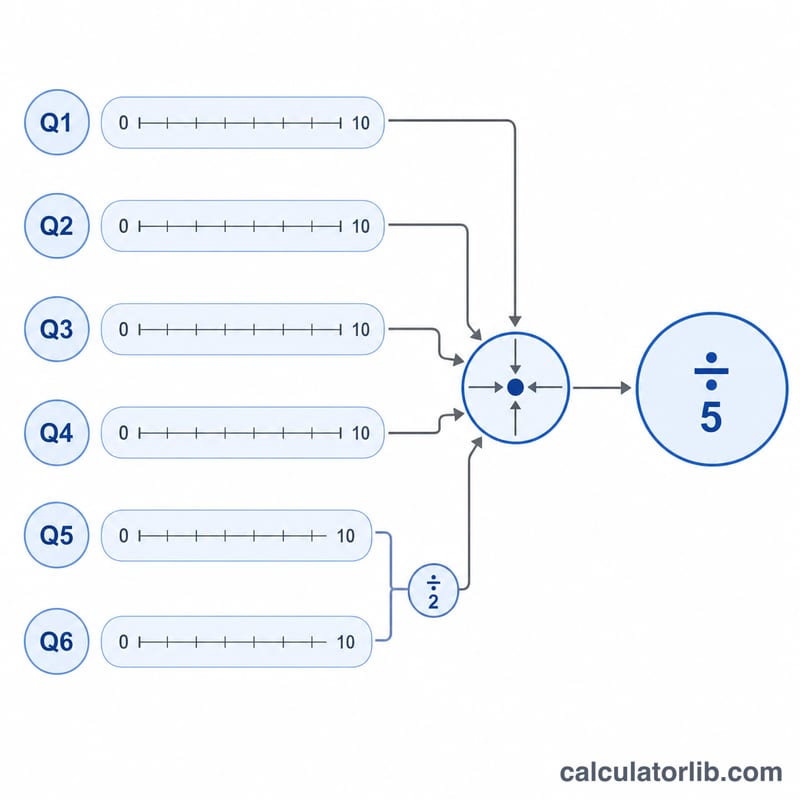
The two morning-stiffness questions (Q5 and Q6) are first averaged so that stiffness contributes the same weight as a single symptom. That average is added to the four other scores, and the total is divided by five:
$$\text{BASDAI} = \frac{\text{Q1} + \text{Q2} + \text{Q3} + \text{Q4} + \dfrac{\text{Q5} + \text{Q6}}{2}}{5}$$
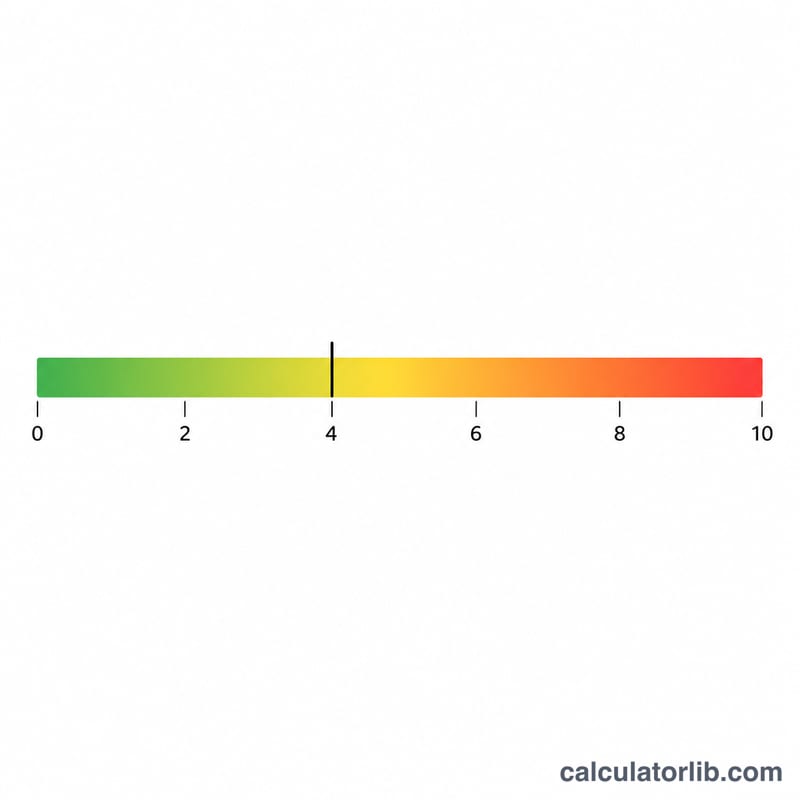
The result lies between 0 and 10. A score of 4 or higher is commonly used as the threshold suggesting active disease and possible inadequate symptom control.
Worked example
Suppose a patient scores Q1 = 6, Q2 = 5, Q3 = 4, Q4 = 3, Q5 = 7, Q6 = 5. The stiffness component is \((7 + 5)/2 = 6\). The total is \(6 + 5 + 4 + 3 + 6 = 24\), and \(24 \div 5 = 4.8\). A BASDAI of 4.8 indicates active disease.
Interpreting Your BASDAI Score
The Bath Ankylosing Spondylitis Disease Activity Index (BASDAI) produces a single score from 0 to 10, where higher values indicate greater patient-reported disease activity. The score is the average of six self-rated symptom questions, with the two morning-stiffness questions (Q5 and Q6) combined into a single averaged item before the overall mean is taken.
Score bands
| BASDAI score | Established interpretation |
|---|---|
| < 4 | Low / relatively inactive disease — symptoms are generally considered controlled. |
| ≥ 4 | Active disease — a widely used threshold suggesting inadequate control. In practice this is the level often used (alongside elevated CRP and clinician judgment) to consider escalation to or continuation of biologic therapy. |
A BASDAI of 4 or greater is the conventional cut-off for "active" ankylosing spondylitis, but it is not an automatic instruction to change treatment. Treatment decisions usually combine the BASDAI with objective markers such as C-reactive protein (CRP), spinal mobility measures (e.g. BASMI), and the treating clinician's assessment.
Importantly, the BASDAI captures only how the patient feels — fatigue, pain, stiffness and tenderness — over the past week. It does not measure structural or radiographic damage, joint erosion, or fusion of the spine. Two people with very different X-ray findings can report the same BASDAI. For that reason it should always be read alongside clinical examination, imaging where appropriate, and inflammatory markers.
This is general educational information about how the BASDAI is scored and interpreted, not personal medical advice. Discuss your own results and any treatment decisions with a qualified rheumatologist or physician.
Key Terms Explained
- Ankylosing spondylitis (AS)
- A chronic inflammatory form of arthritis that mainly affects the spine and sacroiliac joints, causing back pain and stiffness that can, over years, lead to fusion of vertebrae. It is the prototypical form of axial spondyloarthritis with visible damage on X-ray.
- Axial spondyloarthritis (axSpA)
- An umbrella term for inflammatory disease of the axial skeleton (spine and sacroiliac joints). It includes radiographic axSpA (ankylosing spondylitis) and non-radiographic axSpA, where inflammation is present without definite X-ray changes.
- BASDAI
- Bath Ankylosing Spondylitis Disease Activity Index — a validated questionnaire of six 0–10 questions covering fatigue, spinal pain, peripheral joint pain/swelling, areas of tenderness, and morning stiffness (severity and duration), averaged into a single 0–10 disease-activity score.
- Visual Analogue Scale (VAS)
- A rating method where the patient marks symptom intensity along a continuous line, typically scored 0 (none) to 10 (most severe). Each BASDAI question is answered on such a 0–10 scale.
- Morning stiffness
- Stiffness of the spine or joints on waking, common in inflammatory arthritis. BASDAI assesses both its severity (Q5) and how long it lasts (Q6), and prolonged morning stiffness is a hallmark of active inflammatory back pain.
- Peripheral joints
- Joints outside the spine — such as the hips, knees, shoulders, hands and feet. BASDAI Q3 asks about pain or swelling in these joints.
- Enthesitis
- Inflammation at the sites where tendons or ligaments attach to bone (entheses), a characteristic feature of spondyloarthritis. BASDAI Q4 captures discomfort at tender areas including these sites.
- Disease activity
- The current level of active inflammation and symptoms, as opposed to accumulated structural damage. The BASDAI is a measure of disease activity, which can fluctuate and respond to treatment.
- Biologic therapy
- Targeted medications (such as TNF inhibitors or IL-17 inhibitors) used when disease activity remains high despite NSAIDs. A persistently elevated BASDAI is one of the criteria often used to consider starting or continuing such therapy.
Example Scores Across Different Patients
Each row applies the documented formula \(\text{BASDAI} = \dfrac{Q1 + Q2 + Q3 + Q4 + \frac{Q5 + Q6}{2}}{5}\). The "stiffness average" column is \(\frac{Q5+Q6}{2}\); the "sum" column is the four single items plus that average; the BASDAI is that sum divided by 5.
| Patient | Q1 | Q2 | Q3 | Q4 | Q5 | Q6 | Stiffness avg (Q5,Q6)/2 | Sum | BASDAI | Band |
|---|---|---|---|---|---|---|---|---|---|---|
| A — well controlled | 2 | 1 | 1 | 2 | 2 | 2 | 2.0 | 8.0 | 1.6 | Low / inactive (< 4) |
| B — borderline near threshold | 4 | 4 | 3 | 4 | 5 | 5 | 5.0 | 20.0 | 4.0 | Active — at threshold (≥ 4) |
| C — clearly active | 7 | 8 | 6 | 7 | 8 | 8 | 8.0 | 36.0 | 7.2 | Active / high (≥ 4) |
| D — high fatigue, modest spine pain | 9 | 3 | 2 | 4 | 6 | 4 | 5.0 | 23.0 | 4.6 | Active (≥ 4) |
Worked detail for Patient C: stiffness average \(= \frac{8 + 8}{2} = 8.0\); sum \(= 7 + 8 + 6 + 7 + 8.0 = 36.0\); BASDAI \(= \frac{36.0}{5} = 7.2\). Patient B sits exactly on the conventional \(\ge 4\) "active disease" line, illustrating why borderline scores are interpreted together with CRP and clinical judgment rather than in isolation.
FAQ
What is a good BASDAI score? Lower is better. Scores below 4 generally indicate low disease activity, while 4 or above suggests active disease.
How often should it be measured? It is often repeated at each clinic visit or before and after a change in therapy to monitor response.
Is BASDAI a diagnosis? No. It measures symptom activity, not diagnosis, and should be interpreted alongside clinical assessment.