通过MCP连接 →

输入计算

数学公式

Show calculation steps (3)
  1. Resistor Power Dissipation

    Resistor Power Dissipation: LED 串并联阵列计算器

    P = voltage across resistor x string current; resistor voltage = Vsupply - LEDs per string x Vf

  2. Total Array Current

    Total Array Current: LED 串并联阵列计算器

    Total current = current per string x number of parallel strings

  3. Total Power

    Total Power: LED 串并联阵列计算器

    Total power = supply voltage x total array current (in amps)

广告

结果

限流电阻(每路灯串)
300
欧姆(Ω)
LED 两端电压(每路灯串) 6 V
电阻两端电压 6 V
阵列总电流 40 mA
每个电阻功耗 0.12 W
阵列总功耗 0.48 W

功能说明

这个计算器用于设计由多路相同灯串并联组成的 LED 阵列。每一路灯串由若干个串联的 LED 加上一个限流电阻构成。它能算出限流电阻的阻值、LED 与电阻之间的电压分配、整个阵列消耗的总电流,以及每个电阻和整个阵列所产生的功耗。
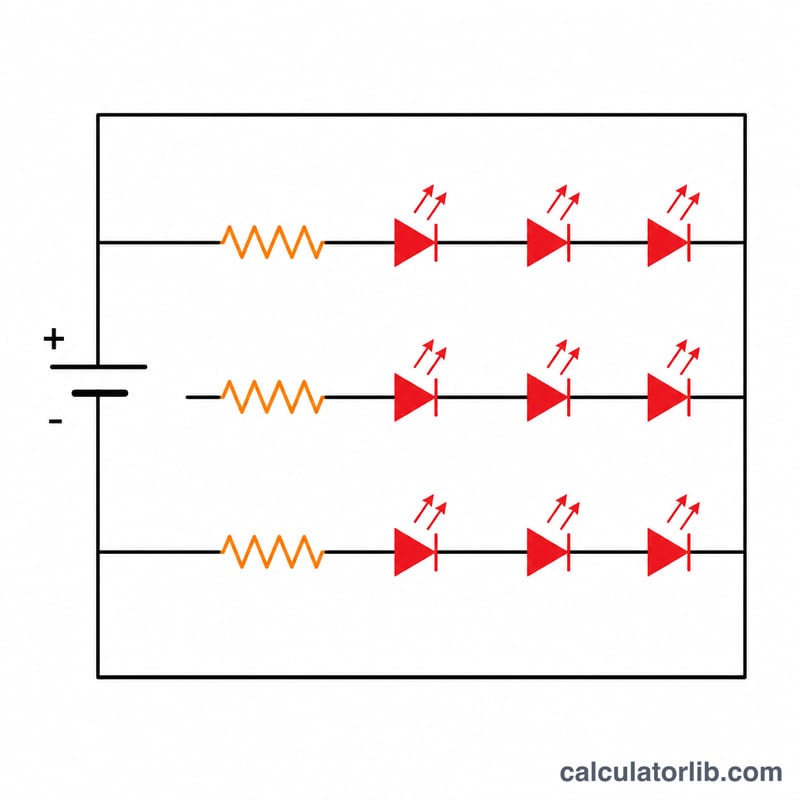
Diagram of an LED array with multiple parallel strings, each string having LEDs in series and a series resistor connected to a power supply
An LED array: several parallel strings, each with LEDs in series plus a current-limiting resistor.

使用方法

依次填入电源电压、单个 LED 的正向电压、每路灯串的目标电流(单位为毫安)、每路灯串中串联的 LED 数量,以及并联灯串的总路数。计算器会返回每路灯串所需的限流电阻;如果电源电压过低、无法点亮所选数量的 LED,它还会给出提示。

公式解析

一路灯串中的所有 LED 共消耗 \(n \times V_f\) 伏电压。限流电阻则需要承担剩余的电压,即 \(V_{supply} - n\cdot V_f\),同时流过灯串电流 \(I\)。根据欧姆定律,

$$R = \dfrac{V_{supply} - n_{led}\cdot V_f}{I}$$

由于每一路并联灯串各自流过自己的电流,因此阵列总电流就是 灯串数 \(\times I\),总功率为 \(V_{supply} \times I_{total}\)。
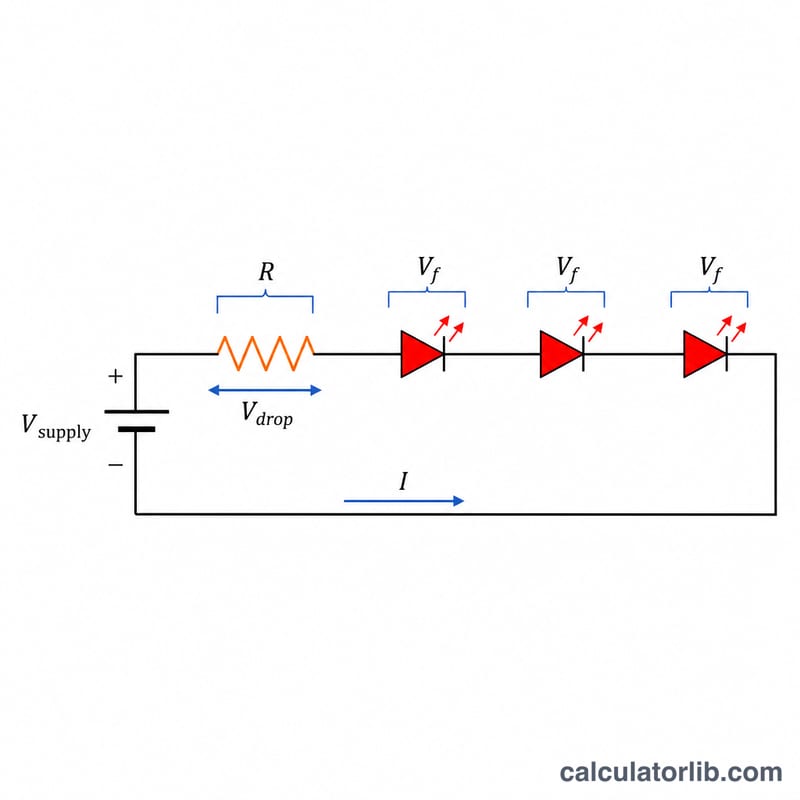
Annotated single LED string showing supply voltage, forward voltage drops across each LED, and the resistor voltage drop
Voltage budget along one string: supply minus the LED forward drops leaves the voltage across the resistor.

计算示例

电源 12 V,每路 3 个 LED、每个 2 V,每路电流 20 mA,共 2 路灯串。LED 压降 = \(3 \times 2 = 6\) V。电阻压降 = \(12 - 6 = 6\) V。

$$R = \frac{6}{0.02} = 300\ \Omega$$

总电流 = \(20 \times 2 = 40\) mA。每个电阻功耗 = \(6 \times 0.02 = 0.12\) W;阵列总功耗 = \(12 \times 0.04 = 0.48\) W。

常见问题

为什么每路灯串都要单独配一个电阻?由于不同 LED 的正向电压会有细微差异,给每一路灯串单独配一个电阻,比所有灯串共用一个电阻能更好地均衡各路电流。

电阻应该选多大功率?建议选用额定功率至少为计算所得单个电阻功耗两倍的电阻,以留出足够的安全余量。

如果算出来的电阻值是负数怎么办?说明电源电压低于所有 LED 正向电压之和——请减少每路灯串的 LED 数量,或改用更高的电源电压。
最后更新: