
What This Calculator Does
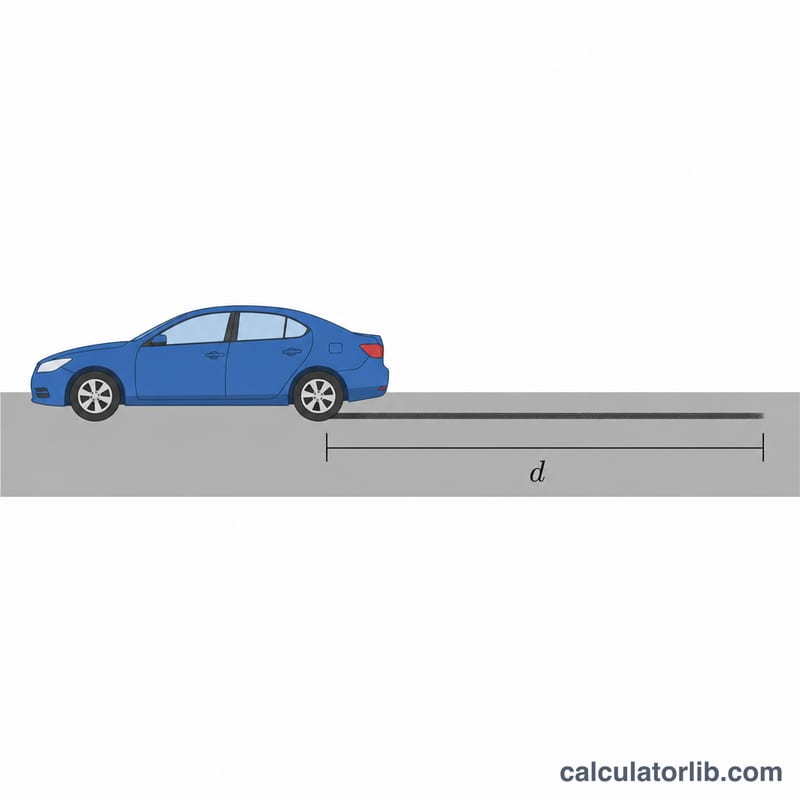
The Speed from Skid Mark Calculator estimates the minimum speed a vehicle was traveling at the moment it began to skid. It is a classic tool in accident reconstruction and forensic crash analysis. By measuring the length of the tire skid marks left on the road and knowing the road surface's drag factor (coefficient of friction) plus the vehicle's braking efficiency, you can recover an approximate pre-skid speed.
How to Use It
Enter the skid mark length in feet, the drag factor for the road surface (dry asphalt is roughly 0.7, wet asphalt 0.4–0.6, gravel 0.5–0.7, ice 0.1–0.2), and the braking efficiency as a percentage (100% if all wheels locked and braked equally). The calculator returns the estimated speed in miles per hour, kilometers per hour, feet per second, and meters per second.
The Formula Explained
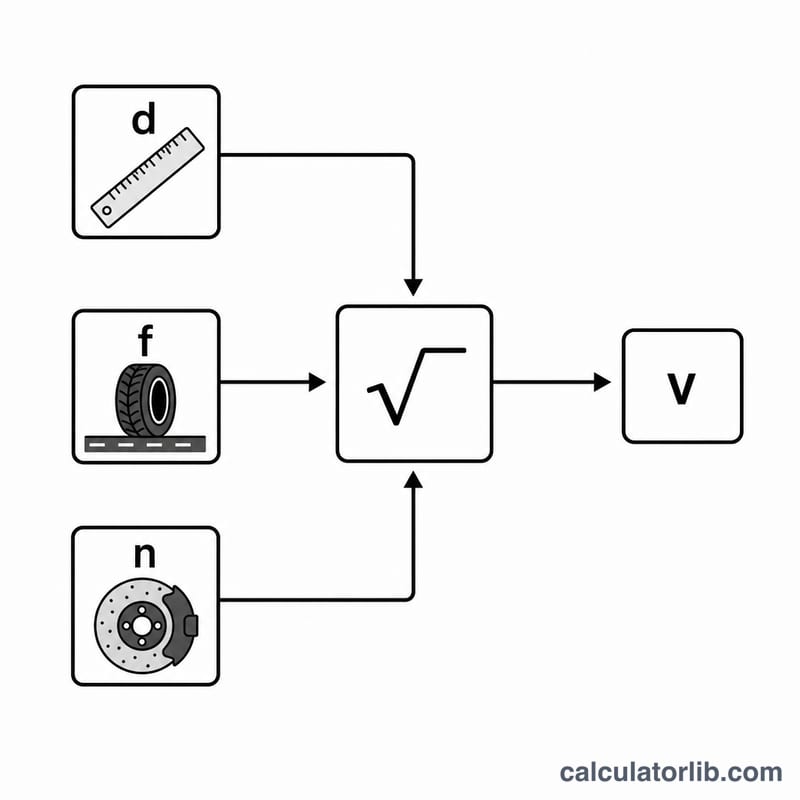
The widely used field formula is $$v = \sqrt{30 \cdot d \cdot f} \times n$$ where d is the skid distance in feet, f is the drag factor, and n is the braking efficiency expressed as a fraction. The constant 30 bundles together gravity and the unit conversions that produce speed directly in mph. The underlying physics is energy conservation: kinetic energy \(\tfrac{1}{2}mv^2\) is dissipated by friction work \(\mu m g d\), which rearranges to \(v = \sqrt{2\mu g d}\). Because real braking is rarely perfect, the efficiency factor n scales the result down.
Worked Example
Suppose a car leaves a 60 ft skid on a surface with a drag factor of 0.5 and the brakes operated at 80% efficiency. First compute the base term: $$\sqrt{30 \times 60 \times 0.5} = \sqrt{900} = 30 \text{ mph}$$ Apply braking efficiency: $$30 \times 0.80 = 24 \text{ mph}$$ which is about 10.73 m/s. This is the minimum speed — the actual speed was likely higher because energy lost before the skid began is not captured.
FAQ
Is this the exact crash speed? No. It is a minimum estimate. Pre-braking distance, energy absorbed by impact, and road grade can all raise the true speed.
What drag factor should I use? Use values from a friction test or published tables for the surface and tire condition; dry asphalt is commonly 0.65–0.75.
Why include braking efficiency? If not all wheels lock or brakes are uneven, less than full friction is applied, so efficiency scales the estimated speed.