What this calculator does
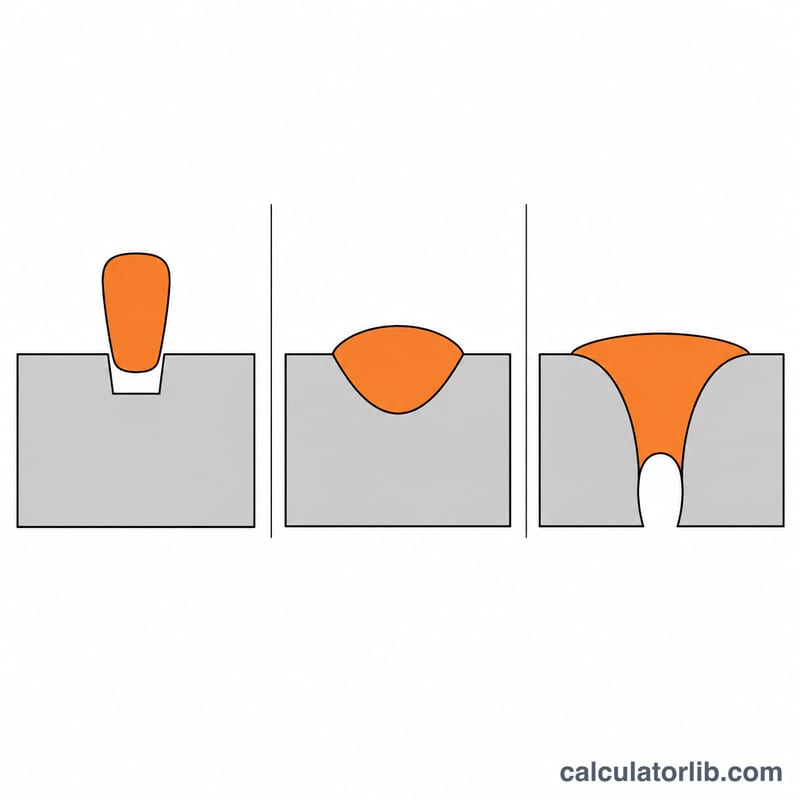
The Welding Current Calculator recommends the amperage to set on your welding machine based on the electrode diameter you are using and the thickness of the material you are joining. Setting the right current is the single biggest factor in producing a clean, strong stick (SMAW) weld: too little current causes poor fusion and sticking electrodes, while too much burns through thin metal and creates spatter and undercut.
The formula
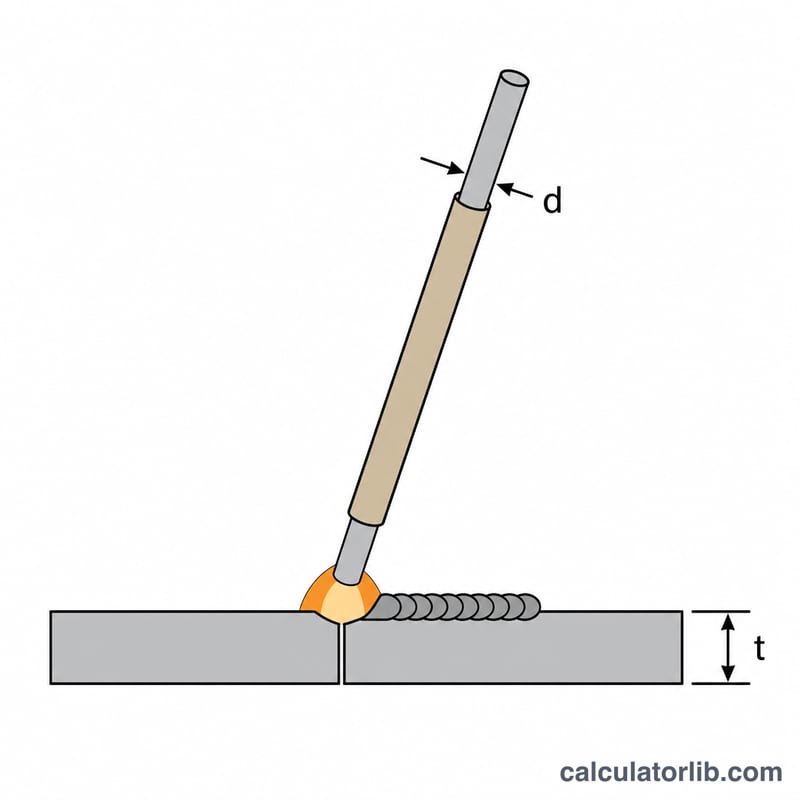
For common mild-steel electrodes, the recommended current scales roughly linearly with electrode diameter. A widely used shop rule of thumb is about 40 amps per millimetre of electrode diameter:
$$I = 40 \times d$$
where \(I\) = welding current in amperes and \(d\) = electrode diameter in millimetres. Because real settings depend on joint type, position and polarity, the calculator also reports a practical working window:
$$I_{min} = 35\,d \qquad I_{max} = 45\,d$$
The material thickness \(t\) guides electrode selection: the electrode diameter should generally not exceed the plate thickness, and thin sheet is welded near the lower end of the range.
How to use it
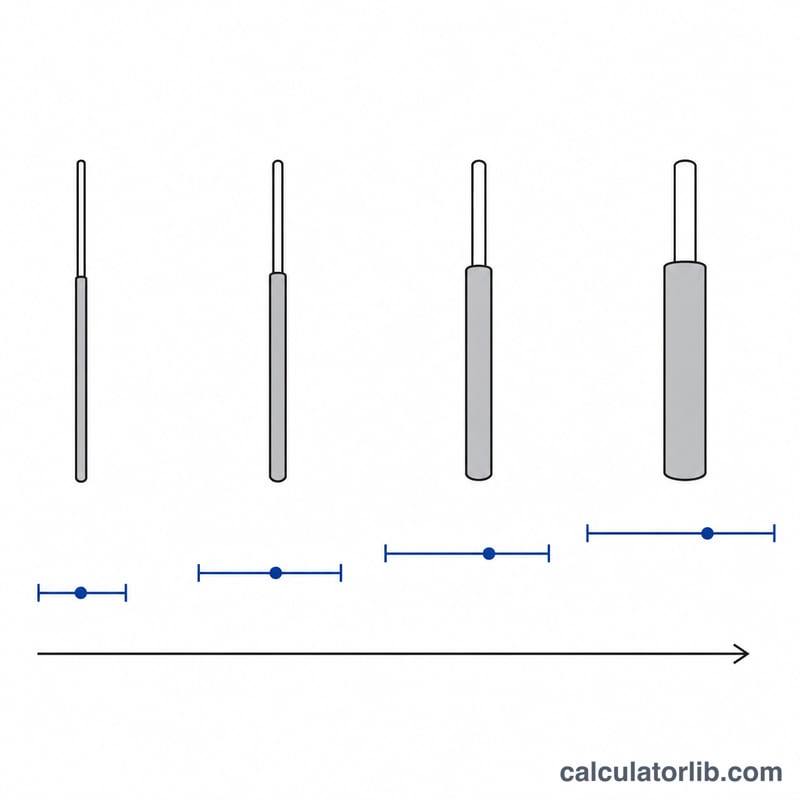
Enter the material thickness in millimetres and the diameter of the electrode you plan to use. The calculator returns the recommended amperage plus a minimum and maximum. Start near the middle value, then fine-tune by watching the arc, the bead profile and penetration on a scrap piece before welding the actual joint.
Worked example
Suppose you are welding \(6\,\text{mm}\) plate with a \(3.2\,\text{mm}\) electrode. The recommended current is:
$$I = 40 \times 3.2 = 128\,\text{A}$$
with a practical range of:
$$I_{min} = 35 \times 3.2 = 112\,\text{A}, \quad I_{max} = 45 \times 3.2 = 144\,\text{A}$$
So you would dial in about \(128\,\text{A}\) and adjust within roughly \(112\)–\(144\,\text{A}\).
FAQ
Is this valid for all welding processes? The rule of thumb targets mild-steel stick (SMAW) electrodes. MIG and TIG use different settings, and specialty electrodes have their own charts.
What if the electrode is larger than the plate? Choose a smaller electrode. As a guideline the electrode diameter should not exceed the material thickness, and thin material should be welded near the minimum current.
Should I always use the exact recommended amperage? No. Use it as a starting point, then adjust based on arc stability, bead appearance and penetration on a test coupon.