What this calculator does
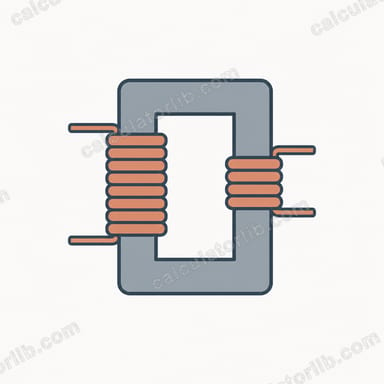
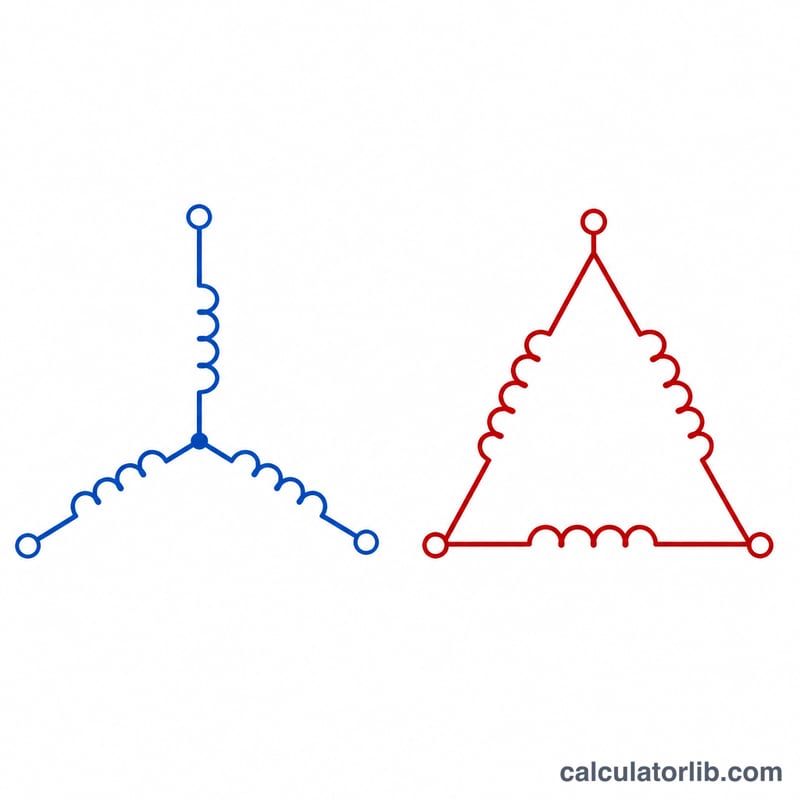
The Three-Phase Transformer Turns Ratio Calculator finds the per-phase turns ratio of a three-phase transformer and predicts the secondary line voltage and line current from the primary side. It accounts for how the primary and secondary windings are connected, because Wye (star) and Delta connections change the relationship between line and phase quantities.
The formula explained
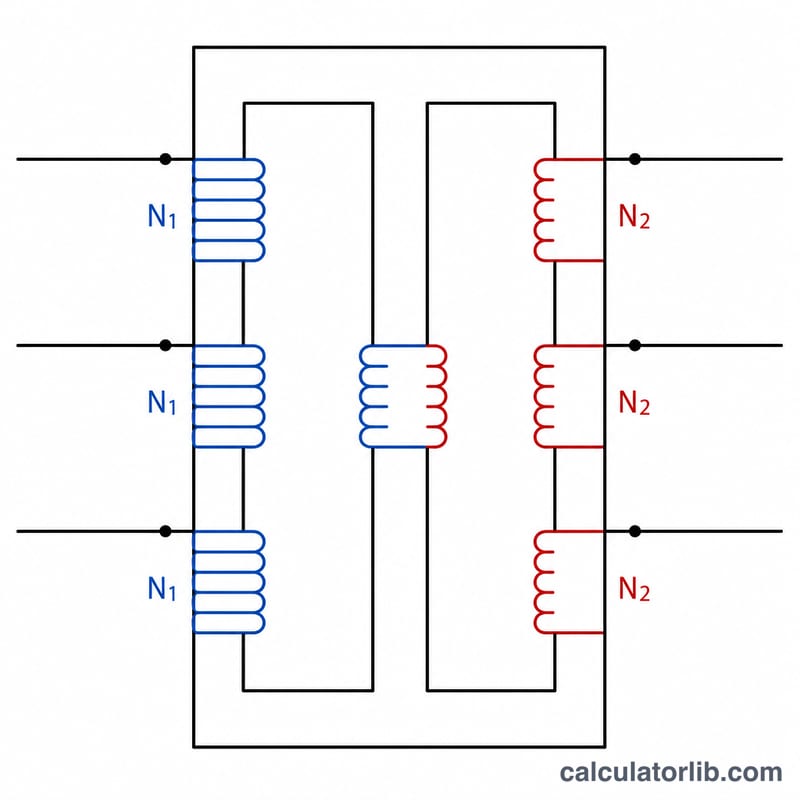
The turns ratio compares primary to secondary turns per phase, and it equals the per-phase voltage ratio:
$$a = \frac{N_1}{N_2} = \frac{V_{1,ph}}{V_{2,ph}}$$Here \(N_1\) and \(N_2\) are turns per phase and \(V_{1,ph}\), \(V_{2,ph}\) are the per-phase voltages. Line and phase voltages are linked by the connection: \(V_{ph} = V_L/\sqrt{3}\) for Wye and \(V_{ph} = V_L\) for Delta. Ampere-turn balance gives the current relation \(I_{2,ph} = a\,I_{1,ph}\).
How to use it
Enter the primary and secondary turns per phase, the primary line voltage and line current, and choose each winding connection. The calculator converts line values to phase values, applies the ratio, and converts back to secondary line values.
Worked example
Take a Delta-Wye transformer with \(N_1 = 100\), \(N_2 = 50\), \(V_{1L} = 11000\,\text{V}\).
$$a = \frac{N_1}{N_2} = \frac{100}{50} = 2$$The primary is Delta, so \(V_{1,ph} = V_{1L} = 11000\,\text{V}\) and
$$V_{2,ph} = \frac{V_{1,ph}}{a} = \frac{11000}{2} = 5500\,\text{V}.$$The secondary is Wye, so the secondary line voltage is
$$V_{2L} = \sqrt{3}\,V_{2,ph} = 1.732 \times 5500 \approx 9526\,\text{V}.$$FAQ
Is the turns ratio the same as the line voltage ratio? Not always. The turns ratio is a per-phase quantity; the line voltage ratio also depends on whether each side is Wye or Delta.
Why does the secondary current rise when voltage drops? Ampere-turns must balance, so a step-down in voltage (ratio greater than 1) produces a proportional step-up in current per phase.
Does this include losses? No. It assumes an ideal transformer with no leakage, copper or core losses.