
What is the Three-Phase Power Calculator?
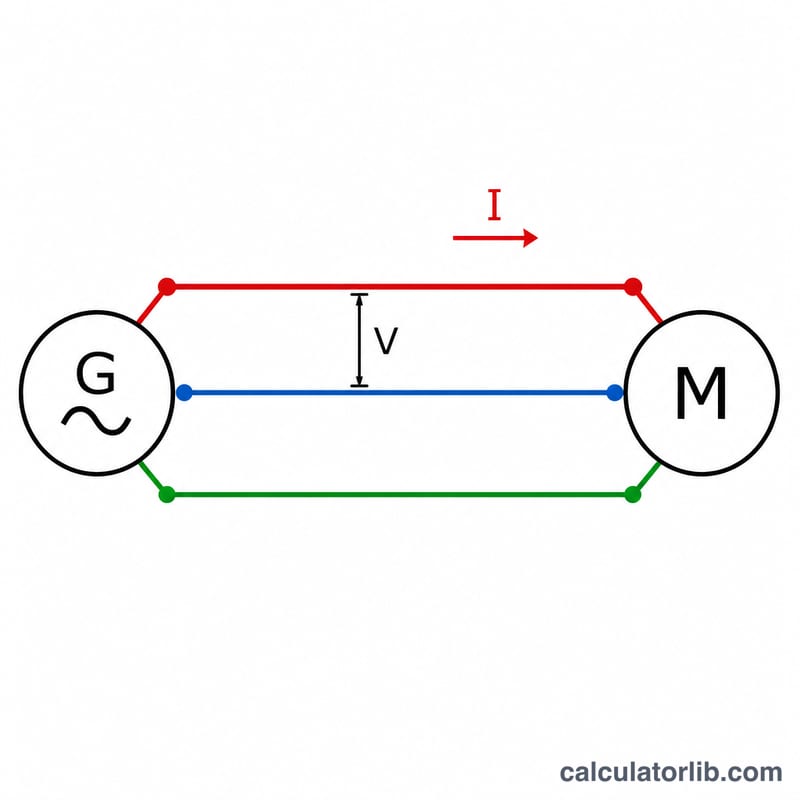
This tool computes the power in a balanced three-phase AC electrical system. Three-phase power is the standard for industrial machinery, motors, and commercial distribution because it delivers power more efficiently and smoothly than single-phase. From the line-to-line voltage, line current, and the power factor, the calculator returns the active (real) power in watts, the apparent power in volt-amperes, and the reactive power in volt-amperes reactive.
How to use it
Enter the line-to-line voltage (e.g. 400 V or 415 V), the line current measured in amperes, and the power factor (cos φ) — a value between 0 and 1 where 1 means a purely resistive load. Click calculate to see the three power figures. Note that the line voltage here is the phase-to-phase (line) voltage, not the phase-to-neutral voltage.
The formula explained
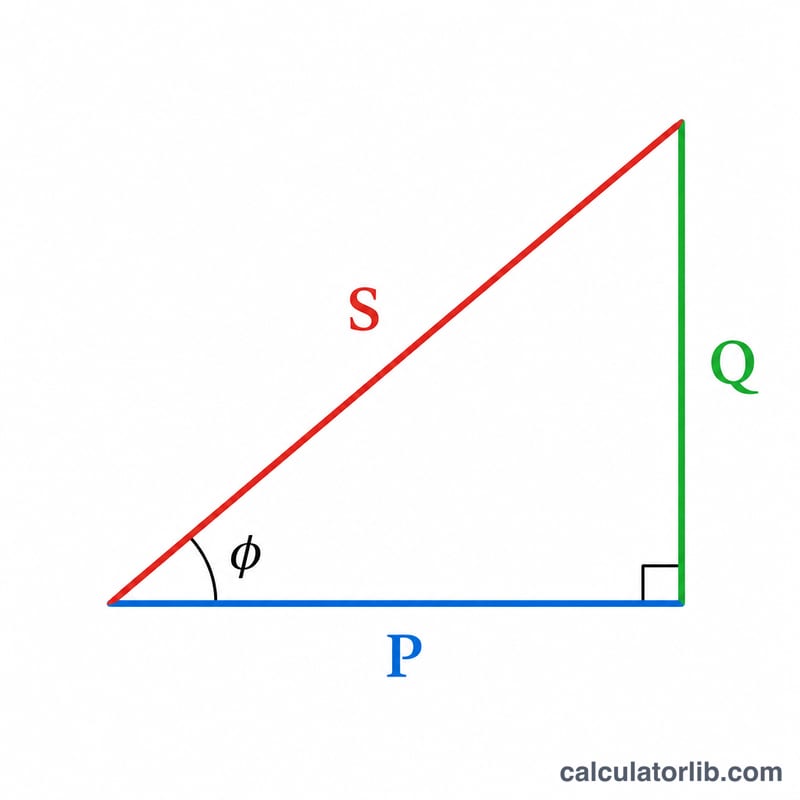
Active power is given by $$P = \sqrt{3} \cdot \text{V}_L \cdot \text{I}_L \cdot \cos\varphi$$ The \(\sqrt{3}\) factor (\(\approx 1.732\)) appears because, in a balanced three-phase system, the line voltage is \(\sqrt{3}\) times the phase voltage. Apparent power is $$S = \sqrt{3} \cdot \text{V}_L \cdot \text{I}_L$$ and reactive power is $$Q = \sqrt{3} \cdot \text{V}_L \cdot \text{I}_L \cdot \sin\varphi$$ where \(\sin\varphi = \sqrt{1 - \cos^2\varphi}\).
Worked example
For \(\text{V}_L = 400\ \text{V}\), \(\text{I}_L = 10\ \text{A}\), and power factor \(0.8\): $$P = 1.732 \times 400 \times 10 \times 0.8 \approx 5{,}542\ \text{W}$$ Apparent power $$S = 1.732 \times 400 \times 10 \approx 6{,}928\ \text{VA}$$ and reactive power $$Q \approx 6{,}928 \times 0.6 \approx 4{,}157\ \text{VAR}$$
FAQ
Should I use line or phase voltage? Use the line-to-line voltage with this formula. The \(\sqrt{3}\) already accounts for the relationship to phase voltage.
What if power factor is 1? Then active power equals apparent power and reactive power is zero — a purely resistive load.
How do I get kW? Divide the watt result by 1,000. The 5,542 W example equals about 5.54 kW.