
What This Calculator Does
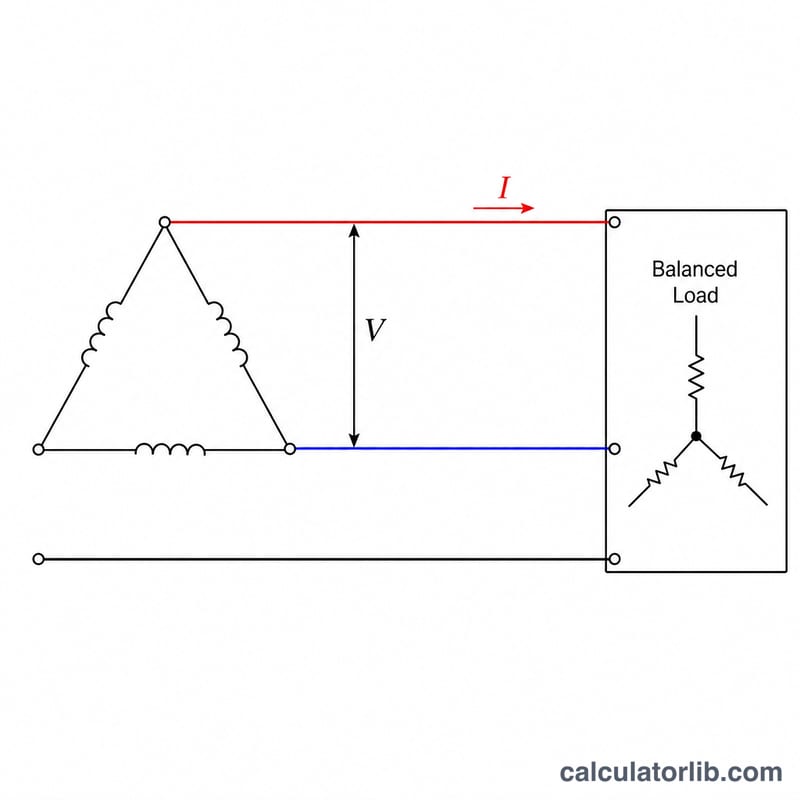
This tool converts real power (watts) into electrical current (amperes) for a balanced three-phase AC system. Three-phase power is common in industrial and commercial installations such as motors, large HVAC units and distribution panels. Because the three phases share the load, the current calculation includes the factor \(\sqrt{3}\) (about 1.732) along with the line-to-line voltage and the power factor.
How to Use It
Enter the real power in watts, the line-to-line voltage (the voltage measured between any two of the three phases — e.g. 400 V, 415 V or 480 V), and the power factor (typically 0.8–1.0 for many loads). The calculator returns the line current in amperes. Use real power in watts, not apparent power in VA; the power factor already accounts for the difference.
The Formula Explained
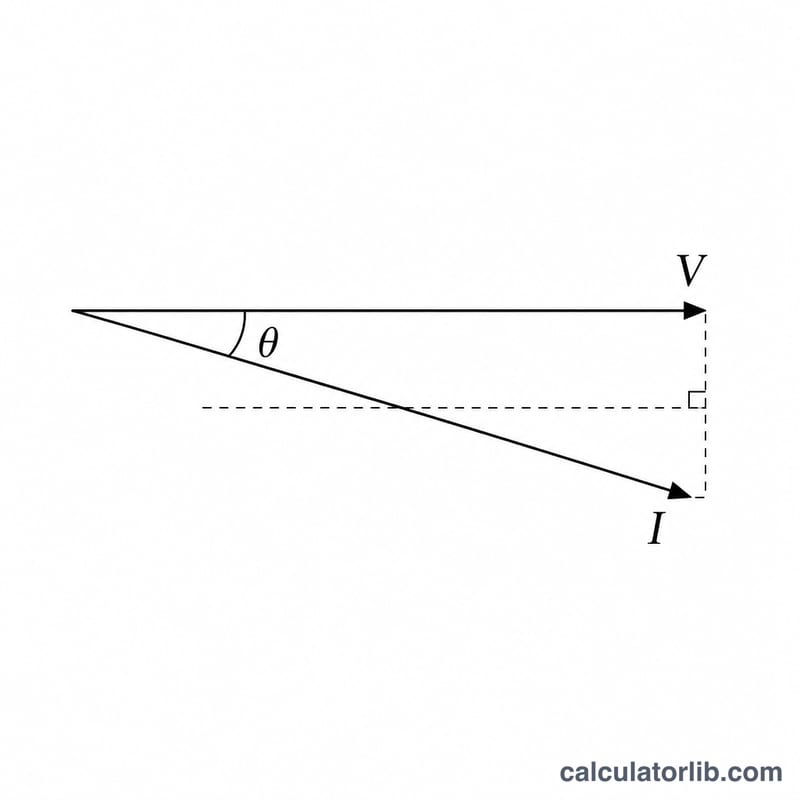
The line current is given by $$I = \frac{P}{\sqrt{3}\times V_{LL}\times PF}$$ Here P is real power in watts, VLL is the line-to-line voltage, and PF is the power factor. The \(\sqrt{3}\) term arises from the geometry of three-phase systems, relating line and phase quantities. A higher voltage or higher power factor reduces the current needed to deliver the same power.
Worked Example
Suppose a load draws 10,000 W at 400 V line-to-line with a power factor of 0.8. The denominator is $$\sqrt{3}\times 400\times 0.8 = 1.732\times 400\times 0.8 \approx 554.26$$ So \(I = 10{,}000 \div 554.26 \approx\) 18.04 A.
FAQ
Should I use line-to-line or phase voltage? This calculator uses line-to-line voltage (e.g. 400 V). If you only have phase voltage, multiply it by \(\sqrt{3}\) to get line-to-line voltage first.
What power factor should I use? Resistive loads (heaters) are near 1.0; motors are often 0.8–0.9. Check the equipment nameplate for an accurate value.
Does this work for single-phase? No — single-phase uses \(I = \frac{P}{V\times PF}\) without the \(\sqrt{3}\) factor.