
What is the Three-Phase Current Calculator?
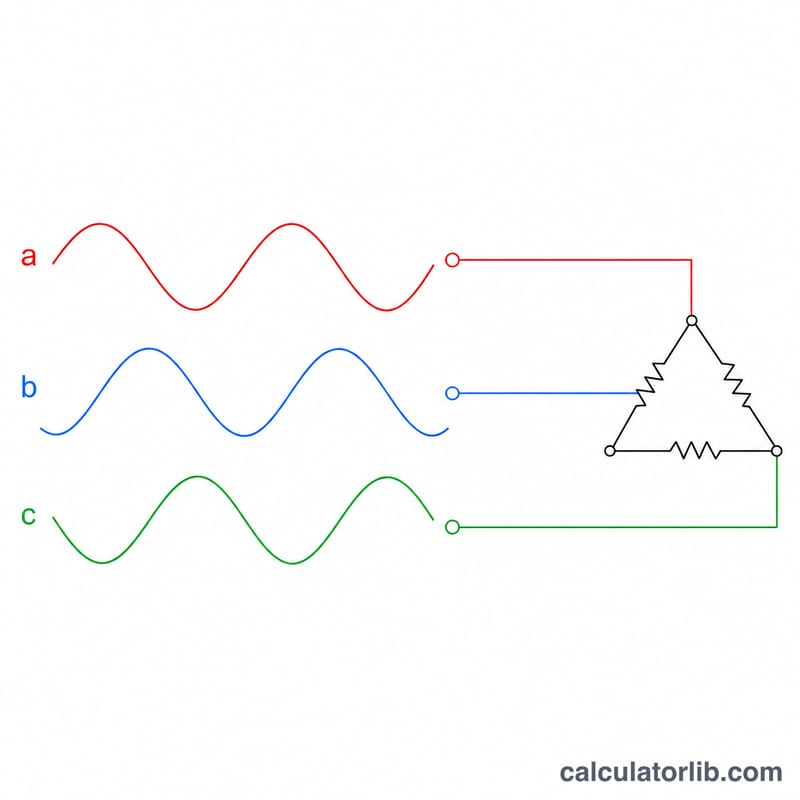
This tool computes the line current (in amperes) drawn by a balanced three-phase load. It uses the standard power equation for three-phase systems, relating real power, line-to-line voltage and power factor. It applies universally to any balanced three-phase AC system regardless of country, though typical line voltages are 400 V (Europe) or 480 V (North America).
How to use it
Enter the load's real power in watts, the line-to-line (phase-to-phase) voltage, and the power factor (a value between 0 and 1, typically 0.8–0.95 for motors). The calculator returns the line current in amps, along with the real power in kW and the apparent power in kVA.
The formula explained
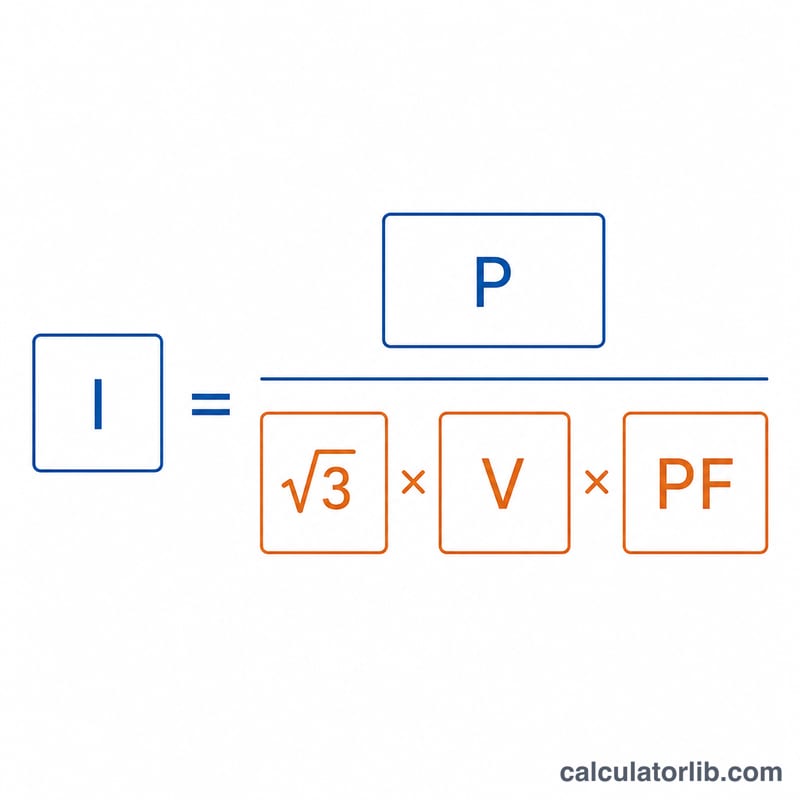
For a balanced three-phase load: $$I = \frac{P}{\sqrt{3} \times V \times PF}$$, where P is real power in watts, V is the line-to-line voltage, PF is the power factor, and \(\sqrt{3} \approx 1.732\). The \(\sqrt{3}\) factor arises because line current relates to phase quantities through the geometry of three-phase systems. Apparent power \(S = P / PF\) gives the kVA, which is what transformers and generators must be sized for.
Worked example
A 10,000 W motor on a 400 V three-phase supply with a power factor of 0.9: $$I = \frac{10000}{1.732 \times 400 \times 0.9} = \frac{10000}{623.5} \approx 16.04 \text{ A}$$ The apparent power is \(10 / 0.9 \approx 11.11\) kVA.
FAQ
Which voltage do I enter? Use the line-to-line voltage (e.g. 400 V or 480 V), not the phase-to-neutral voltage.
What if I have kW instead of W? Multiply kW by 1000 to get watts before entering.
What power factor should I use? For resistive loads use 1.0; for induction motors 0.8–0.9 is common. Check the equipment nameplate when in doubt.