
What Is a Current Divider?
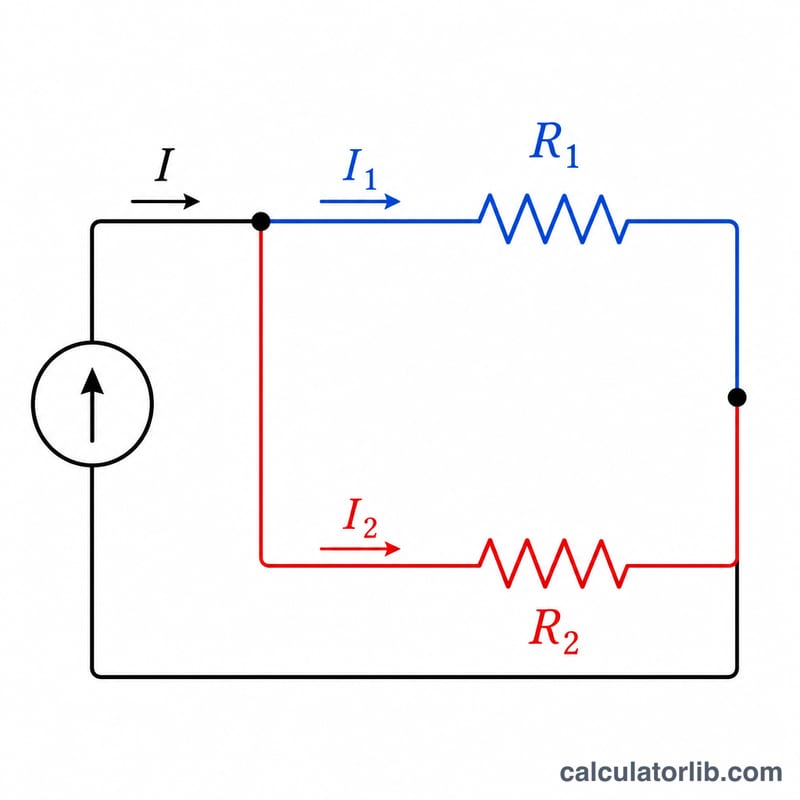
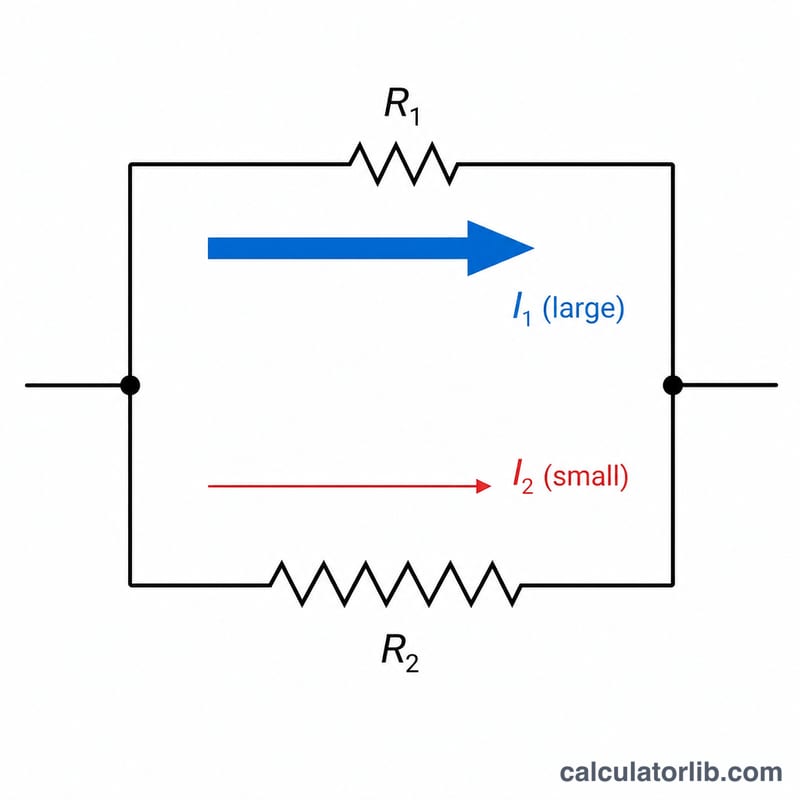
A current divider is a simple parallel circuit in which a total current splits between two (or more) branches. Because both resistors share the same voltage, the current through each branch is inversely proportional to its resistance — the smaller resistor carries the larger current. This calculator handles the common two-resistor case using Kirchhoff's current law and Ohm's law.
How to Use It
Enter the total current entering the parallel combination (in amperes), then enter the two resistor values R1 and R2 (in ohms). The calculator returns the current flowing through each resistor. The two branch currents always add up to the total current you entered.
The Formula Explained
For two resistors in parallel, the current through R1 is:
$$I_{R1} = \text{I}_{\text{total}} \cdot \frac{\text{R2}}{\text{R1} + \text{R2}}$$
Notice the resistor in the numerator is the other branch's resistance. This is because more current naturally flows down the path of least resistance, so R1 receives a share weighted by R2. The current through R2 follows the same rule with R1 in the numerator.
Worked Example
Suppose 1 A enters a node and splits between R1 = 100 Ω and R2 = 200 Ω. Then:
$$I_{R1} = 1 \times \frac{200}{100 + 200} = \frac{200}{300} = 0.6667 \text{ A}$$$$I_{R2} = 1 \times \frac{100}{300} = 0.3333 \text{ A}$$
The currents sum to 1 A, confirming Kirchhoff's current law, and the smaller resistor (R1) carries the larger current.
FAQ
Why does the smaller resistor get more current? Both resistors have the same voltage across them. By Ohm's law (\(I = V/R\)), a smaller R means a larger I.
Does this work for more than two resistors? This tool covers the two-resistor case. For more branches, replace the "other" resistance with the parallel combination of all the remaining branches.
What units should I use? Use amperes for current and ohms for resistance. The result is in amperes. The ratio is unitless, so consistent units are all that matter.