
What Is a Capacitors in Series Calculator?
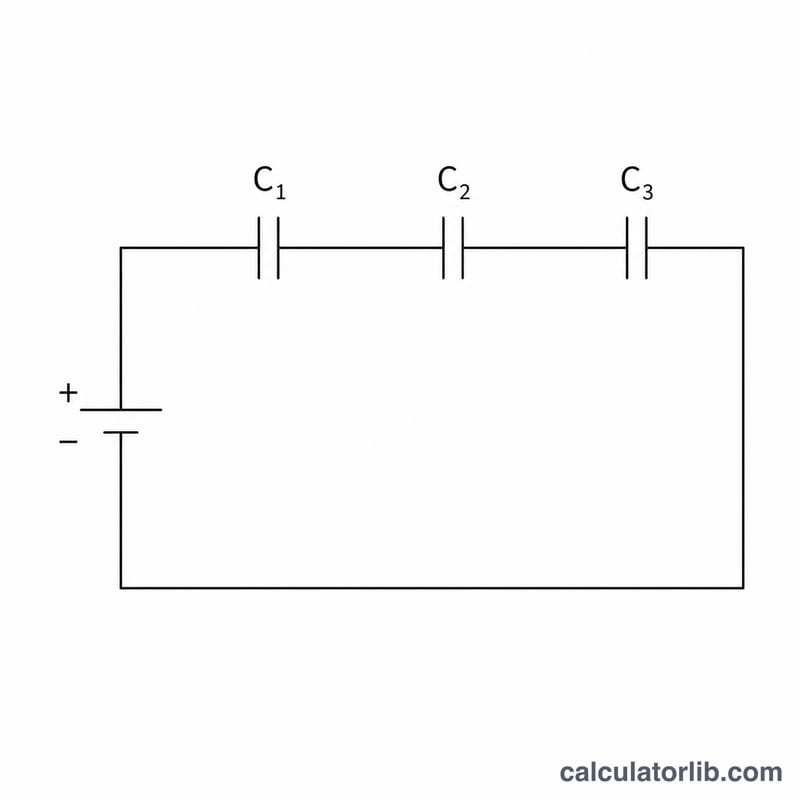
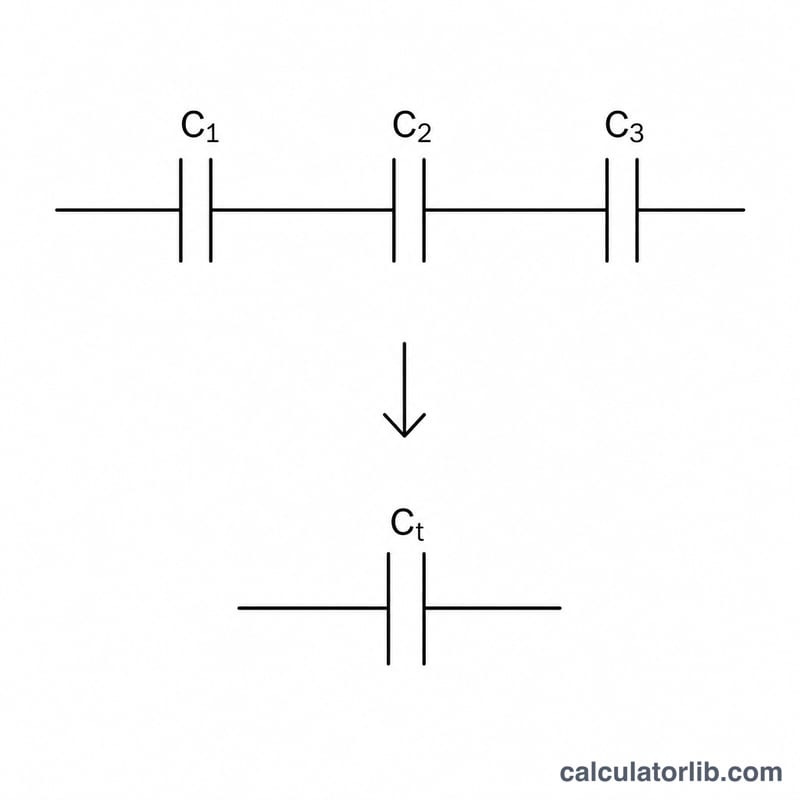
This calculator finds the equivalent (total) capacitance of two or more capacitors connected in series. When capacitors are wired end-to-end in a single path, the combined capacitance is always less than the smallest individual capacitor. This is the opposite of resistors in series and of capacitors in parallel.
How to Use It
Enter the capacitance of each capacitor in microfarads (µF). The first two fields are required; the third and fourth are optional, so you can combine two, three, or four capacitors. Leave a field blank or set it to zero to ignore it. Press calculate to see the total series capacitance.
The Formula Explained
The governing equation is:
$$\frac{1}{C_{\text{total}}} = \frac{1}{C_1} + \frac{1}{C_2} + \dots + \frac{1}{C_n}$$
You add the reciprocals of every capacitance, then take the reciprocal of that sum. Because reciprocals are added, the result is dominated by the smallest capacitor. For just two capacitors this reduces neatly to the "product over sum" form: \(C_{\text{total}} = \frac{C_1 \times C_2}{C_1 + C_2}\).
Worked Example
Suppose you connect a 10 µF and a 20 µF capacitor in series. Then $$\frac{1}{C_{\text{total}}} = \frac{1}{10} + \frac{1}{20} = 0.10 + 0.05 = 0.15.$$ So \(C_{\text{total}} = \frac{1}{0.15} \approx 6.667\) µF — smaller than either capacitor, as expected.
FAQ
Why is series capacitance smaller than the smallest capacitor? Because the same charge must pass through every capacitor, the total voltage divides across them, which effectively increases the plate separation and reduces capacitance.
What units should I use? Use the same unit for every input. This tool labels inputs in microfarads (µF), and the result is returned in µF. The math works identically for nF or pF if you stay consistent.
What about voltage rating? In series the working voltage adds up across capacitors, which is one reason series connections are sometimes used — but matching capacitors are recommended to share voltage evenly.