
What Is a High Pass Filter Calculator?
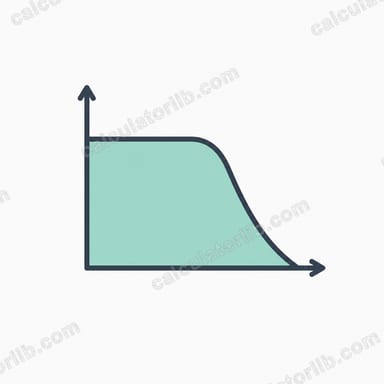
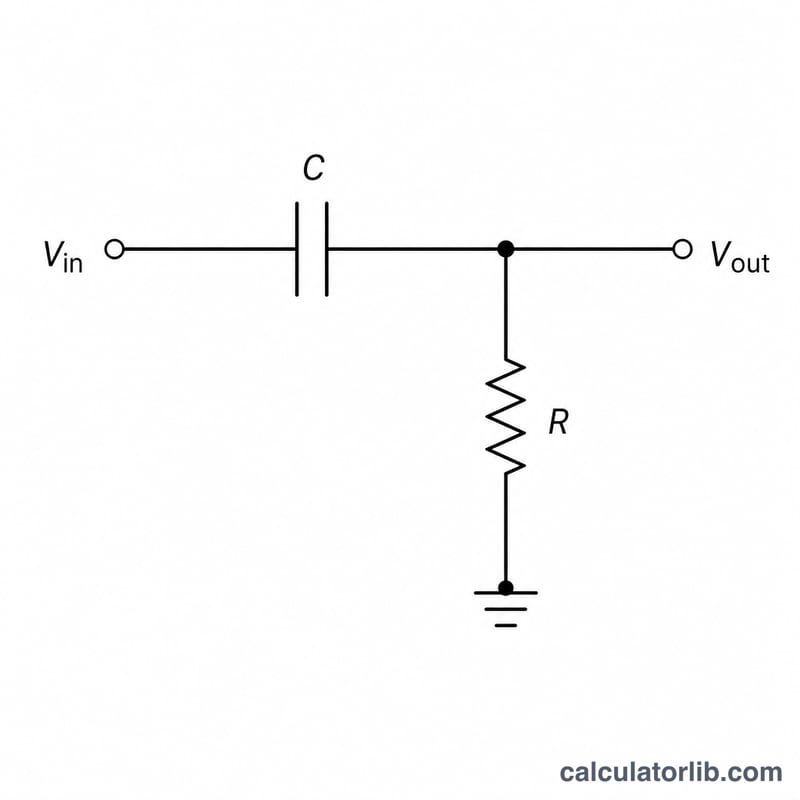
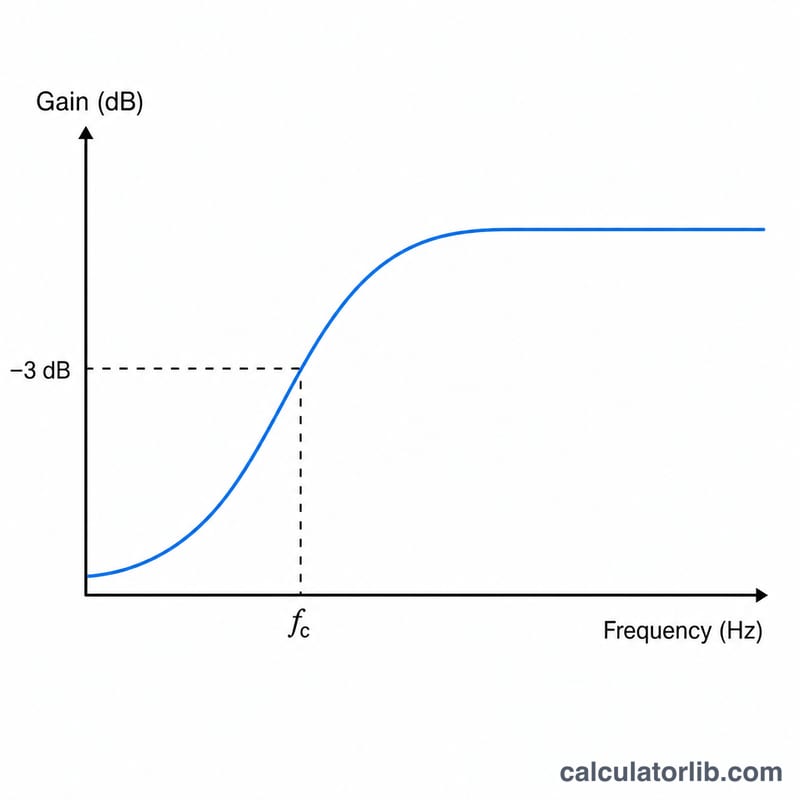
A high pass filter calculator finds the cutoff (corner) frequency of a simple first-order RC high-pass filter. A high-pass filter passes signals above the cutoff frequency while attenuating signals below it. These circuits are everywhere in audio, radio, and signal-processing designs, used to block DC offsets and remove low-frequency rumble.
How to Use It
Enter the resistance R in ohms and the capacitance C in farads. The calculator returns the cutoff frequency in hertz. Remember to convert prefixed units first: 1 kΩ = 1000 Ω, 1 µF = 0.000001 F, and 1 nF = 0.000000001 F.
The Formula Explained
The cutoff frequency is given by:
$$f_c = \frac{1}{2\pi \cdot R \cdot C}$$
At this frequency the output power is half (−3 dB) of the passband level. Increasing either R or C lowers the cutoff frequency, letting more low frequencies through; decreasing them raises it.
Worked Example
Suppose R = 1000 Ω and C = 1 µF (0.000001 F). Then $$f_c = \frac{1}{2 \times 3.14159 \times 1000 \times 0.000001} = \frac{1}{0.0062832} \approx 159.15 \text{ Hz}.$$ So signals well above about 159 Hz pass through, while lower frequencies are attenuated.
FAQ
What is the cutoff frequency? It is the frequency where the filter's output drops to 70.7% (−3 dB) of the input amplitude.
Does this apply to active filters? This formula is for a passive first-order RC high-pass stage. Active filters use the same RC corner frequency but add gain and buffering.
How do I get a specific cutoff frequency? Pick a standard capacitor value, then solve \(R = \frac{1}{2\pi \times f_c \times C}\) for the needed resistance.