
What Is the Harmonic Series?
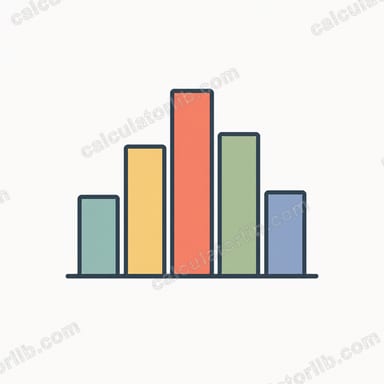
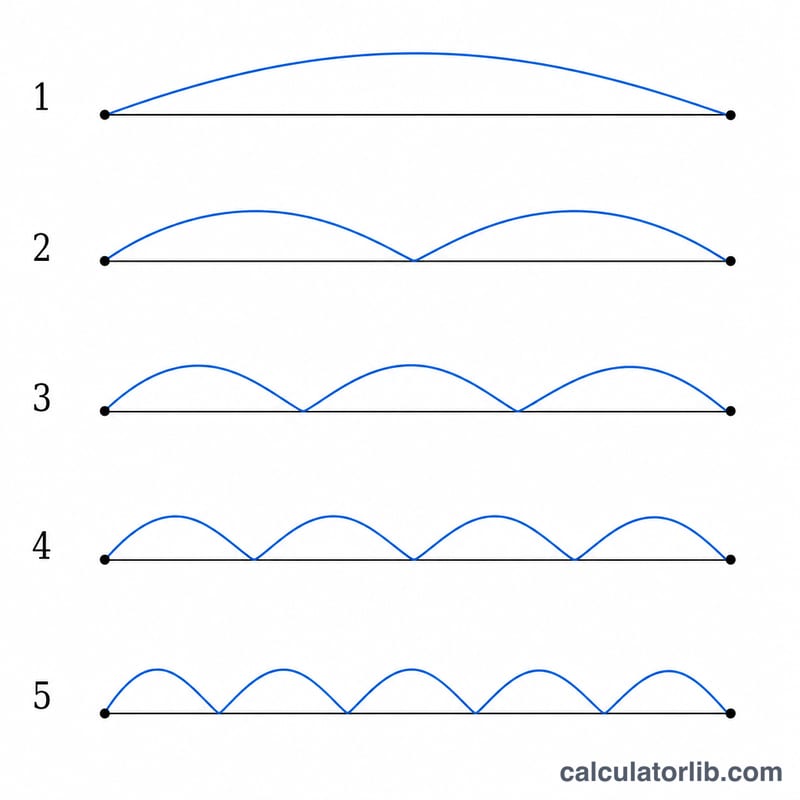
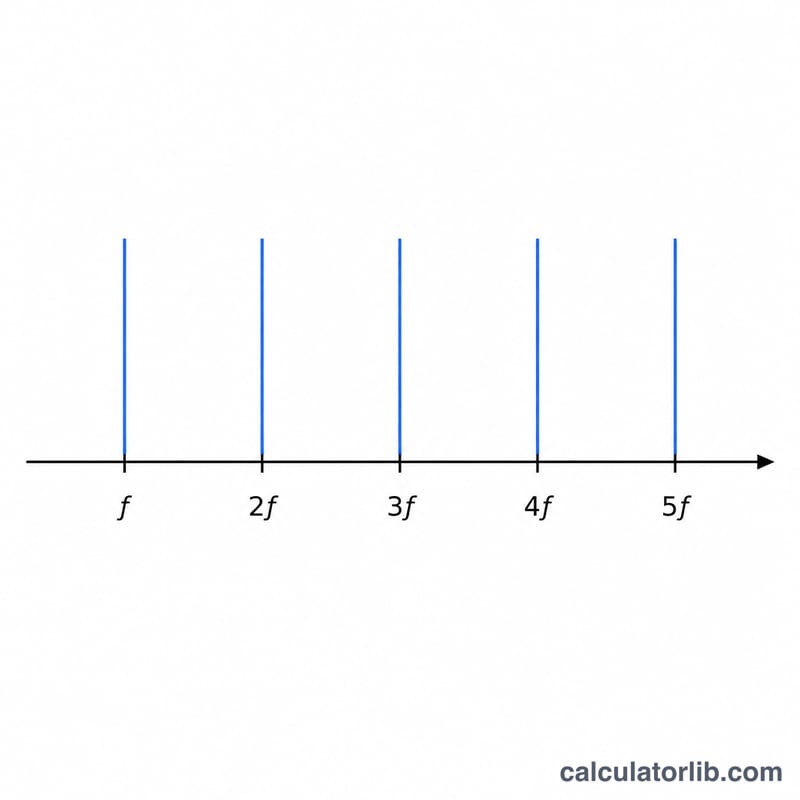
The harmonic series is the sequence of frequencies that are integer multiples of a single base tone called the fundamental frequency (\(f_1\)). When a string, air column, or other resonant body vibrates, it produces not only the fundamental but also a series of overtones — the 2nd, 3rd, 4th harmonics and beyond. These harmonics give each instrument its characteristic timbre and are central to music theory, acoustics, and physics.
How to Use This Calculator
Enter the fundamental frequency in hertz (Hz) — for example 440 Hz, the standard pitch A4. Then enter the harmonic number \(n\), where \(n = 1\) is the fundamental, \(n = 2\) is the first overtone (one octave up), \(n = 3\) is the second overtone, and so on. The calculator instantly returns the frequency of that harmonic.
The Formula Explained
The relationship is beautifully simple: $$f_n = n \times f_1$$ The nth harmonic's frequency is just the fundamental multiplied by the whole number \(n\). Because the spacing is linear in \(n\) but pitch is logarithmic, the gap between consecutive harmonics shrinks musically as you climb the series — the octave (1→2) is large, while 7→8 is a small step.
Worked Example
Suppose the fundamental frequency is 220 Hz (A3) and you want the 3rd harmonic. Then $$f_3 = 3 \times 220 = 660 \text{ Hz}$$ That note is close to E5, which is why the 3rd harmonic corresponds musically to a perfect fifth above the octave.
FAQ
Is the fundamental a harmonic? Yes — the fundamental is the 1st harmonic (\(n = 1\)), so \(f_1 = 1 \times f_1\).
What is the difference between a harmonic and an overtone? Overtones are numbered starting above the fundamental: the 1st overtone is the 2nd harmonic. Harmonics are numbered from the fundamental itself.
Does this work for any waveform? The formula gives the ideal harmonic frequencies for a perfectly harmonic source. Real instruments may show slight inharmonicity, but this calculator gives the theoretical values.