
What is the Speaker Box Volume Calculator?
This tool calculates the net internal volume of a speaker or subwoofer enclosure — the actual air space inside the box that determines how a driver performs. You enter the external box dimensions and the thickness of the panel material (MDF, plywood, etc.), and it returns the usable internal volume in cubic feet, cubic inches, and liters.
How to use it
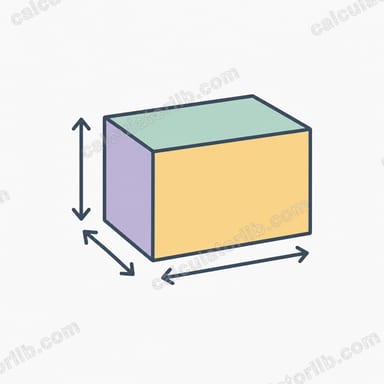
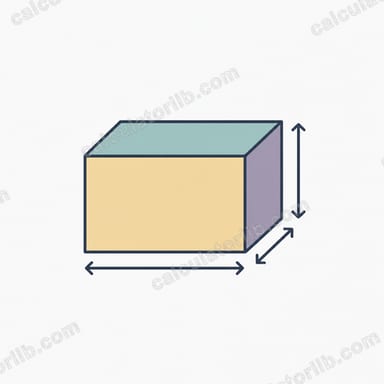
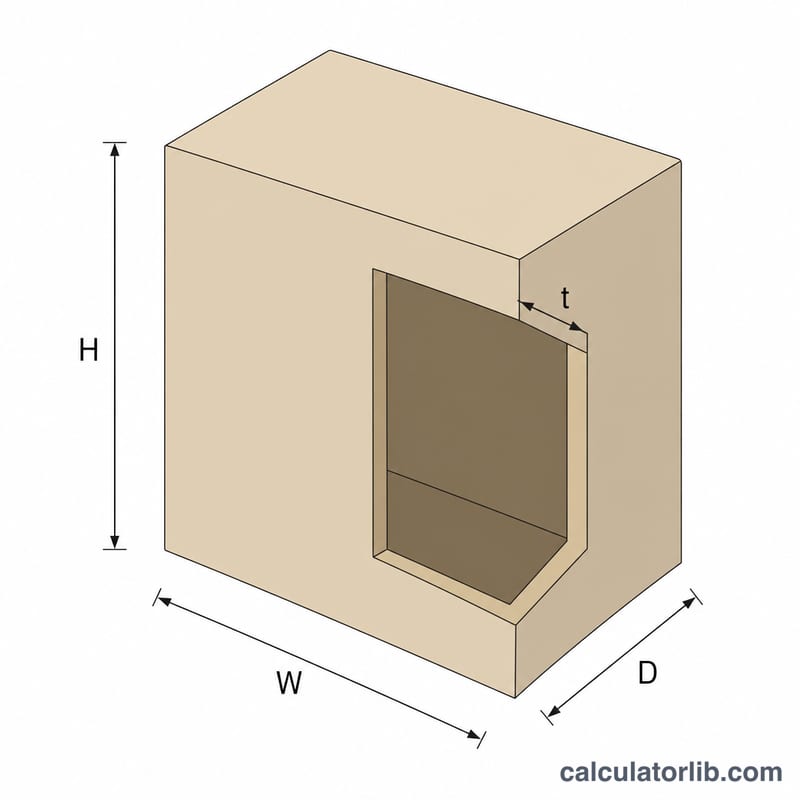
Measure the outside Height, Width, and Depth of your enclosure in inches. Enter the thickness of the wood you are using (commonly 0.75 in for ¾" MDF). The calculator subtracts material from both walls of each dimension, multiplies the three internal dimensions, and converts to volume units. Note this is gross internal volume — you should still subtract the displacement of the driver, port, and any bracing for a true net figure.
The formula explained
Each external dimension loses two panel thicknesses (one wall on each side), so the internal dimension is the external value minus 2t. The product of the three internal dimensions is the volume in cubic inches; dividing by 1728 (12³) converts to cubic feet.
$$V_b = \dfrac{\left(H - 2t\right)\left(W - 2t\right)\left(D - 2t\right)}{1728}$$
Worked example
For an 18 × 14 × 12 in box built from ¾" (0.75 in) material: internal dimensions = $$(18 - 1.5) \times (14 - 1.5) \times (12 - 1.5) = 16.5 \times 12.5 \times 10.5 = 2165.63 \text{ in}^3.$$ Dividing by 1728 gives 1.253 cubic feet (≈ 35.5 liters).
FAQ
Does this include driver displacement? No. The result is the empty internal air volume. Subtract the displacement listed in your driver's spec sheet, plus any port and bracing volume, for the final tuned net volume.
What thickness should I use? Most enclosures use ¾" (0.75 in) MDF. Use the actual thickness of your panels — some builders double-baffle, which changes one dimension.
Why divide by 1728? There are 12 inches in a foot, so one cubic foot equals \(12 \times 12 \times 12 = 1728\) cubic inches.