
What Is the Note Frequency Calculator?
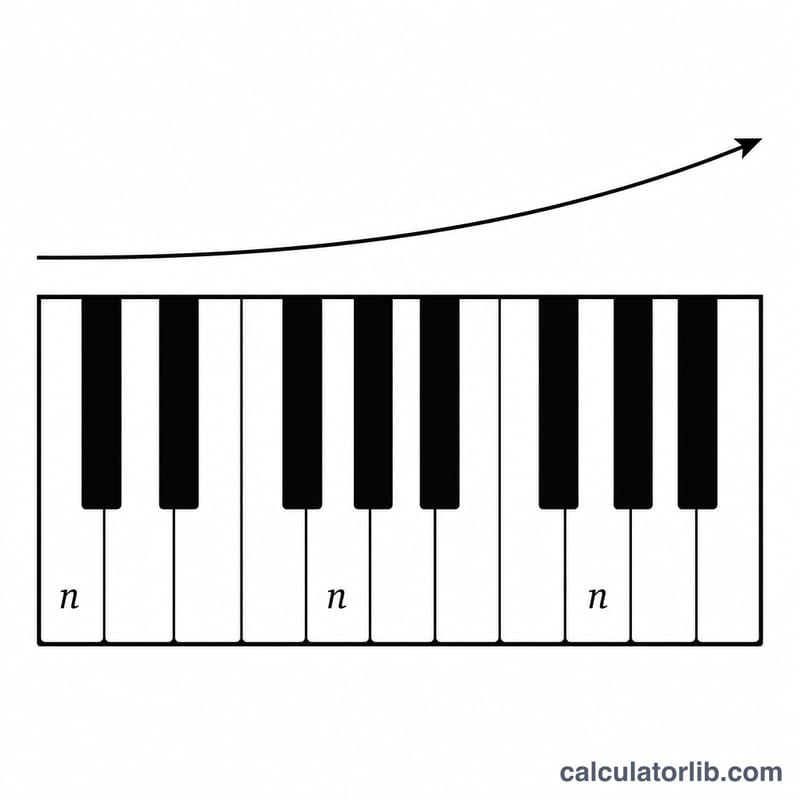
This tool converts a piano key number into its sounding frequency in hertz (Hz) using the modern 12-tone equal temperament tuning system. On a standard 88-key piano, the keys are numbered 1 (the lowest A0) through 88 (the highest C8). Key 49 is A4, conventionally tuned to 440 Hz — the international concert pitch standard. The calculator is universal and works for any instrument tuned to equal temperament.
How to Use It
Enter the piano key number you want to analyse and, if you like, change the reference pitch for A4 (some orchestras tune to 442 or 443 Hz, while historical "baroque pitch" is around 415 Hz). The calculator returns the frequency in Hz, plus the wavelength in air (using the speed of sound, 343 m/s) and the wave period in milliseconds.
The Formula Explained
The frequency is found with:
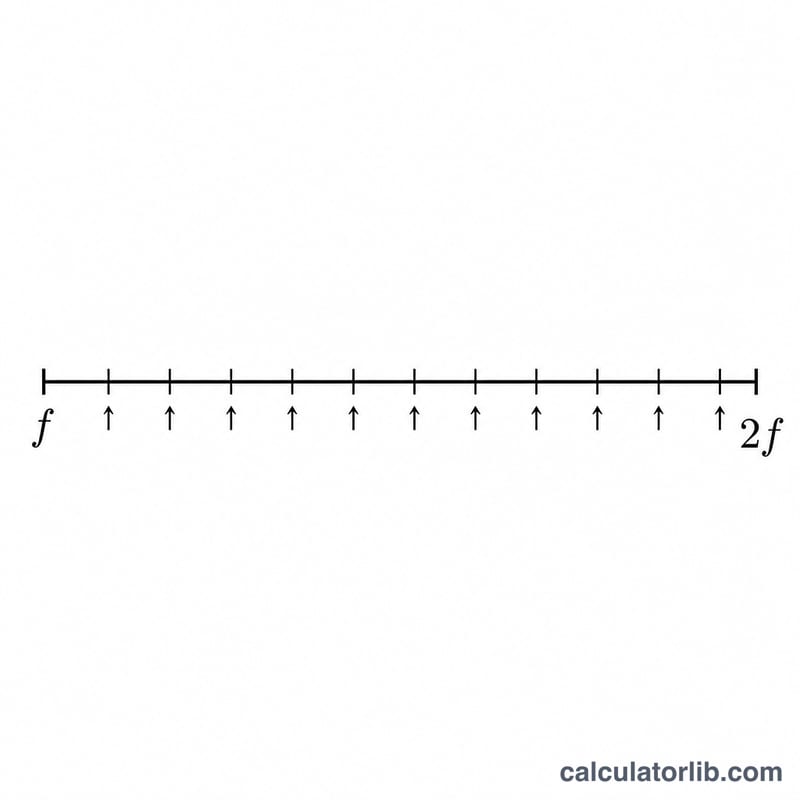
$$f = 440 \times 2^{\frac{n - 49}{12}}$$Each semitone is a factor of the twelfth root of two (≈ 1.0594631). Because there are 12 semitones in an octave, raising the exponent by 12 doubles the frequency — exactly one octave higher. The term \((n - 49)\) measures how many semitones a key sits above or below A4.
Worked Example
For Middle C (key 40): \(n - 49 = -9\), so $$f = 440 \times 2^{-9/12} = 440 \times 0.594604 \approx 261.63 \text{ Hz}$$ That matches the textbook value for C4.
FAQ
Which key is A4? Key 49 corresponds to A4 at 440 Hz by default.
Can I tune to 432 Hz? Yes — set the reference pitch field to 432 and every note will scale proportionally.
Does this work above key 88? The formula is valid for any integer; the calculator allows up to 108 so you can explore notes beyond the standard keyboard.