
What is the Fret Position Calculator?
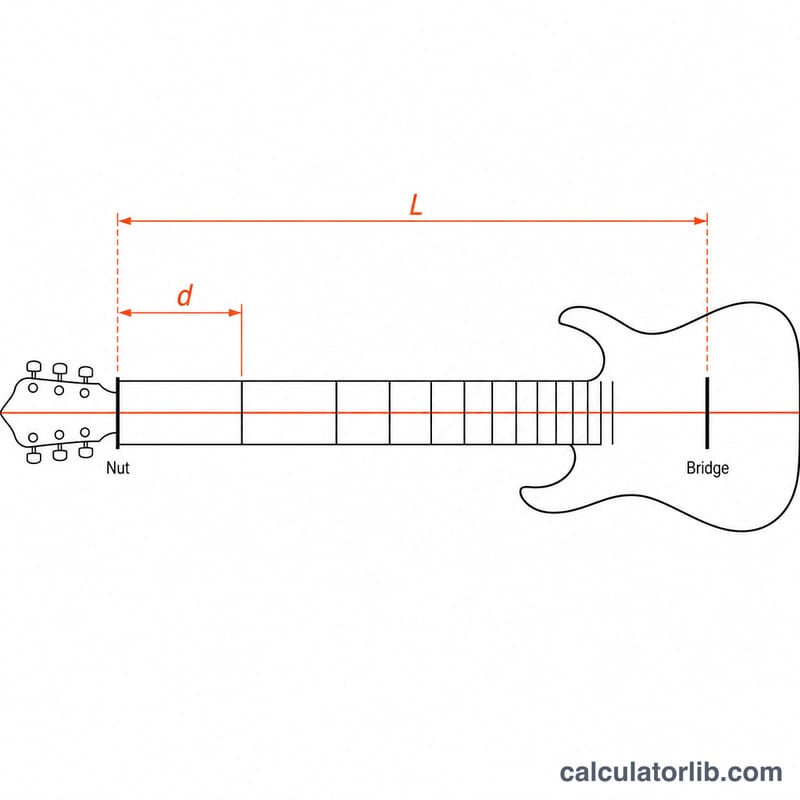
This tool determines exactly where each fret should sit on a stringed instrument such as a guitar, bass, or ukulele. Given a scale length (the distance from the nut to the bridge saddle) and a fret number, it returns the distance from the nut to that fret, the remaining distance to the bridge, and the spacing to the next fret. It is a universal physics/music tool — no country or jurisdiction applies.
How to use it
Enter your instrument's scale length in any unit you prefer (inches or millimeters — the result comes back in the same unit). Then enter the fret number you want to locate, from 1 up to 36. The calculator instantly shows where to place the fret.
The formula explained
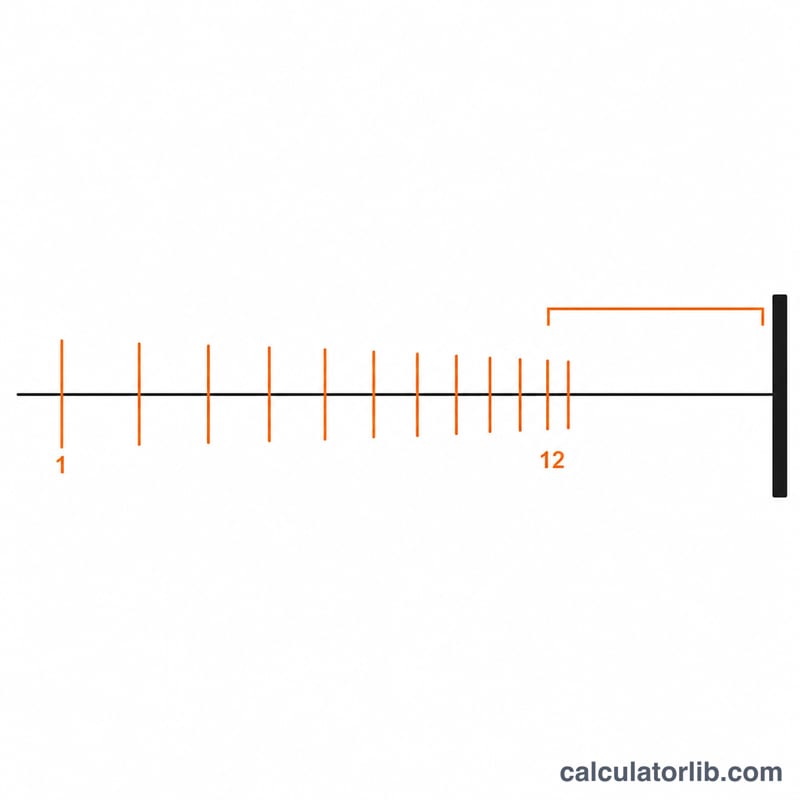
Western instruments use 12-tone equal temperament, meaning every octave divides into 12 equal half-steps and the frequency ratio between adjacent semitones is the twelfth root of two. Because string pitch is inversely proportional to its vibrating length, the speaking length at fret n equals \( L / 2^{n/12} \). The distance from the nut to that fret is therefore $$d = L - \frac{L}{2^{\,n/12}}.$$ At the 12th fret the length is exactly halved, placing it at the midpoint — the octave.
Worked example
For a Fender-style 25.5-inch scale at the 12th fret: $$d = 25.5 - \frac{25.5}{2^{12/12}} = 25.5 - 12.75 = 12.75 \text{ inches}$$ from the nut. The spacing to the 13th fret is \( 25.5 - 25.5/2^{13/12} \approx 13.4648 \), minus 12.75 \( \approx 0.7148 \) inches.
FAQ
Does this account for intonation compensation? No — it gives the theoretical equal-temperament positions. Real builds add a small bridge compensation for string action and gauge.
What unit does it use? Whatever unit you enter the scale length in; the output matches it.
Why does the 12th fret land at the middle? Because halving a string's length raises its pitch exactly one octave (2:1 frequency ratio).