What this calculator does
The Weaving Yarn Calculator estimates how much yarn you need to dress a loom and weave a project. It splits the estimate into warp (the lengthwise threads held under tension) and weft (the crosswise threads carried by the shuttle), then adds an allowance for loom waste, take-up, and shrinkage. The result is total yardage so you can buy or wind enough yarn before you start.
The formula explained
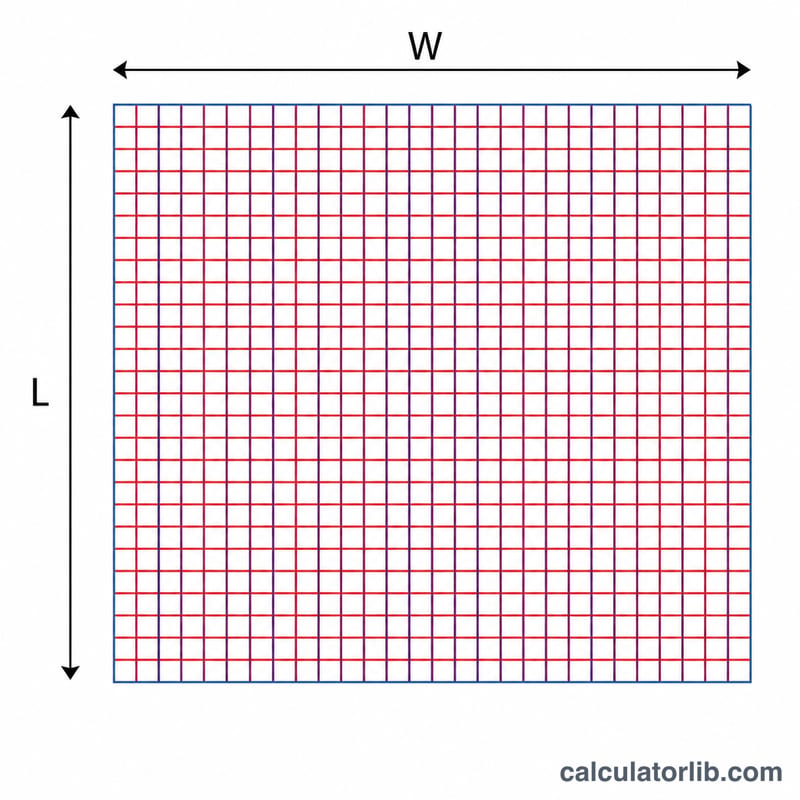
Let \(W\) = fabric width in inches, \(L\) = fabric length in inches, \(E\) = warp sett in ends per inch (EPI), \(P\) = weft sett in picks per inch (PPI), and \(a\) = the waste allowance as a decimal (15% = 0.15). The number of warp ends is \(W \times E\) and each end must be at least \(L(1+a)\) long. The number of picks is \(L \times P\) and each pick spans \(W(1+a)\). Converting inches to yards by dividing by 36 gives:
$$\text{Total} = \frac{(W \times E)\,L(1+a) + (L \times P)\,W(1+a)}{36}$$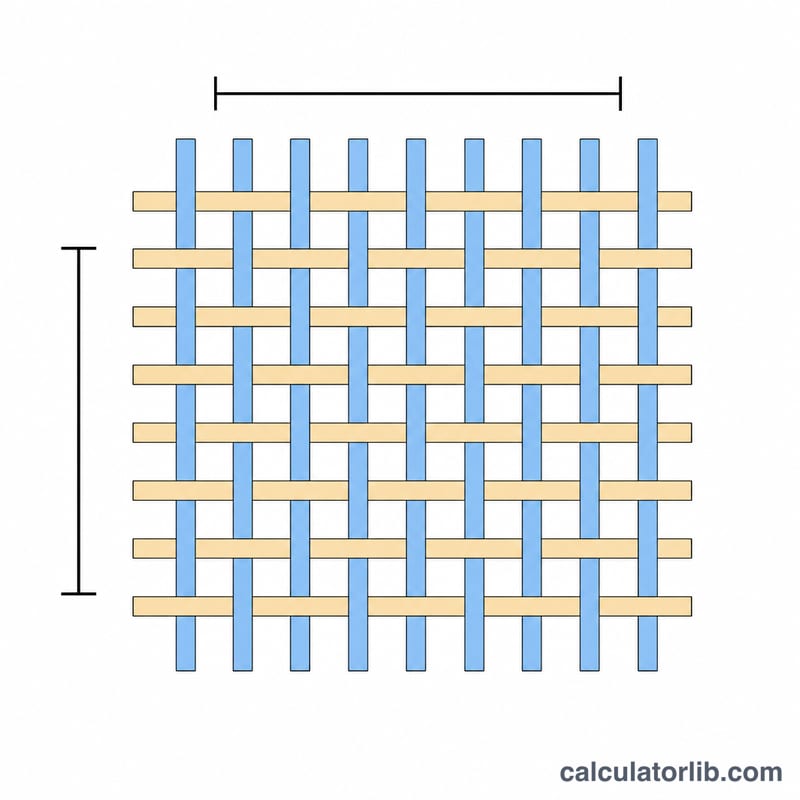
How to use it
Enter the finished fabric width and length, the warp sett (EPI) and weft sett (PPI) from your project draft, and a waste allowance. A 10-15% allowance is common for scarves and yardage; increase it for fringe, sampling, or long warps where loom waste is proportionally larger.
Worked example
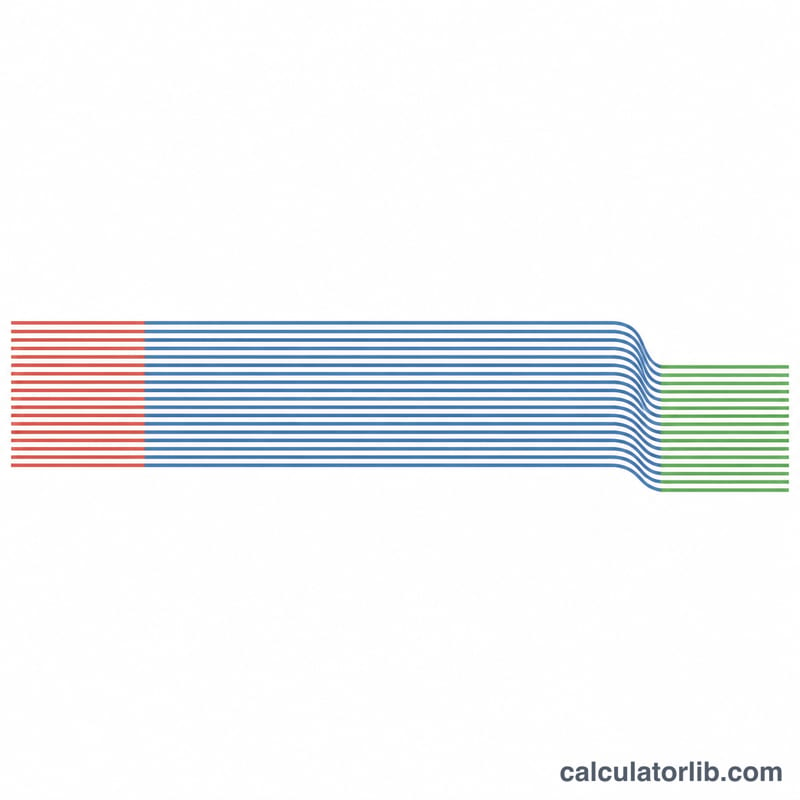
For \(W=15\) in, \(L=40\) in, \(E=10\) EPI, \(P=8\) PPI, and \(a=0.10\): there are \(15 \times 10 = 150\) warp ends, each \(40 \times 1.10 = 44\) in long, so the warp is
$$\frac{150 \times 44}{36} = 183.3\ \text{yd}.$$There are \(40 \times 8 = 320\) picks, each \(15 \times 1.10 = 16.5\) in wide, so the weft is
$$\frac{320 \times 16.5}{36} = 146.7\ \text{yd},$$giving a total of about \(330\) yards.
Typical Sett (EPI/PPI) by Yarn Weight
Sett is how closely you space your yarn. A common starting point for a balanced plain weave is roughly half the yarn's wraps per inch (WPI):
$$\text{EPI} \approx \frac{\text{WPI}}{2}$$
To measure WPI, wrap the yarn snugly (not stretched, no gaps) around a ruler for one inch and count the wraps. For a balanced plain weave the weft picks per inch (PPI) are set close to the warp ends per inch (EPI), so PPI ≈ EPI. The values below are general handweaving guidelines (based on the WPI method commonly used in North American and UK handweaving); actual WPI varies with fiber, twist, and manufacturer, so wrap your own yarn and weave a sample before committing.
| Yarn (example) | Approx. WPI | Plain-weave sett — EPI (≈ WPI/2) | Balanced weft (PPI) |
|---|---|---|---|
| Fine — 8/2 cotton | ~24 | 18–24 | ≈ EPI |
| Fingering — sock / superfine wool | ~16–18 | 12–15 | ≈ EPI |
| Medium — DK / worsted-weight wool | ~11–14 | 10–15 | ≈ EPI |
| Bulky — chunky wool | ~7–9 | 6–8 | ≈ EPI |
Note that the WPI/2 rule is a quick estimate that tends to run low for fine, smooth cottons and high for lofty woolens, which is why published sett charts often suggest a range. For twill and other floats you can sett more closely (roughly two-thirds to three-quarters of WPI) than for plain weave. When in doubt, sample at two or three setts and choose the fabric hand you prefer.
Practical Recommendations
Once the calculator gives you a total yardage (and the separate warp and weft figures), use these steps to turn the estimate into a confident yarn order:
- Round up to whole put-ups. Yarn is sold by the skein, ball, or cone, so round your requirement up to the next whole unit rather than buying a partial amount.
- Buy a 10–15% margin. Add a buffer on top of the calculated total to cover threading errors, broken ends, and sampling. Add more (20% or more) for long warps, for fringe or knotted finishes that consume extra length, or if you plan to wet-finish and sample heavily.
- Order from a single dye lot. Buy all of one color at once from the same dye lot; separate lots can differ enough to show as visible banding in the finished cloth.
- Wind warp and weft separately. Use the split warp and weft totals from the estimator to measure your warp and to set aside weft, so you don't run short on one while over-buying the other. If warp and weft are the same yarn, combine the totals before ordering.
- Convert yardage to weight before ordering. Many yarns (especially cones) are sold by weight, so use the yarn's yards-per-pound (ypp) rating to convert:
$$\text{Pounds needed} = \frac{\text{Total yards}}{\text{yards per pound}}$$
For example, a yarn rated at 3,360 ypp with a required 4,200 yards works out to \(4200 \div 3360 \approx 1.25\) lb — so you would order at least 1.5 lb (rounding up) plus your safety margin. Keep any leftover yarn and record the sett, loom waste, and take-up you actually used; those real numbers make your next estimate far more accurate.
FAQ
Does this include loom waste? Yes. The allowance percentage is applied to both warp length and weft width, which approximates loom waste, take-up, and finishing shrinkage.
What is sett? Sett is how closely threads are packed: EPI is ends per inch for the warp and PPI is picks per inch for the weft. Both come from your weave structure and yarn size.
How do I convert yards to weight? Divide total yards by your yarn yards-per-pound (or yards-per-gram) rating to estimate the amount of yarn to purchase.