What this calculator does
Yarn labels tell you metres per ball, but patterns think in finished garments. This calculator bridges the two: give it the finished size of your project, the yarn weight category and the stitch you plan to work, and it returns the total yarn length in yards and metres, the approximate weight in grams, and how many balls to put in the basket. It works for sweaters, blankets, scarves, shawls, hats and amigurumi panels, in either inches or centimetres.
How to use it
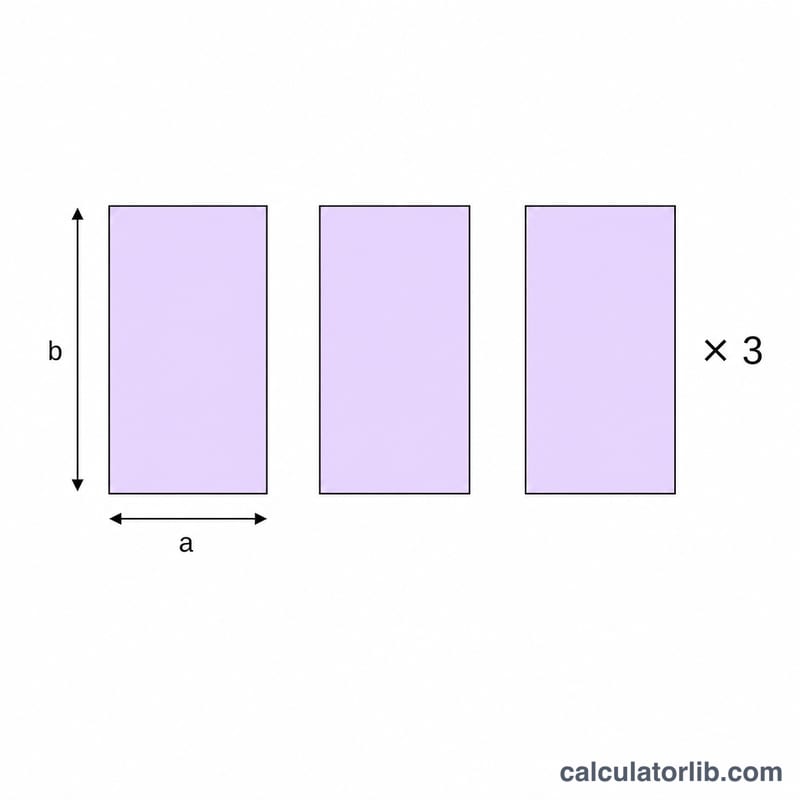
Measure (or read from your schematic) the width and length of one flat piece of fabric. Enter how many identical pieces there are - a simple drop-shoulder sweater is roughly two body panels plus two sleeve rectangles. Pick the CYC yarn weight number printed on the ball band, choose your stitch, then set a waste margin. Fifteen percent is a sensible default; raise it to 25 percent for colourwork, seaming-heavy patterns or if you plan to swatch generously.
The formula
Every yarn weight consumes a fairly predictable amount of length per unit of fabric area at its standard gauge. Calling that rate \(f_w\), the estimate is:
$$L = A \times f_w \times f_s \times n \times \left(1 + \frac{p}{100}\right)$$
where \(A\) = area of one piece in square inches, \(f_s\) = stitch factor (garter 1.15, single crochet 1.40, open mesh 0.85, stockinette 1.00), \(n\) = number of pieces and \(p\) = waste percent. Centimetre inputs are converted with \(1\,\text{sq in} = 6.4516\,\text{sq cm}\), and metres come from \(1\,\text{yd} = 0.9144\,\text{m}\).
Worked example
A worsted-weight (\(f_w = 0.80\)) stockinette sweater with two panels of 20 in × 25 in and a 15 percent margin:
$$L = (20 \times 25) \times 0.80 \times 1.00 \times 2 \times 1.15 = 920\,\text{yd}$$
At 220 yd per 100 g ball that is \(920 / 220 = 4.18\) balls, so buy 5 balls, about 418 g of yarn.
Yarn Weight and Stitch Factor Table
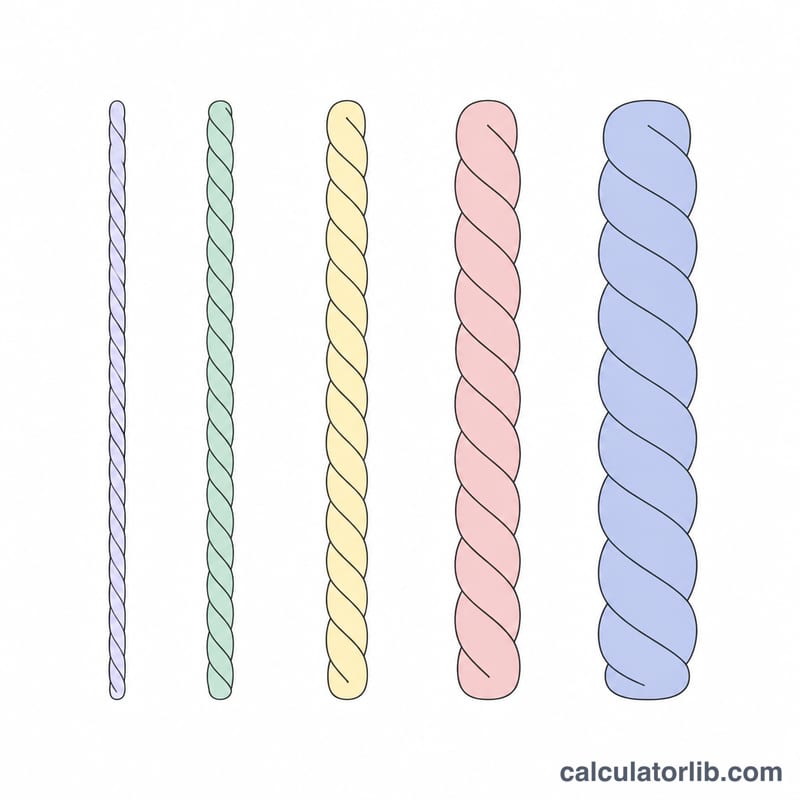
The yarn weight numbers 0–7 below follow the Craft Yarn Council (CYC) Standard Yarn Weight System, a US industry guideline that is also printed on many ball bands sold in Europe and Asia. Gauge is given as stockinette stitches over 4 in (10 cm) on the recommended needle. Yarn sold outside the US may use national conventions instead (for example UK 4-ply, Australian 8-ply, or a Japanese gosu label), so always check the ball band rather than assuming the CYC number.
| CYC no. | Category name | Knit gauge (sts / 4 in / 10 cm) | Needle size (metric / US) | Hook size (metric) | \(f_w\) (yd per sq in) | Typical yd / 50 g | Typical yd / 100 g |
|---|---|---|---|---|---|---|---|
| 0 | Lace (cobweb, thread) | 33–40 | 1.5–2.25 mm / 000–1 | 1.6–2.25 mm | 1.35 | 350–600 | 700–1200 |
| 1 | Super Fine (fingering, sock, baby) | 27–32 | 2.25–3.25 mm / 1–3 | 2.25–3.5 mm | 1.10 | 175–230 | 380–460 |
| 2 | Fine (sport, baby) | 23–26 | 3.25–3.75 mm / 3–5 | 3.5–4.5 mm | 0.90 | 130–165 | 260–330 |
| 3 | Light (DK, light worsted) | 21–24 | 3.75–4.5 mm / 5–7 | 4.5–5.5 mm | 0.80 | 105–125 | 210–250 |
| 4 | Medium (worsted, afghan, aran) | 16–20 | 4.5–5.5 mm / 7–9 | 5.5–6.5 mm | 0.65 | 85–110 | 170–220 |
| 5 | Bulky (chunky, craft, rug) | 12–15 | 5.5–8 mm / 9–11 | 6.5–9 mm | 0.50 | 55–70 | 110–140 |
| 6 | Super Bulky (super chunky, roving) | 7–11 | 8–12.75 mm / 11–17 | 9–15 mm | 0.33 | 30–45 | 60–90 |
| 7 | Jumbo (roving, arm-knitting) | 6 and fewer | 12.75 mm and larger / 17+ | 15 mm and larger | 0.18 | 10–20 | 20–40 |
The factor \(f_w\) is an average consumption rate for plain stockinette worked at the middle of the standard gauge range. It is a planning estimate, not a physical constant: a lofty woollen-spun single and a dense mercerised cotton of the same CYC number can differ by 10–20 % in metres consumed per square inch. The yards-per-ball columns are the ranges most commonly seen on commercial ball bands and vary by fibre — cotton and other dense fibres give fewer yards per 50 g than wool or acrylic.
| Stitch / technique | \(f_s\) | Why |
|---|---|---|
| Stockinette (baseline) | 1.00 | Reference fabric for the \(f_w\) rates above |
| Garter stitch | 1.15 | Row gauge is much tighter, so more rows per inch of length |
| Ribbing and cables | 1.20–1.30 | Fabric pulls in widthwise; cable crossings consume extra length |
| Single crochet (UK double crochet) | 1.40 | Short, dense stitches — the most yarn-hungry common fabric |
| Double crochet (UK treble) | 1.10 | Taller stitches cover more area per stitch than single crochet |
| Open mesh, granny and lace | 0.85 | Holes cover area with no yarn in them |
The two factors multiply the surface area, so the full estimate is
$$Y = A \cdot f_w \cdot f_s \cdot \left(1 + \frac{w}{100}\right)$$where \(A\) is total area in square inches (width × length × number of pieces) and \(w\) is the waste allowance in percent. Switching from stockinette to single crochet at the same weight raises the requirement by 40 %; switching from worsted to DK at the same finished size raises it by roughly \(0.80 / 0.65 \approx 1.23\), or about 23 %.
Typical Yardage by Project Type and Size
The figures below are the ranges most often quoted in published knitting and crochet patterns for DK (CYC 3) and worsted (CYC 4) yarn. Gram equivalents assume roughly 230 yd per 100 g for DK and 200 yd per 100 g for worsted; a heavier or denser fibre will need more grams for the same yardage. Sizes use US/UK garment conventions.
| Project | Approximate finished size | DK (CYC 3) yardage | Worsted (CYC 4) yardage | Approximate grams (worsted) |
|---|---|---|---|---|
| Baby blanket | 30 × 36 in (76 × 91 cm) | 900–1300 yd | 750–1100 yd | 375–550 g |
| Throw blanket | 50 × 60 in (127 × 152 cm) | 2000–3000 yd | 1700–2600 yd | 850–1300 g |
| Adult pullover, XS | 30–32 in / 76–81 cm bust | 1000–1300 yd | 850–1100 yd | 425–550 g |
| Adult pullover, M | 38–40 in / 97–102 cm bust | 1400–1750 yd | 1200–1500 yd | 600–750 g |
| Adult pullover, XXL | 50–52 in / 127–132 cm bust | 2000–2500 yd | 1750–2200 yd | 875–1100 g |
| Cardigan, M (with bands and buttonholes) | 38–40 in / 97–102 cm bust | 1600–2000 yd | 1350–1800 yd | 675–900 g |
| Scarf | 8 × 60 in (20 × 152 cm) | 450–700 yd | 400–600 yd | 200–300 g |
| Triangular shawl | 60 in / 152 cm wingspan | 600–900 yd | 500–800 yd | 250–400 g |
| Adult beanie | 20–22 in / 51–56 cm head | 170–280 yd | 150–250 yd | 75–125 g |
| Pair of adult socks | US women's 7–9 / EU 38–40 | 250–350 yd | —* | — |
| Amigurumi toy, small | 6–8 in (15–20 cm) tall | 120–220 yd | 100–200 yd | 50–100 g |
*Socks are normally worked in super fine (CYC 1) yarn at 350–450 yd per pair; worsted-weight socks are a boot/slipper style and are not directly comparable.
Treat these as typical published pattern figures, not guarantees. Real consumption moves with gauge (a swatch 10 % looser than the pattern uses roughly 10 % less yarn over the same area, a tighter swatch correspondingly more), with the amount of positive ease you choose, with sleeve and body length, and with the stitch pattern — cables, colourwork floats and dense crochet can push a garment well above the top of its range. Enter your own finished measurements into the calculator when your size, length or stitch pattern differs from a standard sample garment.
FAQ
Why does crochet need more yarn? Single crochet packs far more yarn into the same area than knitting, typically 30 to 45 percent more, which is why the stitch factor exists.
Do cables and colourwork change the answer? Yes. Cables pull the fabric in and eat extra length, and stranded colourwork carries a second strand across the back. Use the ribbing/cables option and a larger margin.
Should I round up on skeins? Always. Buying a spare ball from the same dye lot is far cheaper than discovering a mismatch on the final sleeve.