
What is a Proration Calculator?
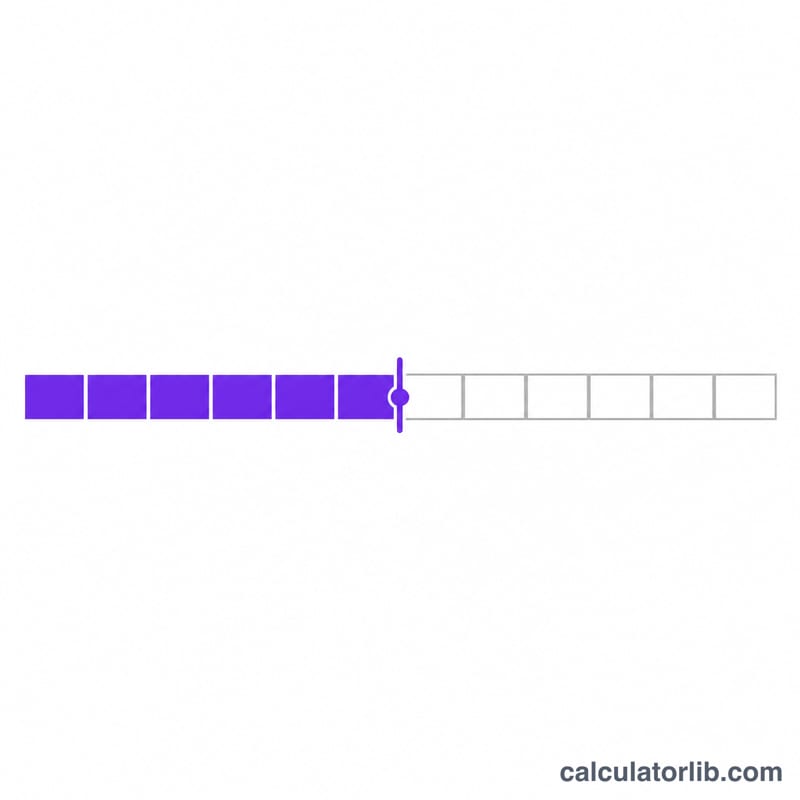
A proration calculator splits a fixed charge across only the portion of a period that actually applies. It is most often used for rent when a tenant moves in or out mid-month, but the same math works for subscriptions, insurance premiums, salaries, membership fees, and utility bills. Instead of paying for a whole month or year, you pay for the exact number of days used.
The Formula
Proration is a simple two-step calculation. First find the daily rate, then multiply by the number of days charged:
$$P = \frac{A}{D} \times d$$where \(A\) = the full period amount, \(D\) = the total number of days in the period, and \(d\) = the number of days you are actually charged for. The daily rate on its own is \(r = \frac{A}{D}\).
How to Use It
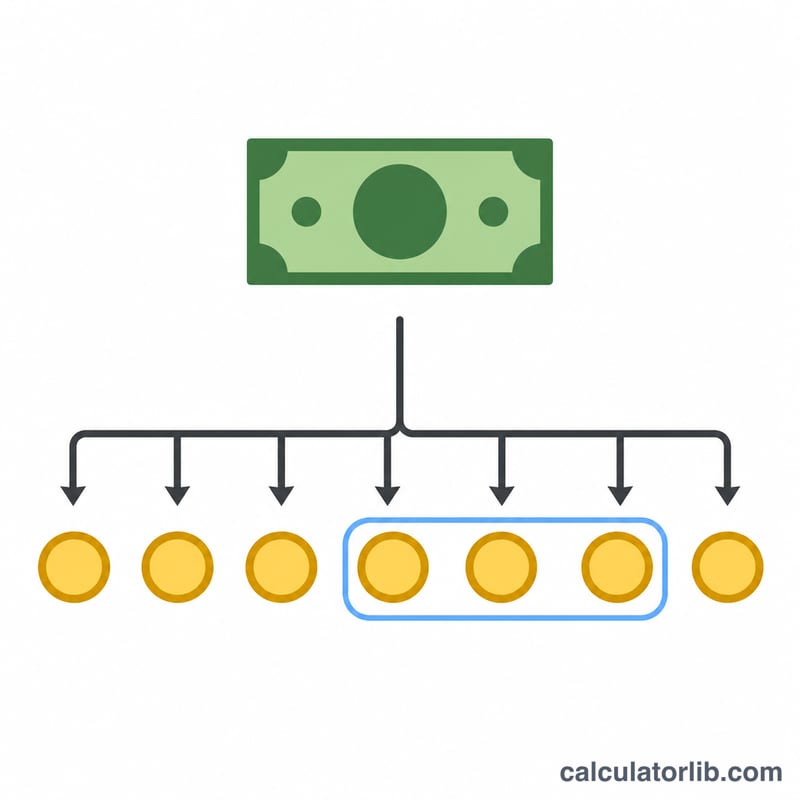
Enter the full period amount (for example, one month of rent), the total days in that period (28, 29, 30, or 31 for months, or 365 for a year), and the number of days you want to charge. The calculator returns both the prorated total and the daily rate so you can verify the split.
Worked Example
Suppose monthly rent is $1,200, the month has 30 days, and the tenant occupies the unit for 10 days:
$$r = \frac{1200}{30} = 40$$ $$P = 40 \times 10 = 400$$The tenant owes \(\$400\) for the 10 days.
Proration Scenario Comparison
Proration splits a full-period amount by the number of days it actually covers. The daily rate is the full amount divided by the total days in the period, and the prorated total multiplies that daily rate by the days you are charging:
$$\text{Prorated} = \frac{\text{Full Amount}}{\text{Total Days}} \times \text{Days Charged}$$The table below works through common cases. Note that proration conventions vary by landlord, contract, and jurisdiction: some parties prorate by the actual number of days in the specific month, while others use a fixed 30-day "banker's month" or the exact days in the calendar year. This calculator uses whatever total-days value you enter, so choose the convention that matches your agreement.
| Full Amount | Total Days in Period | Days Charged | Daily Rate | Prorated Total |
|---|---|---|---|---|
| $1,200 (monthly rent) | 30 | 10 | $40.00 | $400.00 |
| $1,200 (monthly rent) | 30 | 15 | $40.00 | $600.00 |
| $1,200 (monthly rent) | 30 | 20 | $40.00 | $800.00 |
| $1,200 (monthly rent) | 31 | 15 | $38.71 | $580.65 |
| $180 (annual subscription) | 365 | 90 | $0.49 | $44.38 |
Refund (unused days). Proration also works in reverse to compute a refund for days not used. Suppose a $1,200 monthly service is cancelled after 20 of 30 days. The 10 unused days are refunded at the same $40.00 daily rate:
$$\text{Refund} = \frac{\$1{,}200}{30} \times 10 = \$40.00 \times 10 = \$400.00$$So the provider keeps $800.00 for the 20 days used and refunds $400.00 for the 10 unused days.
Same amount, different month lengths. Because months are not equal, an identical full amount produces a different daily rate depending on whether the period is a 28-, 30-, or 31-day month. Using $1,200:
| Full Amount | Total Days in Period | Daily Rate |
|---|---|---|
| $1,200 | 28 (February, common year) | $42.86 |
| $1,200 | 30 (e.g. April, June) | $40.00 |
| $1,200 | 31 (e.g. January, March) | $38.71 |
This is why the day-count convention matters: prorating the same $1,200 for 10 days yields $428.57 in a 28-day month but only $387.10 in a 31-day month. Agree on the total-days basis before calculating.
FAQ
Which day count should I use? Use the actual number of days in the specific month for the most accurate result, or 30 days if your lease specifies a banker month.
Does this work for annual fees? Yes. Set total days to 365 (or 366 in a leap year) and enter the days of coverage.
Can I prorate refunds? Absolutely. Enter the number of unused days as the days to charge to find the refundable portion.