What is final payment proration?
When an employee leaves, joins, or changes status partway through a pay or benefit period, a fixed payment such as a severance bonus, annual bonus, or allowance is often prorated. Proration means paying only the portion that corresponds to the time actually worked, rather than the full lump sum. This calculator determines that fair share from three simple inputs: the full payment amount, the number of days worked, and the total number of days in the period.
The formula explained
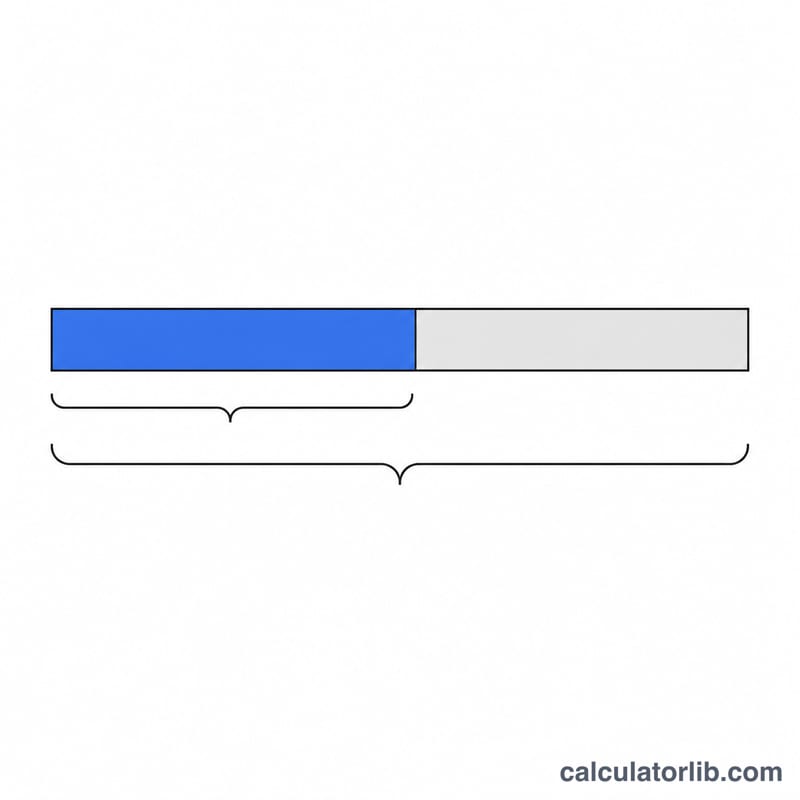
The prorated payment is the full amount multiplied by the fraction of the period worked:
$$P = A \times \frac{d}{D}$$where \(A\) = the full payment amount, \(d\) = the days worked in the period, and \(D\) = the total days in the period. The ratio \(\frac{d}{D}\) is the fraction of the period completed. The daily rate is \(r = \frac{A}{D}\), and the percent of the period worked is \(\frac{d}{D} \times 100\).
How to use it
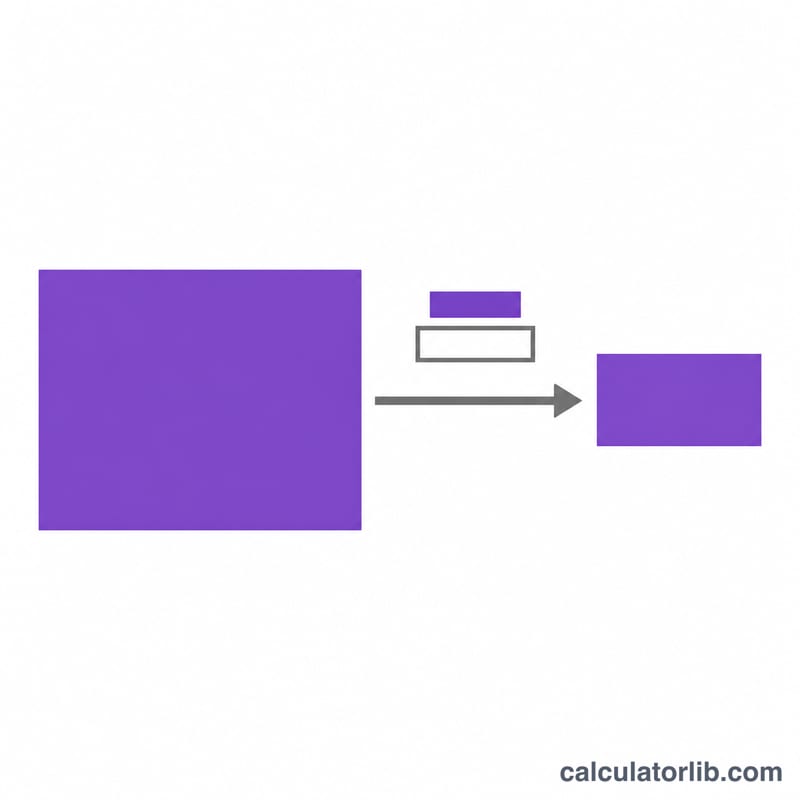
Enter the full payment that would be due for a complete period, the days the person actually worked, and the total days that make up the period (for example 30 for a month or 365 for a year). The calculator returns the prorated amount, the equivalent daily rate, and the percentage of the period worked.
Worked example
Suppose a severance bonus of $10,000 covers a 30-day period, but the employee only worked 15 of those days. The fraction worked is \(\frac{15}{30} = 0.5\), so:
$$P = \$10{,}000 \times \frac{15}{30} = \$5{,}000$$The employee is owed $5,000, exactly half of the full bonus, at a daily rate of \(r = \frac{\$10{,}000}{30} = \$333.33\) per day.
Proration Scenarios Compared
Each row applies the same proration formula, \( P = A \times \dfrac{d}{D} \), where \(A\) is the full amount, \(d\) is days worked, and \(D\) is the total days in the period. The fraction worked \(d/D\) is the share of the period completed, and the daily rate \(r = A/D\) is the value earned per day. Amounts are gross (before tax or deductions) and are rounded to the nearest cent.
| Scenario | Full amount \(A\) | Days worked \(d\) | Total days \(D\) | Fraction \(d/D\) | Daily rate \(A/D\) | Prorated \(P\) |
|---|---|---|---|---|---|---|
| Mid-month new hire | $6,000 | 12 | 30 | 0.4000 (40.0%) | $200.00 | $2,400.00 |
| Leaver at ¾ year | $12,000 | 273 | 365 | 0.7479 (74.8%) | $32.88 | $8,975.34 |
| Half-period severance | $10,000 | 15 | 30 | 0.5000 (50.0%) | $333.33 | $5,000.00 |
| Nearly-full period | $4,000 | 28 | 30 | 0.9333 (93.3%) | $133.33 | $3,733.33 |
Worked check for the new hire: \( P = \$6{,}000 \times \dfrac{12}{30} = \$6{,}000 \times 0.4 = \$2{,}400.00 \). For the ¾-year leaver: \( P = \$12{,}000 \times \dfrac{273}{365} = \$12{,}000 \times 0.74795 = \$8{,}975.34 \).
Interpreting Your Result
The prorated payment \(P\) is the share of a fixed payment \(A\) that corresponds to the fraction of the period you actually worked. It is not a new or separate award — it simply splits the full amount in proportion to time, using \( P = A \times \dfrac{d}{D} \).
- Daily rate. The quantity \( r = \dfrac{A}{D} \) is the value earned per day of the period. Multiplying it by days worked gives the same result: \( P = r \times d \). For example, a $10,000 payment over a 30-day period has a daily rate of \( \dfrac{\$10{,}000}{30} = \$333.33 \) per day.
- Percent of period completed. The value \( \dfrac{d}{D} \times 100 \) is the percentage of the period you completed. Working 15 of 30 days gives \( \dfrac{15}{30} \times 100 = 50\% \), so you receive half of the full amount.
- Gross figure. \(P\) is a gross amount — it is calculated before income tax, withholding, benefit deductions, or other adjustments. The net amount you actually receive will be lower once those are applied.
Accuracy depends on a consistent day basis: \(d\) and \(D\) must be measured the same way — either both as calendar days or both as working (business) days — matching whatever your employment contract or company policy specifies. Mixing bases (for example, working days in the numerator and calendar days in the denominator) distorts the fraction and the result. Rules for how final pay and severance are prorated vary by employer, contract, and jurisdiction, so confirm the correct day basis and rounding convention with the governing document.
This is general information, not professional advice. For decisions about a specific final payment, severance, or the tax applied to it, consult the relevant contract, policy, or a qualified professional.
FAQ
What counts as a period? Any consistent span the payment covers, such as a month, quarter, or year. Use the same unit for both days worked and total days.
Should I count calendar days or working days? Use whichever basis your contract or policy specifies, but be consistent across both inputs so the ratio is accurate.
Can it prorate a partial month for a new hire? Yes. Enter the days worked since the start date and the total days in that month to get the fair partial payment.