What this converter does
The Artificial Marble Waste to Tons Converter turns a measured volume of engineered stone (artificial marble) waste into a weight in metric tons. This is essential when planning disposal, hauling, landfill fees, or recycling, since transport and tipping costs are almost always billed by weight rather than by volume.
The formula explained
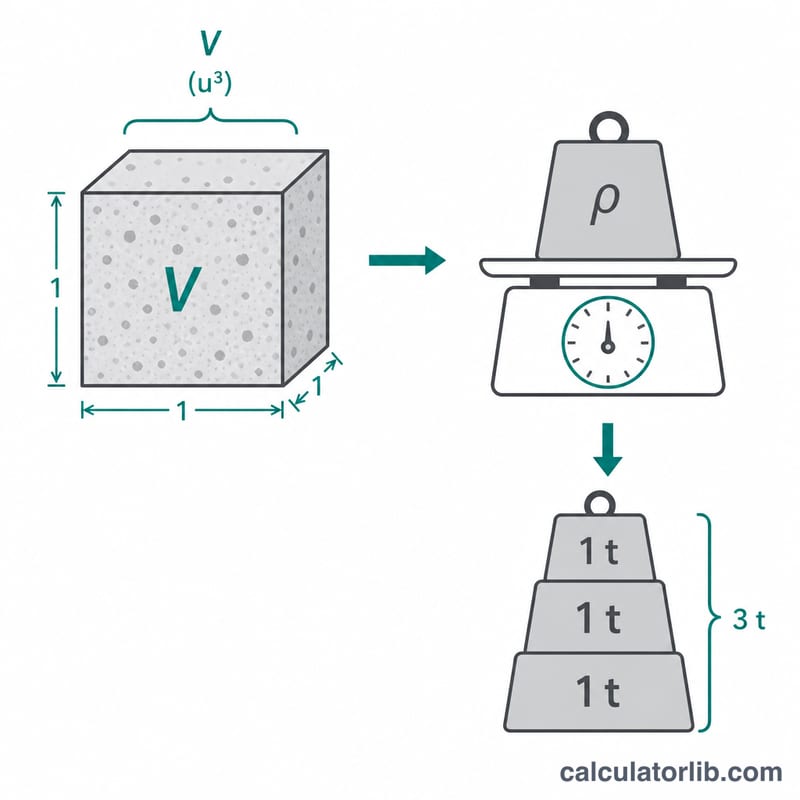
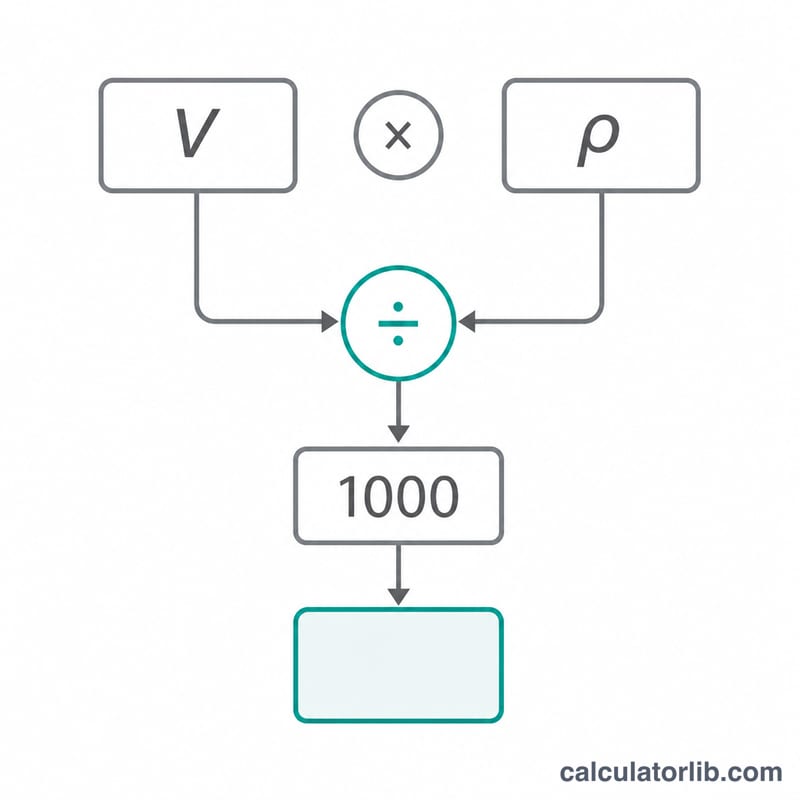
Weight is the product of volume and density. If \(V\) is the waste volume in cubic metres and \(\rho\) is the material density in kilograms per cubic metre, then the mass in kilograms is \(m = V \times \rho\). Dividing by 1000 converts kilograms to metric tons:
$$\text{Tons} = \frac{V \times \rho}{1000}$$Here \(V\) = waste volume in m³, \(\rho\) = density in kg/m³, and the result is expressed in metric tons (1 t = 1000 kg). Artificial marble typically has a density near 2400 kg/m³, though resin content and fillers can shift this.
How to use it
Enter the total waste volume in cubic metres and the material density in kilograms per cubic metre. The default density of 2400 kg/m³ is a good starting point for cured engineered stone; adjust it if your supplier provides a specific value. The calculator returns both the intermediate weight in kilograms and the final weight in metric tons.
Worked example
Suppose you have \(2\) m³ of artificial marble offcuts at a density of \(2400\) kg/m³:
$$m = 2 \times 2400 = 4800\,\text{kg}$$$$\text{Tons} = \frac{4800}{1000} = 4.8\,\text{t}$$So the waste weighs 4.8 metric tons, enough to plan a suitable skip or truck load.
Engineered Stone Density Reference
The converter multiplies your waste volume by a material density: \(\text{Tons} = \dfrac{\text{Volume (m}^3) \times \text{Density (kg/m}^3)}{1000}\). Choosing the right density is the single biggest factor in accuracy, because a solid offcut weighs far more per cubic metre than the same volume of broken rubble or wet slurry (which contain air gaps or water). The figures below are typical approximate ranges for common material types, not standardized constants — when accuracy matters, weigh a sample or ask the manufacturer for the product's stated density.
| Material / form | Typical density (kg/m³) | When to use it |
|---|---|---|
| Quartz-based engineered stone (intact slab or offcut) | ~2350–2450 | Use for whole cut-offs, sink knockouts and solid slab pieces with no significant voids. |
| Resin-heavy solid surface (acrylic/polyester, e.g. countertop material) | ~1700–1900 | Use for solid-surface offcuts, which are lighter than quartz because they contain more polymer binder and less mineral filler. |
| Crushed / loose engineered stone rubble | ~1400–1700 (bulk) | Use when the waste is broken into chunks in a skip or bin — the bulk figure is lower than solid stone because it includes air gaps between pieces. |
| Wet cutting slurry / fabrication dust | ~1300–1700 (highly variable) | Use only as a rough estimate; water content changes this a lot. Weigh a filled container where possible rather than relying on volume. |
Solid-form densities are close to the base stone; bulk densities for loose or slurried material are deliberately lower to reflect voids and moisture. If your load mixes forms — for example solid offcuts plus crushed fines — estimate each portion separately and add the tonnages.
Planning Your Disposal or Hauling
Once you have a tonnage, treat it as a planning estimate and build in a little headroom before you book a skip or truck. The steps below apply generally to any waste-hauling job; local rules and fees vary by region, so confirm the specifics with your hauler and disposal site.
- Round up to the next capacity. Skips and trucks are sold in fixed sizes, so round your result up to the next available capacity rather than ordering for the exact figure.
- Add a margin for moisture and mixed debris. Rain, wet slurry, packaging or attached substrate all add weight the clean-material density does not capture. Adding roughly 5–15% is a reasonable buffer for mixed or exposed loads.
- Check metric vs short vs long tons. This tool reports metric tons (tonnes), where \(1\ \text{tonne} = 1000\ \text{kg}\). A US short ton is about 907 kg and a UK long ton about 1016 kg, so a hauler quoting in a different unit is not measuring the same quantity — convert before comparing prices.
- Confirm the fee unit before booking. Landfill and transfer-station tipping fees may be charged per tonne, per short ton, per load or per cubic metre. Verify which unit applies, plus any minimum charge or weighbridge fee, so your volume-based estimate lines up with how you will actually be billed.
Worked example: for \(0.8\ \text{m}^3\) of solid quartz offcuts at \(2400\ \text{kg/m}^3\), \(\text{Tons} = \dfrac{0.8 \times 2400}{1000} = \) 1.92 metric tons. Adding a 10% margin for moisture and mixed debris gives about 2.1 tonnes, which is the figure to size your skip or truck against.
FAQ
What density should I use? Around 2400 kg/m³ for cured engineered stone. Check the product data sheet for an exact figure, as filler and resin ratios vary.
Are these metric or short tons? The result is in metric tons (1000 kg). Multiply by 1.1023 to approximate US short tons.
Can I use it for slurry or dust? Yes, but use the appropriate bulk density for loose or wet waste, which is lower than solid stone.