What this calculator does
The Square Meters to Linear Meters Calculator converts an area of slab or sheet material — such as granite, marble, quartz, laminate, or fabric — into the running length you would need if the material comes in a strip of fixed width. This is essential for ordering stone slabs, countertops, or roll goods, where suppliers price and cut by linear meter rather than by area.
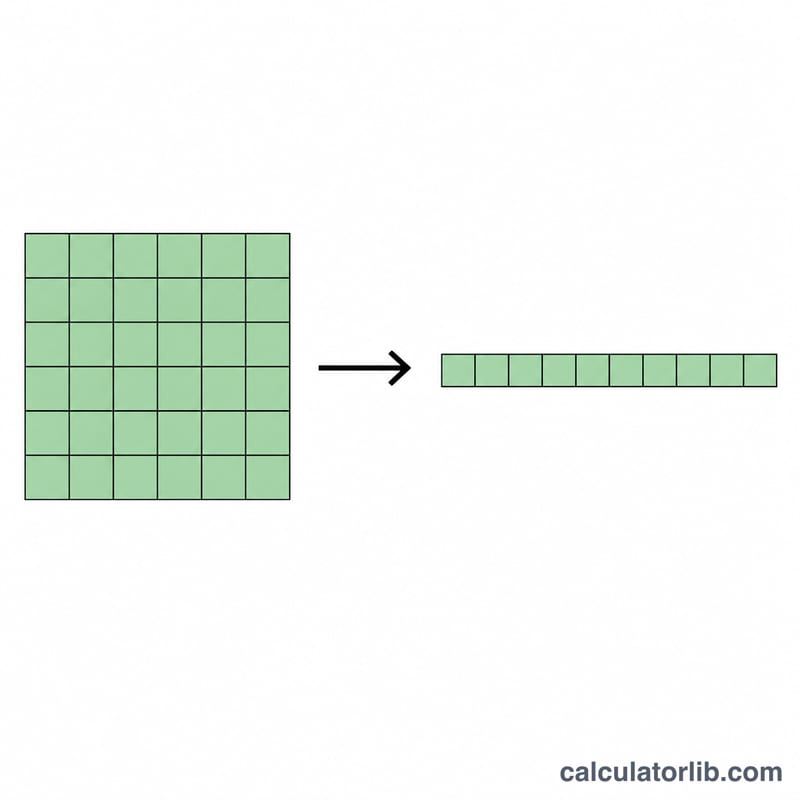
The formula explained
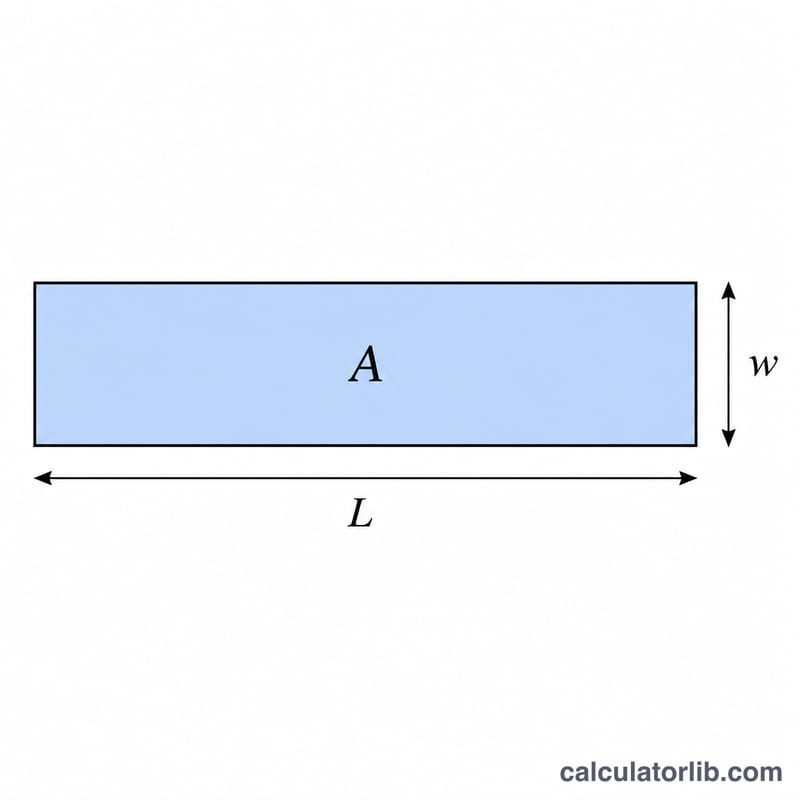
Because a rectangular strip has a constant width, its area is simply length times width. Rearranging gives the running length. The core formula is:
$$L = \frac{A}{W}$$where \(A\) = total area in square meters, \(W\) = fixed strip width in meters, and \(L\) = required linear (running) meters. Note that a larger width produces fewer linear meters for the same area.
How to use it
Enter the total area you need to cover in square meters, then enter the width of the strip or slab in meters. The calculator returns the running length in linear meters. Always confirm the usable width of your material, since edge trim can reduce the effective width.
Worked example
Suppose you need to cover \(10\) m² of countertop using a slab strip that is \(0.5\) m wide. The linear meters required are:
$$L = \frac{A}{W} = \frac{10}{0.5} = 20\,\text{m}$$So you would order 20 running meters of the 0.5 m wide strip.
Linear Meters Across Common Slab Widths
Linear (running) meters are found by dividing the area by the strip width: \(L = \dfrac{A}{W}\). Holding the area constant at 10 m² shows how the running length falls as the strip gets wider — a wider strip carries the same area in fewer running meters.
| Area (m²) | Strip width (m) | Linear meters (m) |
|---|---|---|
| 10 | 0.4 | 25 |
| 10 | 0.5 | 20 |
| 10 | 0.6 | 16.67 |
| 10 | 0.7 | 14.29 |
For example, at 0.6 m width: \(L = \dfrac{10}{0.6} = 16.67\text{ m}\), and at 0.7 m width: \(L = \dfrac{10}{0.7} = 14.29\text{ m}\). The values are rounded to two decimals.
Practical Ordering Tips
The linear-meter figure from \(L = \dfrac{A}{W}\) is a theoretical minimum. It assumes perfect, edge-to-edge use of every strip with no losses. In real fabrication you should adjust it before placing an order.
- Add a waste allowance. Add roughly 5–10% on top of the calculated length to cover saw kerf, trimming, breakage, and off-cuts. Add toward the higher end (or more) when the material has directional veining or a pattern that must be matched across pieces, since matching discards more material.
- Round up. Round the final figure up to the next whole meter, or to the supplier's minimum cut or sale increment. Many stone and slab suppliers sell only in fixed lengths or charge a minimum cut, so ordering the exact decimal value is rarely possible.
- Verify the usable width. Confirm the material's usable width after edge trim, since the raw slab or strip is often a few millimeters to a couple of centimeters wider than the finished, straight-edged width. Use the trimmed (net) width as \(W\) in the formula — using the nominal width overstates how much length you get.
- Recompute after adjusting inputs. If you change the width (for example after learning the true trimmed dimension) or split the job across pieces, re-run the calculation so the running-meter total and cost estimate stay accurate.
These are general fabrication guidelines; supplier terms, standard slab sizes, and trim allowances vary by material and region, so confirm the exact figures with your fabricator before finalizing.
FAQ
Does this account for waste or offcuts? No. It gives the theoretical running length. Add a waste allowance (commonly 5–10%) for cutting and pattern matching.
Can I use other units? Convert your area and width to consistent metric units first. Mixing meters and centimeters will give an incorrect result.
What if my width is zero? A width of zero is undefined for this conversion, so the calculator returns zero — enter a positive width.