What this calculator does
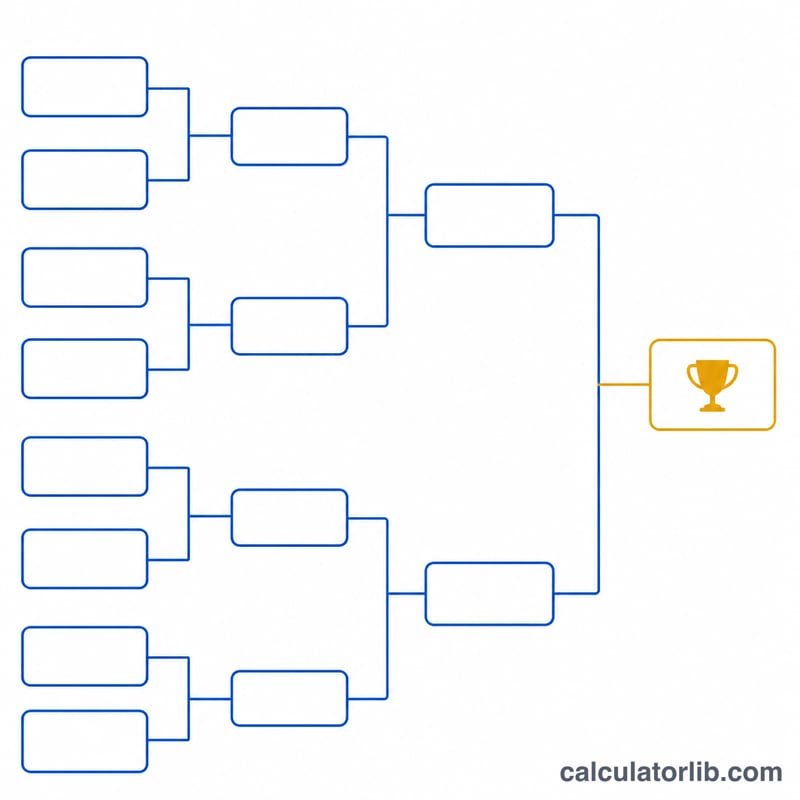
A single-elimination (knockout) tournament eliminates a competitor after one loss, so the field halves every round until one champion remains. This calculator takes your number of participants and returns the number of rounds, the bracket size, how many byes are needed, how many matches happen in the first round, and the total number of matches across the whole event.
The formula explained
Brackets are built on powers of two. If \(N\) is the number of participants, the number of rounds \(R\) is the base-2 logarithm of \(N\) rounded up:
$$R = \lceil \log_2 N \rceil$$The bracket is padded to the next power of two, \(2^{R}\), and the empty slots become byes:
$$B = 2^{R} - N$$Because every match removes exactly one player and only the champion is never removed, the total number of matches is always
$$M = N - 1$$The first round only involves players who do not receive a bye, so first-round matches \(= N - \tfrac{2^{R}}{2}\).
How to use it
Enter the total number of teams or players and read the results table. Use the bracket size to design your printable bracket, use byes to decide which top seeds skip round one, and use total matches to plan venue time and scheduling.
Worked example
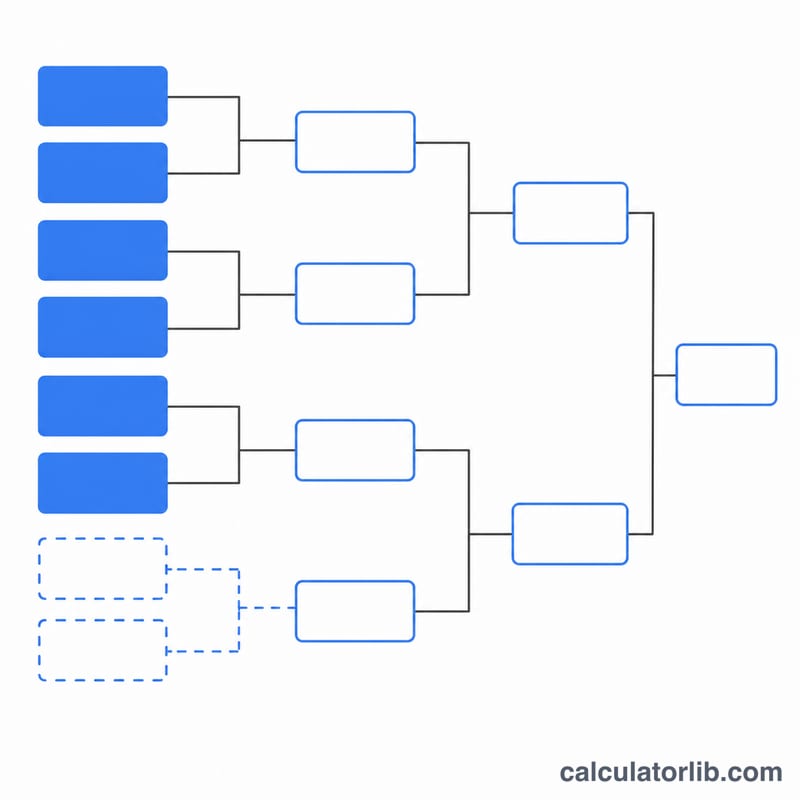
Suppose \(N = 6\) players. Then \(R = \lceil \log_2 6 \rceil = 3\) rounds and the bracket size is \(2^3 = 8\).
$$B = 8 - 6 = 2 \text{ byes}$$$$M = 6 - 1 = 5 \text{ matches}$$First-round matches \(= 6 - \tfrac{8}{2} = 2\). So two matches are played in round one while two seeded players wait on byes, giving four players in round two.
FAQ
Why is the total always N minus 1? Every match eliminates one player, and all but the winner must be eliminated, so \(N-1\) matches are always required.
What is a bye? A bye is a free pass to the next round, given when the participant count is not an exact power of two.
Does seeding change the math? No. Seeding changes who plays whom, but rounds, byes and total matches depend only on the participant count.