What is the KPSS Score Calculator?
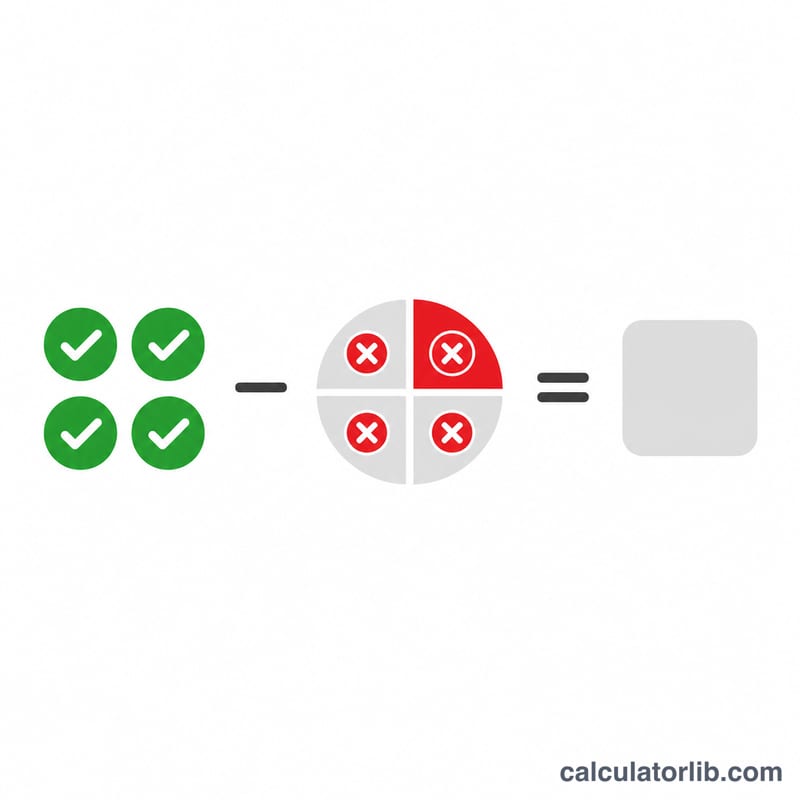
The KPSS (Kamu Personel Seçme Sınavı) is the Turkish public personnel selection exam. This calculator turns the number of correct and wrong answers you gave on the Genel Yetenek (General Ability) and Genel Kültür (General Culture) sections into your net scores and a quick estimated total. Like most Turkish standardized tests, KPSS applies a penalty: every four wrong answers cancel one correct answer, so guessing blindly can lower your net.
The formula explained
The net score for each section is the number of correct answers minus a quarter of the wrong answers:
$$\text{Net} = \text{Correct} - \frac{\text{Wrong}}{4}$$Here \(\text{Correct}\) is the count of right answers and \(\text{Wrong}\) is the count of wrong answers in that section. The two section nets are added to give the total net (out of 120 for the lisans level, where each section has 60 questions). The estimated score maps that total onto a 20-100 scale:
$$\text{Score} = 20 + \frac{\text{Total Net}}{120} \times 80$$Note the real KPSS score is a statistical standard score computed from all candidates' results, so the value here is an approximation for planning, not an official figure.
How to use it
Count your correct and wrong answers for each section from your answer key, enter the four values, and read your section nets, total net, and estimated score. Leave blank answers out entirely, since only wrong answers carry a penalty.
Worked example
Suppose you scored 40 correct and 20 wrong in GY, and 30 correct and 20 wrong in GK:
$$\text{GY Net} = 40 - \frac{20}{4} = 35$$$$\text{GK Net} = 30 - \frac{20}{4} = 25$$The total net is \(35 + 25 = 60\), giving an estimated score of \(20 + \frac{60}{120}\times 80 = 60\).
How Wrong Answers Affect Your Net: A Scenario Comparison
The Turkish KPSS uses a quarter-penalty: every four wrong answers cancel one correct answer in a section, using \(N = \text{Correct} - \dfrac{\text{Wrong}}{4}\). The four candidates below all answer 40 questions correctly per section (except the last), but differ in how many of the remaining questions they guess versus leave blank. The estimated score comes from \(\text{Score} = 20 + \dfrac{N}{120} \times 80\), where \(N\) is the combined Genel Yetenek (GY) and Genel Kültür (GK) net out of 120.
| Scenario | GY (correct / wrong) | GK (correct / wrong) | GY net | GK net | Total net (/120) | Estimated score (20–100) |
|---|---|---|---|---|---|---|
| Answers only what they know (rest blank) | 40 / 0 | 40 / 0 | 40.00 | 40.00 | 80.00 | 73.33 |
| Some guessing | 40 / 8 | 40 / 8 | 38.00 | 38.00 | 76.00 | 70.67 |
| Guesses every remaining question | 40 / 20 | 40 / 20 | 35.00 | 35.00 | 70.00 | 66.67 |
| Blank-heavy (leaves many unanswered) | 30 / 0 | 30 / 0 | 30.00 | 30.00 | 60.00 | 60.00 |
Two effects are visible. First, wrong answers erode net: going from 0 to 20 wrong per section (rows 1 and 3) costs 10 net points and about 6.7 points of estimated score, even though correct answers are unchanged. Second, leaving questions blank avoids the penalty but forfeits the points those questions could have earned — the blank-heavy candidate loses ground purely by attempting fewer questions. Note that a single wrong answer only removes \(\tfrac{1}{4}\) of a point, so a guess is net-positive on average only when you can eliminate enough options to beat that penalty.
Interpreting Your KPSS Net and Estimated Score
These figures apply to the Turkish KPSS (Kamu Personel Seçme Sınavı), specifically the Lisans (bachelor's) level General Ability–General Culture test. At this level each section contains 60 questions — 60 Genel Yetenek and 60 Genel Kültür — so the combined net is out of 120. The section net is computed as \(N = \text{Correct} - \dfrac{\text{Wrong}}{4}\), and this tool adds the two section nets to give the total out of 120.
The 20–100 value this tool reports is a simple linear approximation: it maps a total net of 0 to 20 and a total net of 120 to 100 using \(\text{Score} = 20 + \dfrac{N}{120} \times 80\). It is only an estimate of scale and is not the official standardized (statistical) KPSS puan. The official score is a standardized value calculated by ÖSYM using the distribution of all candidates' results in that exam — it depends on how everyone else performed (for example the mean and standard deviation of the nets), so the same net can correspond to a different official puan in different years.
Finally, whether a given score leads to placement (atama) is not determined here. Placement depends on year- and position-specific cutoff (taban) scores, the quota for each posting, and the pool of applicants who prefer it — none of which this tool knows or computes. Use these numbers to understand how your correct, wrong and blank answers translate into net points and roughly where they sit on a 20–100 scale, and consult the official ÖSYM results and placement guides for authoritative scores and cutoffs.
FAQ
Do blank answers hurt my score? No. Only wrong answers reduce your net; unanswered questions are neutral.
Why four wrong per one correct? That is the standard penalty ratio used to discourage random guessing on the exam.
Is the estimated score my official KPSS result? No. Official scores use a statistical standardization across all test takers; this is a fast approximation.