What Is the Futures Tick Value Calculator?
A tick is the smallest price increment a futures contract can move. The dollar impact of a single tick depends on the contract's point value (the dollar value of a full 1.00 point move). This calculator turns tick size, point value, and a number of ticks into a clear dollar figure, so you can size positions and estimate profit or loss quickly.
The Formula Explained
The value of one tick and the total value across several ticks are found with:
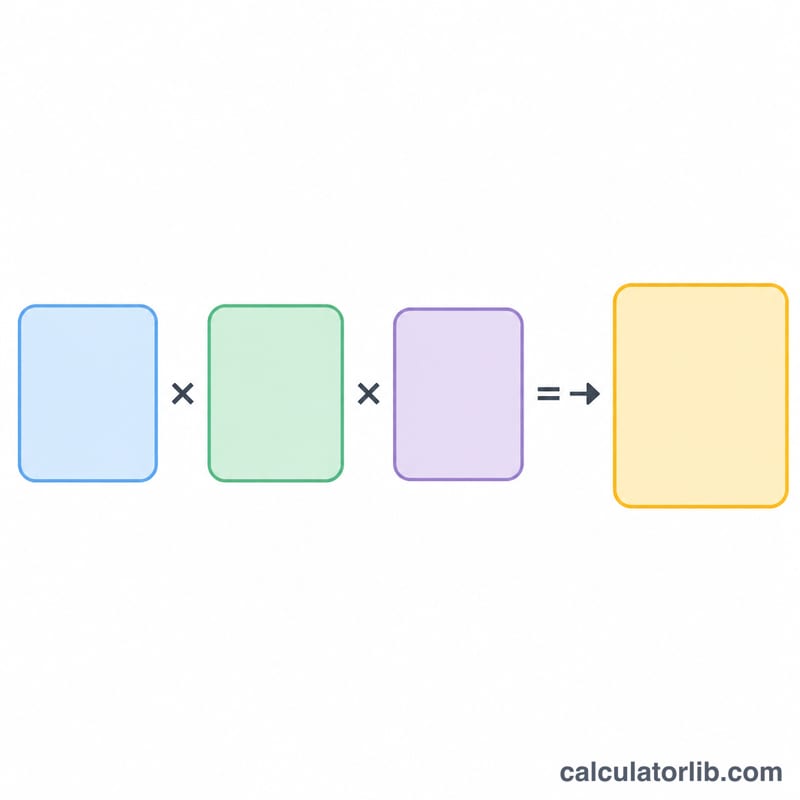
$$\text{Total} = \text{Tick Size} \times \text{Point Value} \times \text{Ticks}$$Here \(\text{Tick Size}\) is the minimum price increment, \(\text{Point Value}\) is the dollars earned per full 1.00 move, and \(\text{Ticks}\) is how many increments the price traveled. The value of a single tick is \(\text{Tick Size} \times \text{Point Value}\).
How to Use It
Enter the tick size (for example \(0.25\)), the point value (for example \(50\) dollars for the E-mini S&P 500), and the number of ticks the market moved. The calculator returns the value per tick and the total dollar value.
Worked Example
For an E-mini S&P 500 contract with a tick size of \(0.25\), a point value of $50, and a move of 8 ticks:
$$\text{Tick Value} = 0.25 \times 50 = \$12.50$$$$\text{Total} = 12.50 \times 8 = \$100.00$$So an 8-tick move is worth $100 per contract.
Standard Futures Contract Specifications
The table below lists widely-published specifications for several commonly traded futures contracts. These are US-exchange products standardized by CME Group (CME, CBOT and NYMEX divisions). The value per tick is simply the tick size multiplied by the point value (multiplier), which is exactly what this calculator computes with \(\text{num\_ticks} = 1\). Contract specifications are set by the exchange and can change, so always confirm the current spec on the official contract page before trading.
| Contract | Tick size | Point value / multiplier | Value per tick |
|---|---|---|---|
| ES — E-mini S&P 500 | 0.25 index points | $50 per point | $12.50 |
| MES — Micro E-mini S&P 500 | 0.25 index points | $5 per point | $1.25 |
| NQ — E-mini Nasdaq-100 | 0.25 index points | $20 per point | $5.00 |
| CL — Crude Oil (WTI) | 0.01 per barrel | $1,000 per point | $10.00 |
| GC — Gold | 0.10 per troy ounce | $100 per point | $10.00 |
| ZB — 30-Year U.S. T-Bond | 1/32 of a point (0.03125) | $1,000 per point | $31.25 |
| 6E — Euro FX | 0.00005 per euro | $125,000 per point | $6.25 |
For example, the E-mini S&P 500 (ES) value per tick follows directly from the formula: \(0.25 \times \$50 = \$12.50\). The 30-Year T-Bond (ZB) is quoted in 32nds, so its tick size of \(1/32 = 0.03125\) point times \(\$1{,}000\) gives \(\$31.25\) per tick.
More Worked Examples
Each example first finds the value of a single tick (tick size × point value), then multiplies by the number of ticks. All contracts below are US CME Group products.
-
Crude Oil (CL) — 15 ticks. CL has a tick size of 0.01 and a point value of $1,000, so one tick is worth $10. Moving 15 ticks:
$$\text{Total Value} = 0.01 \times \$1{,}000 \times 15 = \$150$$The result is $150.
-
Gold (GC) — 8 ticks. GC has a tick size of 0.10 and a point value of $100, so one tick is worth $10. Over 8 ticks:
$$\text{Total Value} = 0.10 \times \$100 \times 8 = \$80$$The total is $80.
-
Micro E-mini S&P 500 (MES) — 20 ticks. MES has a tick size of 0.25 and a point value of $5, so one tick is worth $1.25. Over 20 ticks:
$$\text{Total Value} = 0.25 \times \$5 \times 20 = \$25$$The total is $25.
FAQ
What is point value? It is the dollar value of a full 1.00 price move for one contract, sometimes called the big point value or contract multiplier.
Why not just use tick value directly? Tick value is derived from tick size and point value, so entering both keeps the tool accurate across different contracts.
Does this include fees? No, it reports gross tick value only; commissions and exchange fees are separate.