What is the Defined Daily Dose?
The Defined Daily Dose (DDD) is the WHO measurement unit for the assumed average maintenance dose per day for a drug used for its main indication in adults. It is a technical unit of measurement fixed by the WHO Collaborating Centre for Drug Statistics Methodology, allowing drug consumption to be compared across products, hospitals and countries independently of price, package size or strength.
How to use this calculator
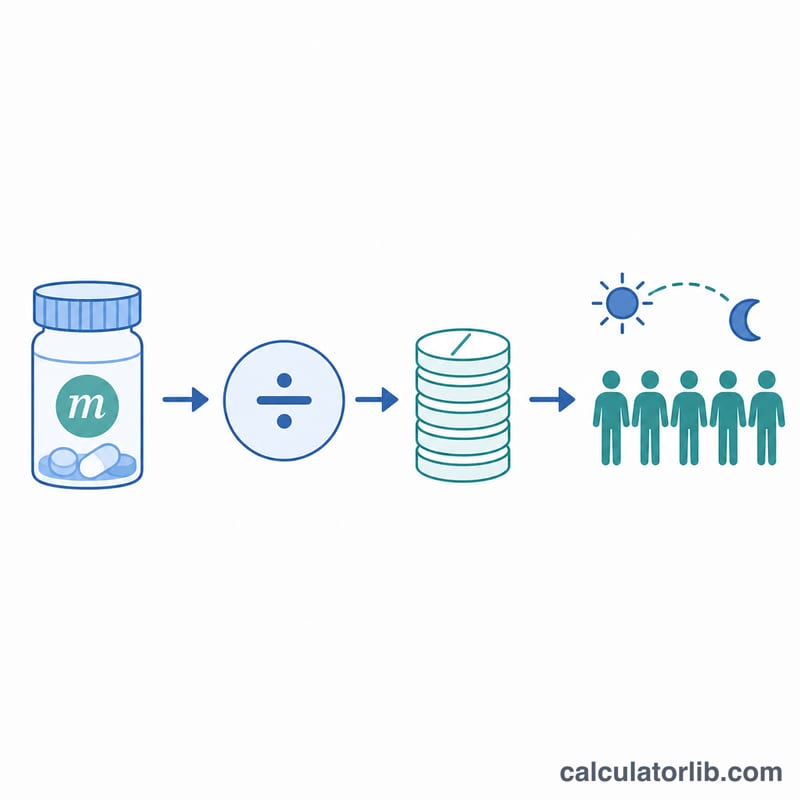
Enter the total quantity of the active ingredient consumed over your study period (in mg) and the standard DDD value for that substance (also in mg). Optionally add the population and the number of days in the period to obtain the standardised DID metric.
The formula explained
The number of defined daily doses is simply the total consumption divided by the DDD:
$$\text{DDDs} = \frac{Q}{\text{DDD}}$$where \(Q\) = total quantity of active ingredient consumed (mg) and \(\text{DDD}\) = standard defined daily dose (mg). To standardise for population and time, the DDD per 1000 inhabitants per day is:
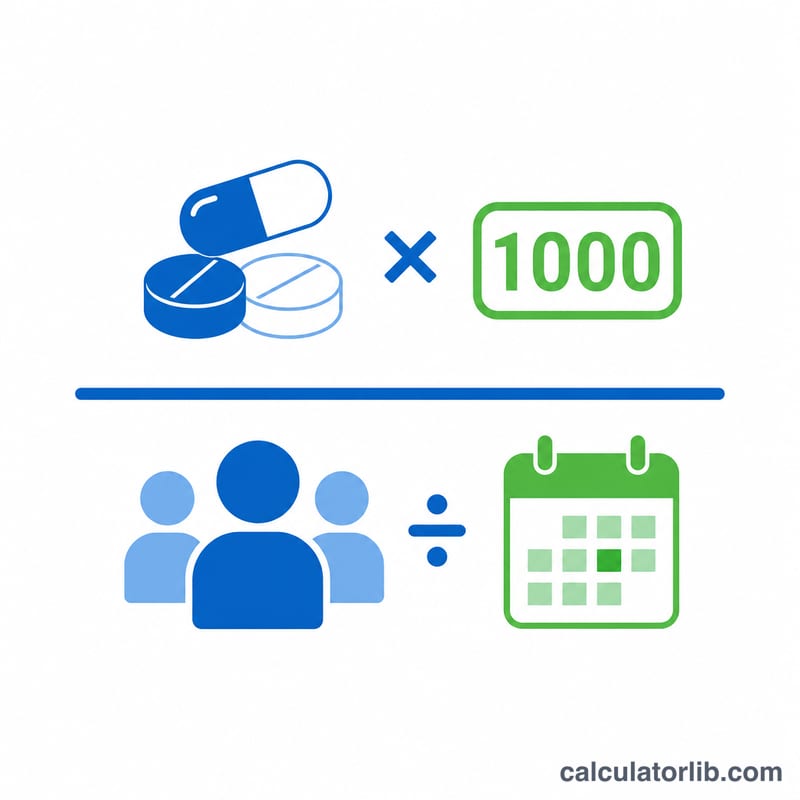
$$\text{DID} = \frac{\text{DDDs} \times 1000}{P \times D}$$with \(P\) = number of inhabitants and \(D\) = number of days in the period.
Worked example
Suppose 3,650,000 mg of a drug are consumed in a year by a population of 10,000, and the DDD is 100 mg:
$$\text{DDDs} = \frac{3{,}650{,}000}{100} = 36{,}500$$$$\text{DID} = \frac{36{,}500 \times 1000}{10{,}000 \times 365} = 10.0$$So 10 DDD per 1000 inhabitants per day are used, meaning about 1% of the population receives the standard dose each day.
Interpreting Your DID Result
The headline output of this calculator is DID — DDDs per 1000 inhabitants per day. It expresses how many standard daily doses were consumed each day for every 1000 people in the population, and is computed as:
$$\text{DID} = \frac{N \times 1000}{\text{Population} \times \text{Days}}, \qquad N = \frac{\text{Total Quantity (mg)}}{\text{Standard DDD (mg)}}$$Because one DDD is meant to approximate one person's daily treatment, DID can be read as a rough estimate of the share of the population treated at the standard dose on any given day: a value of 10 DID means about 10 in every 1000 people — roughly 1% — receive the standard daily dose each day. So 50 DID suggests approximately 5% of the population is treated daily.
For example, if a region of 100,000 people dispensed 730,000,000 mg of metformin (standard DDD 2000 mg) over 365 days, that is 365,000 DDDs, giving a result of 10 DID — consistent with about 1% of that population on standard-dose metformin daily.
The strength of DID is comparability. Because it is built on a fixed international unit rather than on cost, package size, or the specific strength of a product, it lets you compare drug utilisation across regions or countries, track it over time, and compare different products or formulations of the same substance on a common scale — something raw sales figures or tablet counts cannot do.
An important caveat: the DDD and DID are statistical units of measurement, not clinical recommendations. The DDD is a technical unit for aggregate drug-utilisation research; it is not the prescribed dose for any individual, does not necessarily equal the dose a patient actually takes, and does not reflect recommended or effective dosing for a given person or indication. Actual clinical doses vary with age, weight, renal function, indication, and local prescribing practice. DID should be used for measuring and comparing consumption patterns, not as guidance for prescribing or taking medicines. This is general informational content and not professional medical advice; consult a qualified clinician or pharmacist for individual dosing decisions.
FAQ
Is the DDD a recommended dose? No. It is a fixed statistical unit, not a prescribing or clinical recommendation.
What units should I use? Keep the consumed quantity and the DDD in the same unit (usually mg) so the ratio is dimensionless.
What does DID mean? DID stands for DDD per 1000 inhabitants per day, a common way to report ambulatory drug utilisation.