What this calculator does
The Microwave Water Heating Temperature Calculator estimates how hot a quantity of water becomes after heating it in a microwave oven. It combines the electrical energy your oven delivers with the physics of specific heat capacity to predict the final temperature, which is useful for making tea, warming baby bottles, or running kitchen experiments.
The formula explained
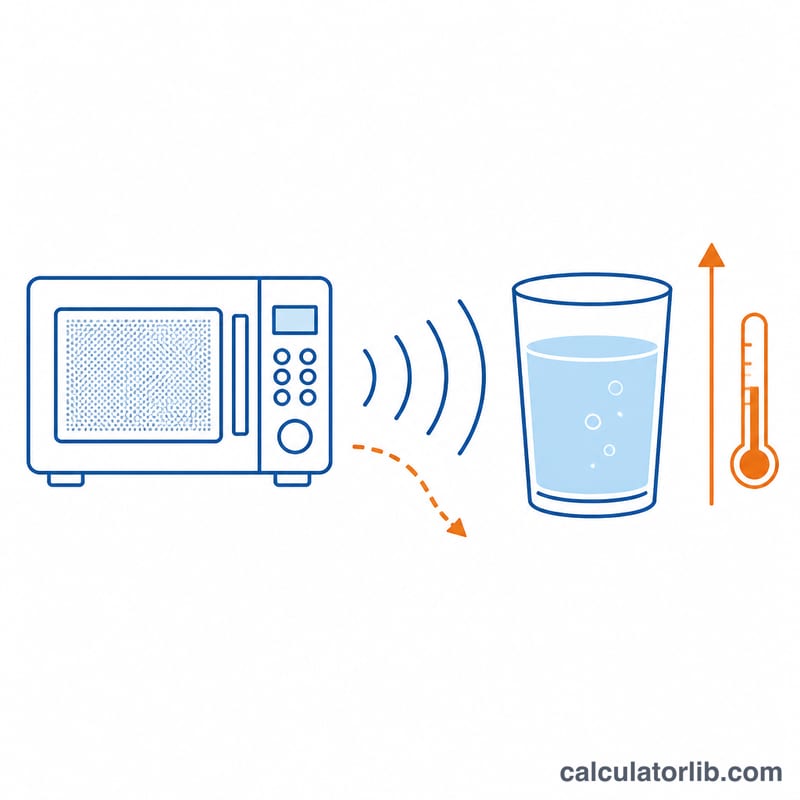
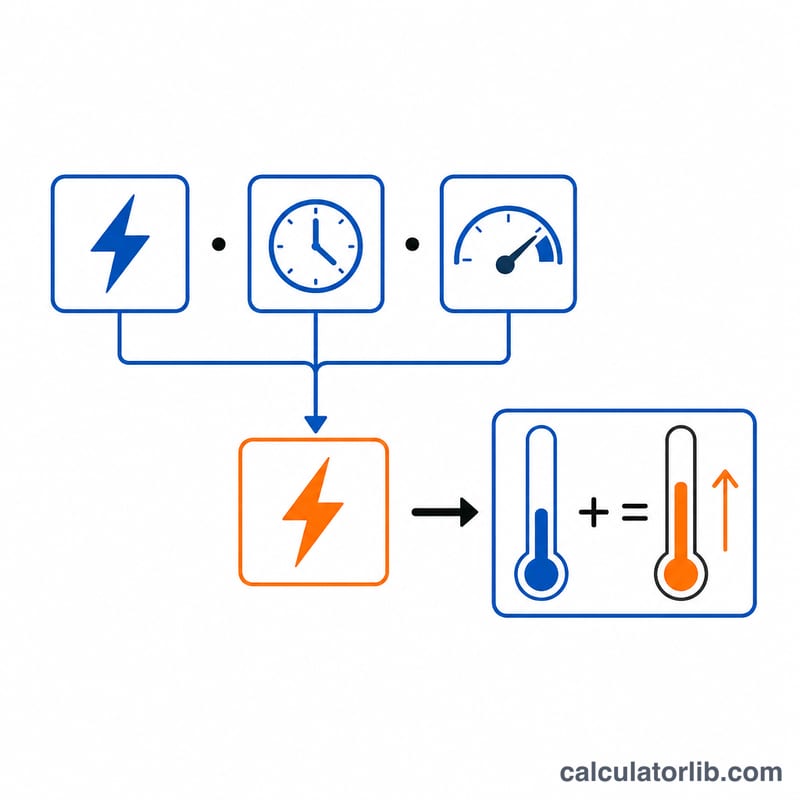
The heat absorbed by water follows \(Q = m \times c \times \Delta T\), where \(m\) = water mass in grams, \(c\) = specific heat capacity of water (about \(4.186\ \text{J/g}\cdot\text{°C}\)), and \(\Delta T\) = temperature rise. The useful energy is \(E = P \times t \times \eta\), with \(P\) = power in watts, \(t\) = time in seconds, and \(\eta\) = efficiency as a fraction. Rearranging gives the final temperature:
$$T_f = T_0 + \frac{P \times t \times \eta}{m \times c}$$Here \(T_0\) is the starting temperature. Efficiency matters because microwaves lose energy to the cavity, container, and reflected power, so only part of the rated wattage reaches the water.
How to use it
Enter the water mass in grams (1 mL of water ≈ 1 g), the initial temperature, the oven's rated power, the heating time in seconds, and an efficiency estimate (50–65% is typical). The calculator returns the temperature rise, useful energy, and predicted final temperature.
Worked example
Heat \(250\,\text{g}\) of water at \(20\,{}^\circ\text{C}\) in an \(800\,\text{W}\) oven for \(60\,\text{s}\) at \(60\%\) efficiency:
$$E = 800 \times 60 \times 0.60 = 28800\,\text{J}$$$$\Delta T = \frac{28800}{250 \times 4.186} = 27.5\,{}^\circ\text{C}$$$$T_f = 20 + 27.5 = 47.5\,{}^\circ\text{C}$$Temperature & Volume Conversions
Results from this calculator are in degrees Celsius. To convert to Fahrenheit, use \(T_{°F} = T_{°C} \cdot \frac{9}{5} + 32\). The table lists several representative result temperatures.
| Temperature (°C) | Temperature (°F) |
|---|---|
| 20 | 68.0 |
| 40 | 104.0 |
| 47.5 | 117.5 |
| 60 | 140.0 |
| 80 | 176.0 |
| 100 | 212.0 |
The calculator asks for the water's mass in grams, but you usually measure water by volume. For liquid water the density is very close to 1 g/mL near room temperature, so you can use the approximation \(1\ \text{mL} \approx 1\ \text{g}\). (This is an approximation: water is densest near 4 °C and expands slightly as it warms, so hot water is a little lighter per mL — but the difference is under about 4% up to boiling and negligible for kitchen estimates.)
| Volume of water | Approx. mass (g) |
|---|---|
| 250 mL | 250 |
| 500 mL | 500 |
| 1000 mL (1 L) | 1000 |
Power note: oven power is entered in watts, and \(1\ \text{W} = 1\ \text{J/s}\). That is why multiplying power (W) by time (s) yields energy in joules: \(\text{W} \cdot \text{s} = \frac{\text{J}}{\text{s}} \cdot \text{s} = \text{J}\), which is exactly the \(E\) term used in the temperature formula.
FAQ
Why is efficiency below 100%? Rated wattage is electrical input; energy is lost to the container, cavity, and reflection, so water absorbs only part of it.
Can the result exceed 100 °C? The math is linear, but real water boils at \(100\,{}^\circ\text{C}\); a higher estimate simply means the water reaches boiling.
Does container type matter? Yes—materials that absorb microwaves lower the effective efficiency reaching the water.