What is a knock-out warrant?
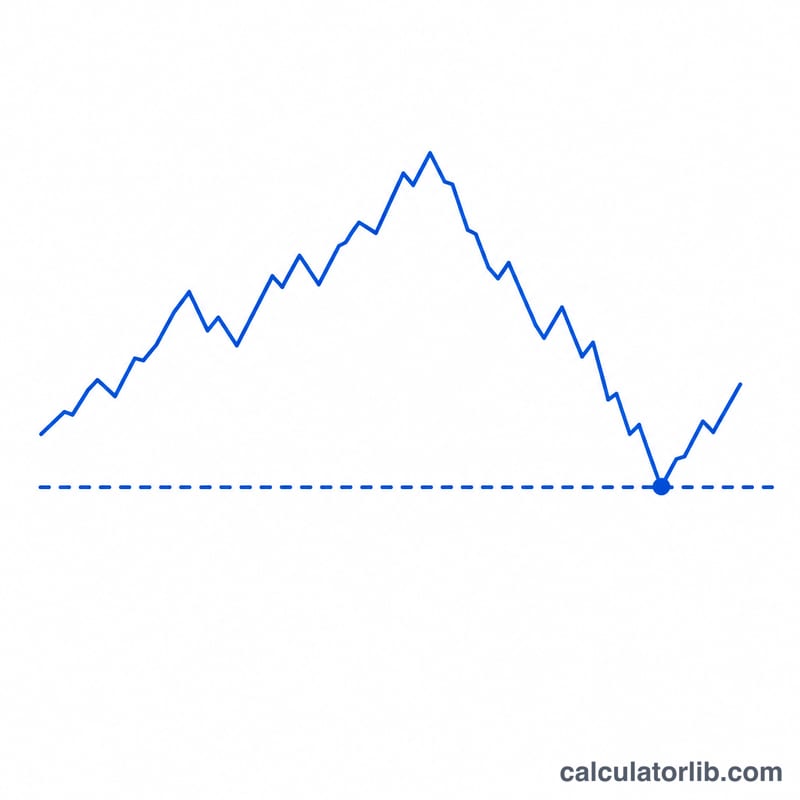
A knock-out warrant (also called a turbo or turbo certificate) is a leveraged product that tracks an underlying asset such as a share, index, or commodity. Because it carries almost no time value, its price is close to its intrinsic value, and it expires worthless the moment the underlying touches a predefined knock-out barrier. This calculator estimates the three numbers traders check first: leverage, breakeven price, and the barrier level.
How to use it
Choose whether the warrant is Long (profits when the underlying rises) or Short (profits when it falls). Enter the current underlying price, the strike or financing level, the subscription ratio (units of underlying per warrant), and an optional barrier buffer in percent. The calculator returns the warrant price per unit, the leverage, the breakeven, and the knock-out barrier level.
The formula explained
The intrinsic value per unit is \(P = \lvert S - K \rvert \times r\), where \(S\) is the underlying price, \(K\) the strike and \(r\) the ratio. Leverage measures how much more your money moves compared with holding the underlying directly:
$$\text{Leverage} = \frac{S}{\lvert S - K \rvert}$$
The knock-out barrier sits at \(B = K \times (1 + b)\) for a long turbo and \(B = K \times (1 - b)\) for a short one, with \(b\) the buffer as a decimal.
Worked example
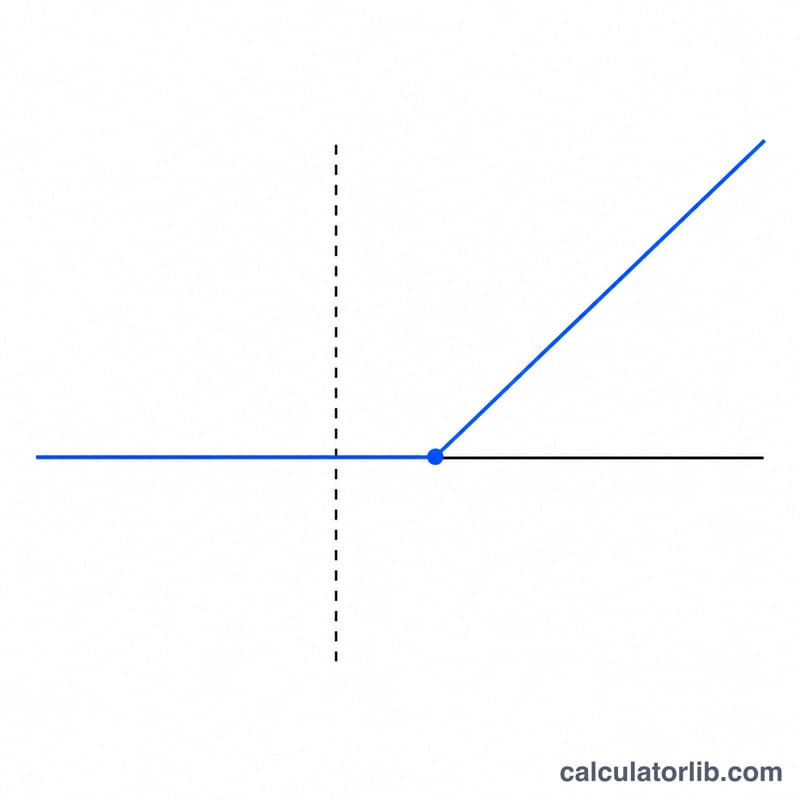
Take a long turbo with underlying \(S = 100\), strike \(K = 80\), ratio \(r = 1\) and no buffer:
$$P = (100 - 80) \times 1 = 20$$ $$\text{Leverage} = \frac{100}{\lvert 100 - 80 \rvert} = 5$$
The breakeven equals \(80 + 20 = 100\) and the barrier equals \(80\). Every 1% move in the underlying moves the warrant by roughly 5%.
Leverage & Barrier Across Scenarios
The following rows use \(P = |S-K|\times r\), \(\text{Leverage} = \dfrac{S}{|S-K|}\), breakeven \(= K \pm \dfrac{P}{r}\) (\(+\) long, \(-\) short), and barrier \(B = K\left(1+\dfrac{b}{100}\right)\). "% move to KO" is \(\dfrac{B-S}{S}\): negative means the underlying must fall, positive means it must rise. Notice how a strike far from \(S\) gives low leverage and a distant barrier, while a strike close to \(S\) gives high leverage and a nearby barrier.
| S | K | Direction | r | Buffer b | Price P | Leverage | Breakeven | Barrier B | % move to KO |
|---|---|---|---|---|---|---|---|---|---|
| 100 | 60 | Long | 1 | 0 | 40.00 | 2.5 | 100 | 60.00 | −40.0% (fall) |
| 100 | 90 | Long | 1 | 0 | 10.00 | 10.0 | 100 | 90.00 | −10.0% (fall) |
| 100 | 90 | Long | 1 | 3 | 10.00 | 10.0 | 100 | 92.70 | −7.3% (fall) |
| 100 | 140 | Short | 1 | 0 | 40.00 | 2.5 | 100 | 140.00 | +40.0% (rise) |
| 100 | 110 | Short | 1 | 0 | 10.00 | 10.0 | 100 | 110.00 | +10.0% (rise) |
| 15,000 | 14,000 | Long | 0.01 | 0 | 10.00 | 15.0 | 15,000 | 14,000.00 | −6.7% (fall) |
The relationship is direct: the closer the strike is to the underlying, the higher the leverage — but the barrier is also closer, so a smaller adverse move wipes the warrant out. The rows with \(K=60\) and \(K=140\) show wide safety margins (40% moves) with modest 2.5× leverage; the rows with a 10-point gap show 10× leverage but only a 10% cushion.
Key Terms & Variables
- Underlying price (S) — the current market price of the asset the warrant tracks (a stock, index, commodity, or currency). It appears in every formula: it sets the intrinsic value through \(|S-K|\) and is the numerator of the leverage ratio.
- Strike / financing level (K) — the reference price the issuer finances. For a long turbo \(K<S\); for a short turbo \(K>S\). It defines intrinsic value \(|S-K|\) and anchors both the breakeven and the barrier.
- Subscription ratio (r) — the number of units of the underlying represented by one warrant (e.g. \(r=0.01\) means 100 warrants cover one index point). It scales the price \(P=|S-K|\times r\) and divides into the breakeven adjustment \(\dfrac{P}{r}\).
- Barrier buffer (b) — a percentage offset (often 0) that shifts the knock-out barrier away from the strike, giving the issuer a margin. It enters as \(B = K\left(1+\dfrac{b}{100}\right)\); a positive \(b\) raises the barrier above the strike.
- Knock-out barrier (B) — the price level that, once touched by the underlying, terminates the warrant (usually near-worthless). For a long turbo it lies at or above the strike; for a short turbo, at or below it.
- Leverage — \(\dfrac{S}{|S-K|}\): how many times more the warrant moves, in percentage terms, than the underlying. It rises sharply as the strike approaches \(S\).
- Breakeven — the underlying price at which the position neither gains nor loses: \(K+\dfrac{P}{r}\) (long) or \(K-\dfrac{P}{r}\) (short). For a pure-intrinsic turbo this equals \(S\) at issue.
- Intrinsic value — \(|S-K|\) per unit of underlying, or \(|S-K|\times r\) per warrant. Knock-out warrants carry little or no time value, so their price is essentially this amount.
- Long vs. short turbo — a long (call-type) turbo gains when the underlying rises and knocks out on a fall to \(B\); a short (put-type) turbo gains when the underlying falls and knocks out on a rise to \(B\). The choice sets whether the breakeven uses \(+\) or \(-\) and on which side of \(K\) the barrier sits.
FAQ
Why is the breakeven equal to the underlying price? A pure knock-out warrant has virtually no time premium, so its cost is just the intrinsic value; you break even when the underlying returns to today price.
What happens if the barrier is hit? The warrant is knocked out and typically expires with little or no residual value, so the position closes immediately.
Does higher leverage mean higher risk? Yes. A strike close to the underlying gives high leverage but a nearby barrier, which knocks out on a small adverse move.