What Is a Knock-Out Certificate?
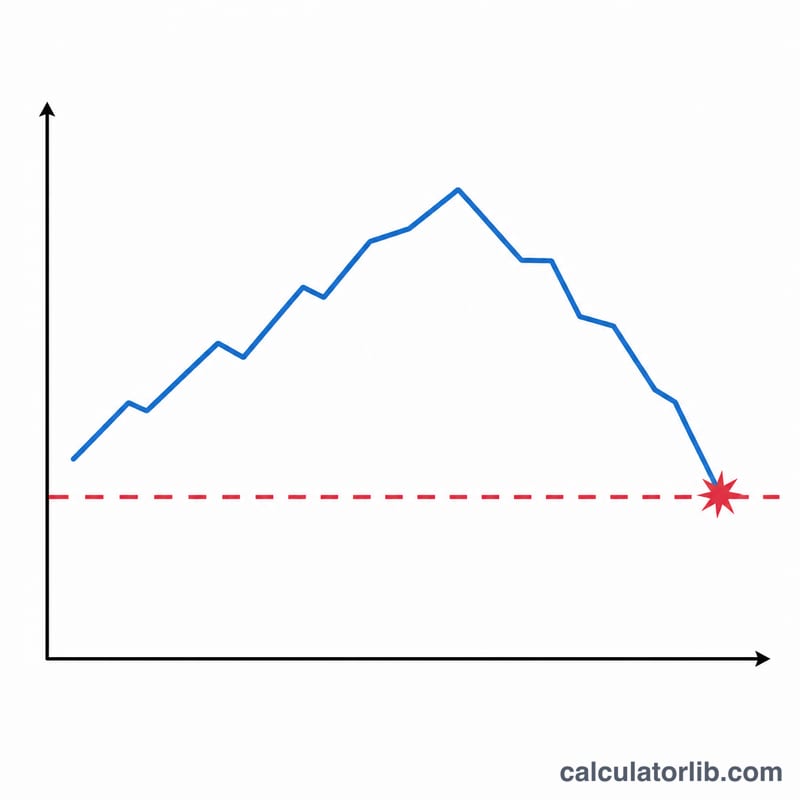
A knock-out certificate (also called a turbo warrant or turbo certificate) is a leveraged product that tracks an underlying asset with a built-in barrier. If the underlying trades through the knock-out level, the product expires and most or all of the invested capital is lost. Because you only fund the difference between the underlying price and the strike, a small stake controls a large exposure.
The Formulas
With underlying price \(S\), strike (financing level) \(K\), certificate price \(P\) and subscription ratio \(r\), the leverage is:
$$L = \frac{S \times r}{P}$$For a long turbo the breakeven underlying level and the knock-out threshold are:
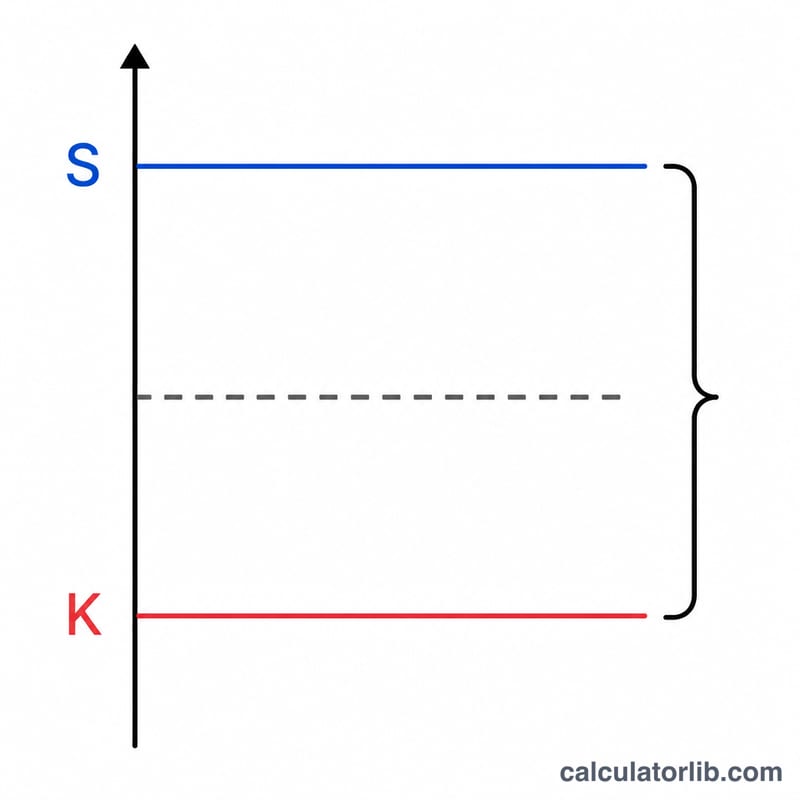
$$BE = K + \frac{P}{r}, \qquad KO = K$$For a short turbo the breakeven is \(BE = K - \frac{P}{r}\). The distance to the barrier is \(\frac{|S-K|}{S}\times 100\%\).
How to Use It
Enter the current underlying price, the strike, the price you pay for one certificate and the subscription ratio (often 0.1 or 0.01 for indices). Choose long or short. The calculator returns leverage, the breakeven level, the knock-out threshold and how far the underlying sits from the barrier.
Worked Example
Suppose \(S = 100\), \(K = 80\), \(P = 21\) and \(r = 1\) for a long turbo:
$$L = \frac{100 \times 1}{21} = 4.76$$ $$BE = 80 + \frac{21}{1} = 101$$Leverage is about 4.76, the underlying must reach 101 to break even, and the position knocks out at 80 — a 20% drop from the current price.
Interpreting Your Result
This calculator turns the raw quotes of a knock-out warrant or turbo certificate into four figures that describe its risk and return profile. Each output has a precise meaning tied to how these instruments are defined.
- Leverage \(\left(\dfrac{S \cdot r}{P}\right)\) is the multiplier applied to the underlying's percentage move. A leverage of 5 means that, ignoring financing costs and spread, a 1% rise in the underlying translates into roughly a 5% change in the certificate's value — in both directions. Leverage amplifies gains and losses equally.
- Breakeven \(\left(K + \dfrac{P}{r}\right)\) is the underlying level at which the position recovers exactly the premium you paid above the certificate's intrinsic value. Below this level (for a long turbo) the position is still at a loss even though the product has not expired.
- Knock-out threshold is the barrier — here equal to the strike / financing level \(K\). If the underlying touches this level, the product is terminated early and typically expires worthless (or repays only a small residual value, depending on the issuer's terms).
- Distance-to-barrier \(\left(\dfrac{S - K}{S} \times 100\%\right)\) measures how far, in percentage terms, the underlying can move against you before the knock-out is triggered. It is a direct gauge of how close a total loss is.
These outputs are linked by an inverse relationship: the closer the barrier \(K\) sits to the current underlying price \(S\), the smaller the certificate price \(P\), and therefore the higher the leverage. In other words, higher leverage necessarily means a smaller distance-to-barrier and a higher knock-out risk. There is no leverage without a correspondingly nearer barrier.
Note that these are the standardised definitions used across issuers; exact settlement terms (residual payout on knock-out, financing adjustments to the strike over time, spread and fees) vary by product and issuer, so always read the specific term sheet. This is general information about how the instrument works, not investment advice.
Scenario Comparison
The table below holds the underlying price constant at \(S = 100\) with subscription ratio \(r = 1\), and varies the strike \(K\) and certificate price \(P\). It shows how moving the barrier closer to the current price raises leverage while shrinking the distance-to-barrier. Leverage is \(L = \dfrac{S \cdot r}{P}\), breakeven is \(K + \dfrac{P}{r}\), the knock-out threshold equals \(K\), and distance-to-barrier is \(\dfrac{|S - K|}{S} \times 100\%\).
| Strike \(K\) | Price \(P\) | Leverage \(L\) | Breakeven | KO threshold | Distance to barrier |
|---|---|---|---|---|---|
| 80 | 21 | 4.76× | 101 | 80 | 20% |
| 90 | 11 | 9.09× | 101 | 90 | 10% |
| 95 | 6 | 16.67× | 101 | 95 | 5% |
| 98 | 3 | 33.33× | 101 | 98 | 2% |
Reading down the table, halving the distance to the barrier roughly doubles the leverage. The 33.33× certificate (barrier just 2% away) is knocked out by a 2% dip in the underlying, while the 4.76× certificate tolerates a 20% adverse move. All four share almost the same breakeven of 101, because the premium above intrinsic value \((P/r)\) shrinks as the barrier nears the current price. This general information illustrates the leverage–risk trade-off and is not investment advice.
FAQ
Does the knock-out equal the strike? For classic turbos the barrier and strike coincide. Mini-futures may set the barrier slightly above (long) or below (short) the strike.
Why is breakeven above the underlying? The small premium \(P/r - (S-K)\) you pay above intrinsic value must be earned back before you profit.
Is higher leverage better? Not necessarily — higher leverage means the barrier sits closer to the current price, so the risk of a total loss rises.