
What Is a Cash-Out Refinance Calculator?
A cash-out refinance replaces your existing mortgage with a new, larger loan and lets you pocket the difference in cash. This calculator (US mortgage conventions) estimates how much cash you would receive, your new monthly principal & interest payment, your new loan-to-value ratio, and the total interest you would pay over the life of the new loan.
How to Use It
Enter your home's current value, the balance remaining on your existing mortgage, the new loan amount you want to take out, your estimated closing costs, the new interest rate (APR), and the new loan term in years. The calculator instantly shows your net cash-out and the cost of the new loan.
The Formula Explained
Net cash out is simply: \(\text{Cash Out} = \text{New Loan} - \text{Current Balance} - \text{Closing Costs}\). The new monthly payment uses the standard amortization formula:
$$\text{Payment} = L \cdot \frac{r}{1 - (1 + r)^{-n}}$$
where \(L\) is the new loan amount, \(r\) is the monthly interest rate (APR \(\div\) 12 \(\div\) 100), and \(n\) is the number of monthly payments (years \(\times\) 12). Total interest is \(\text{Payment} \times n - \text{Loan}\).
Worked Example
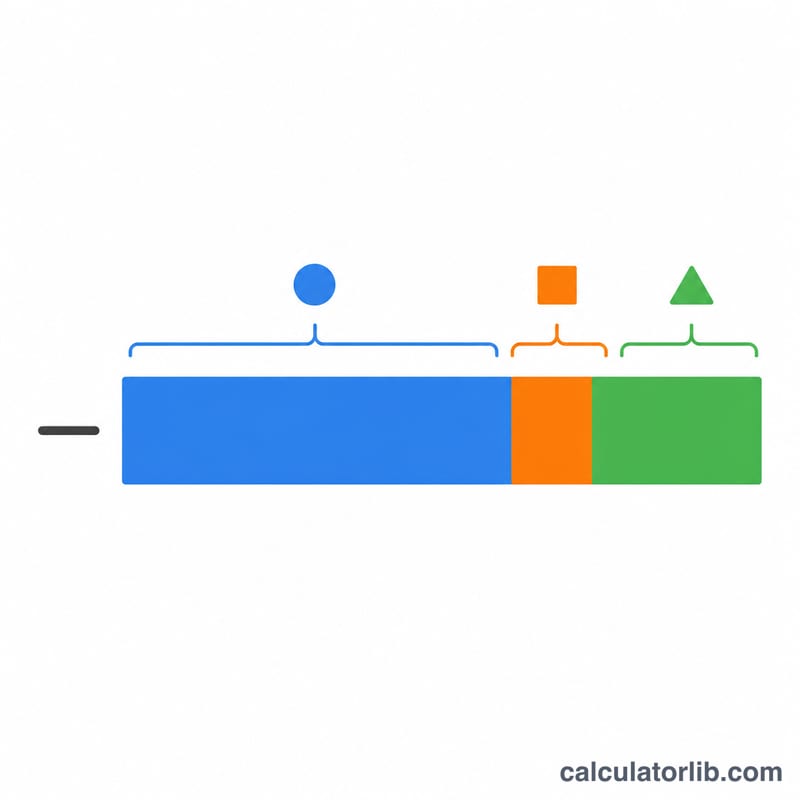
Suppose your home is worth $400,000, you owe $200,000, and you take a new $280,000 loan with $6,000 in closing costs at 6.5% over 30 years. Cash out = \(280{,}000 - 200{,}000 - 6{,}000 = \) $74,000. With \(r = 0.0054167\) and \(n = 360\), the monthly payment is about $1,769.98, the LTV is 70%, and total interest over 30 years is about $357,191.
FAQ
Does this include taxes and insurance? No — the monthly figure is principal and interest only. Escrow for property tax and homeowners insurance is separate.
What LTV do lenders allow for cash-out? Conventional cash-out refinances typically cap at 80% LTV, though limits vary by loan type and lender.
Are closing costs always paid in cash? Not necessarily — many borrowers roll closing costs into the new loan, which reduces the cash received but lowers out-of-pocket cost.