
What Is a Variable Annuity Calculator?
A variable annuity is a long-term, tax-deferred investment contract where you make regular contributions that grow based on the performance of underlying investment options. This calculator estimates the projected future value of your annuity using the future value of an ordinary annuity formula, assuming a constant average return rate. Because variable annuity returns actually fluctuate with the market, the figure here represents a smoothed projection based on an assumed average annual return, not a guarantee.
How to Use It
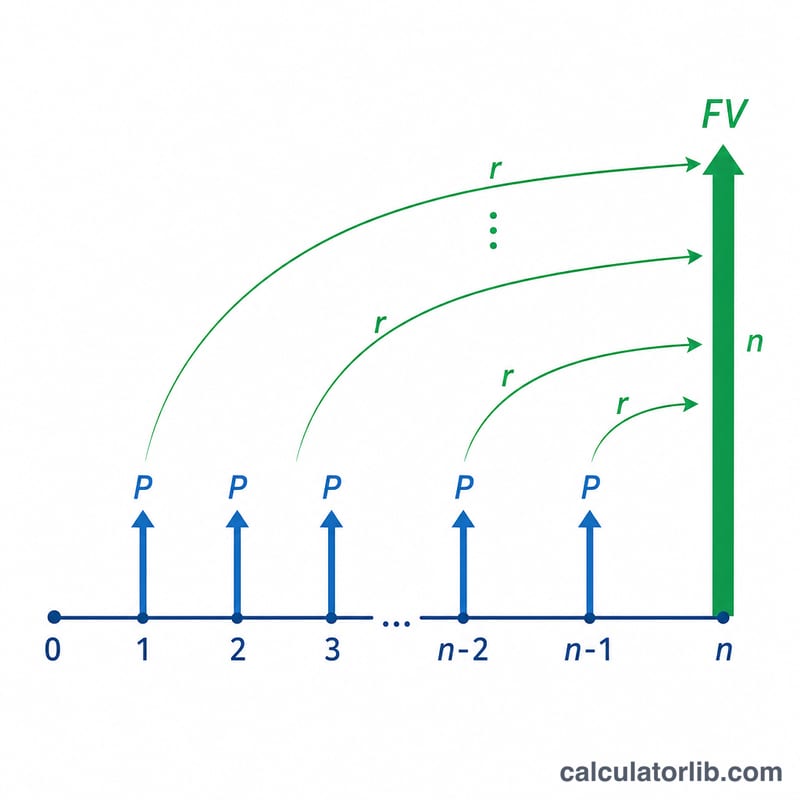
Enter your periodic contribution (the amount you invest each period), your expected average annual return rate as a percentage, the number of years you plan to contribute, and how often you contribute (monthly, quarterly, or annually). The calculator converts the annual rate and term into per-period values, then compounds every contribution to the end of the term.
The Formula Explained
The core equation is $$FV = P \cdot \frac{(1 + r)^{n} - 1}{r}$$ where \(P\) is the periodic contribution, \(r\) is the periodic return rate (annual rate divided by the number of periods per year), and \(n\) is the total number of periods (years times frequency). This is the standard future value of an ordinary annuity, which assumes contributions are made at the end of each period. If the return rate is zero, the future value is simply \(P \times n\).
Worked Example
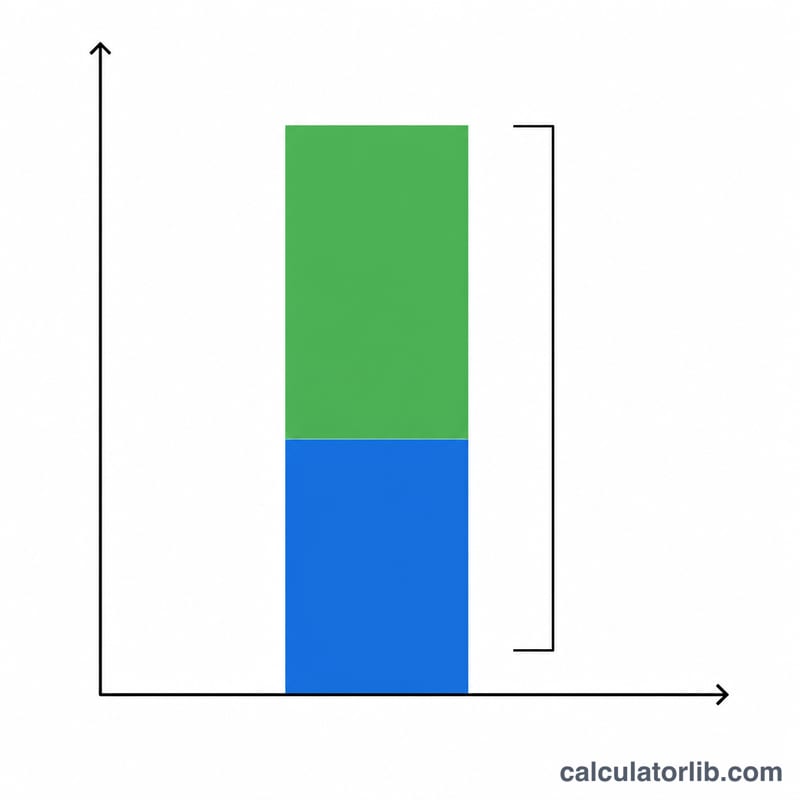
Suppose you contribute $500 monthly for 20 years at a 7% annual return. The monthly rate \(r = 0.07 / 12 \approx 0.0058333\), and the number of periods \(n = 20 \times 12 = 240\). The future value works out to roughly $260,463, of which $120,000 was contributed and about $140,463 was investment growth.
FAQ
Is the projected value guaranteed? No. Variable annuity returns depend on market performance, so actual results will vary above or below this estimate.
Does this include fees? No. Variable annuities often carry mortality, expense, and management fees; subtract those from your expected return for a more conservative estimate.
Are contributions made at the start or end of each period? This calculator uses the ordinary annuity assumption (end of period). Contributions made at the start would grow slightly more.