
What Is a Futures Contract Value?
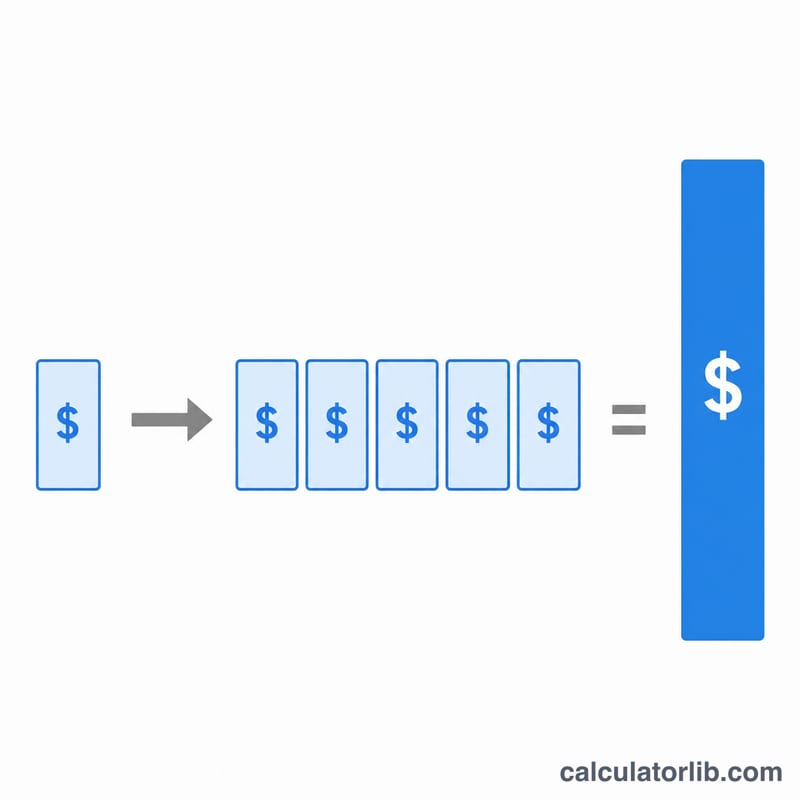
The value of a futures contract — often called its notional value — is the total dollar amount of the underlying asset that the contract controls. It is not the same as the margin you post or the profit you make; it represents the full economic exposure of your position. This calculator multiplies the quoted futures price by the contract size (the units of the underlying per contract) and the number of contracts you hold.
How to Use the Calculator
Enter three values: the current futures price, the contract size (also called the multiplier or units per contract — for example, an E-mini S&P 500 contract has a $50 multiplier), and the number of contracts. The calculator returns the value of a single contract and the total notional value of your whole position.
The Formula Explained
The core equation is:
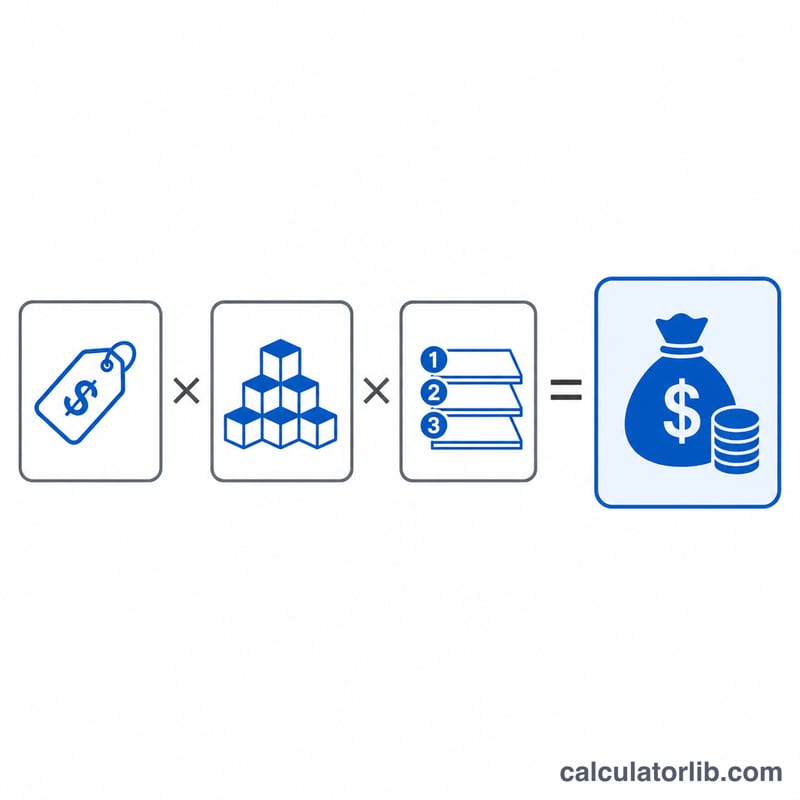
$$\text{Contract Value} = \text{Futures Price} \times \text{Contract Size} \times \text{Number of Contracts}$$
The futures price is the market quote, the contract size scales that price into the unit of trade, and the number of contracts aggregates across your full position. The result tells you the gross exposure, which is useful for position sizing, risk management, and margin estimation.
Worked Example
Suppose crude oil futures trade at $80 per barrel, each contract covers 1,000 barrels, and you hold 3 contracts. The value per contract is \(\$80 \times 1{,}000 = \$80{,}000\). The total contract value is \(\$80{,}000 \times 3 = \$240{,}000\). That $240,000 is your notional exposure to oil price moves.
FAQ
Is notional value the same as margin? No. Margin is a small fraction (often 3–12%) of the notional value that you must post to open the position. Notional value is the full exposure.
What is contract size? It is the standardized quantity of the underlying asset per contract, set by the exchange — e.g., 1,000 barrels of oil, 5,000 bushels of corn, or a $50 multiplier for the E-mini S&P 500.
Does this work for any futures market? Yes — as long as you input the correct contract size or multiplier for your specific instrument, the formula applies universally.