
What Is a Final Settlement Proration Calculator?
When an employment period, subscription, bonus cycle, or benefit entitlement ends partway through its normal term, the payee is usually owed only the fraction that was actually earned. This calculator prorates a full-period amount down to the exact value owed for the days worked or elapsed, so a final settlement, severance line item, or last paycheck can be computed fairly and transparently.
The Formula Explained
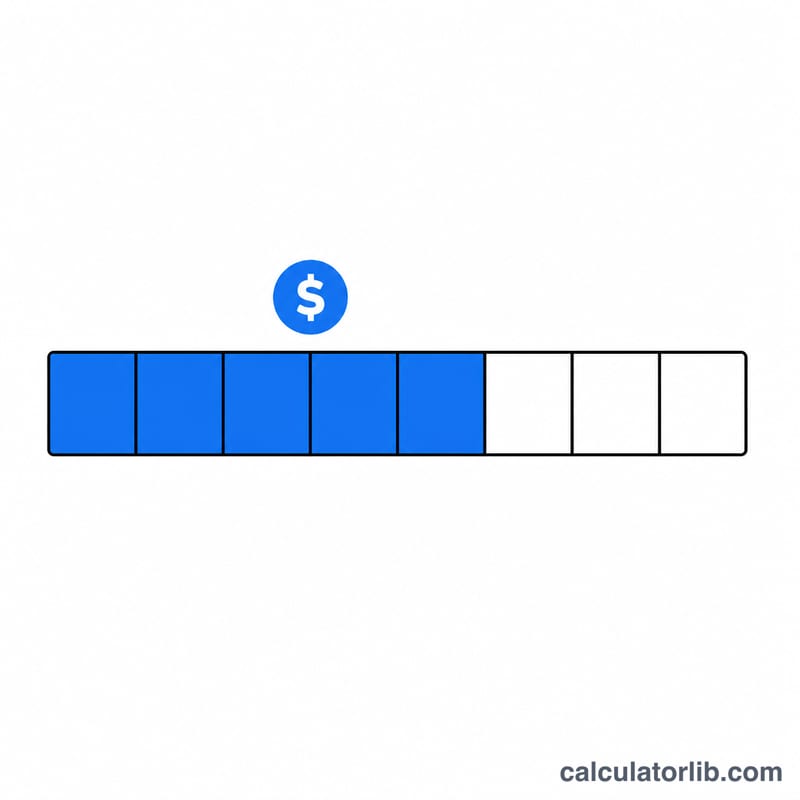
Proration is simple linear scaling. Let \(A\) = the full period amount, \(D_t\) = the total number of days in the period, and \(D_w\) = the days worked or elapsed. The amount owed is:
$$\text{Prorated} = A \times \frac{D_w}{D_t}$$It is often helpful to see the intermediate daily rate, which is the value accrued each day:
$$\text{Daily Rate} = \frac{A}{D_t}$$The remaining, unearned portion is simply \(A - \text{Prorated}\).
How to Use It
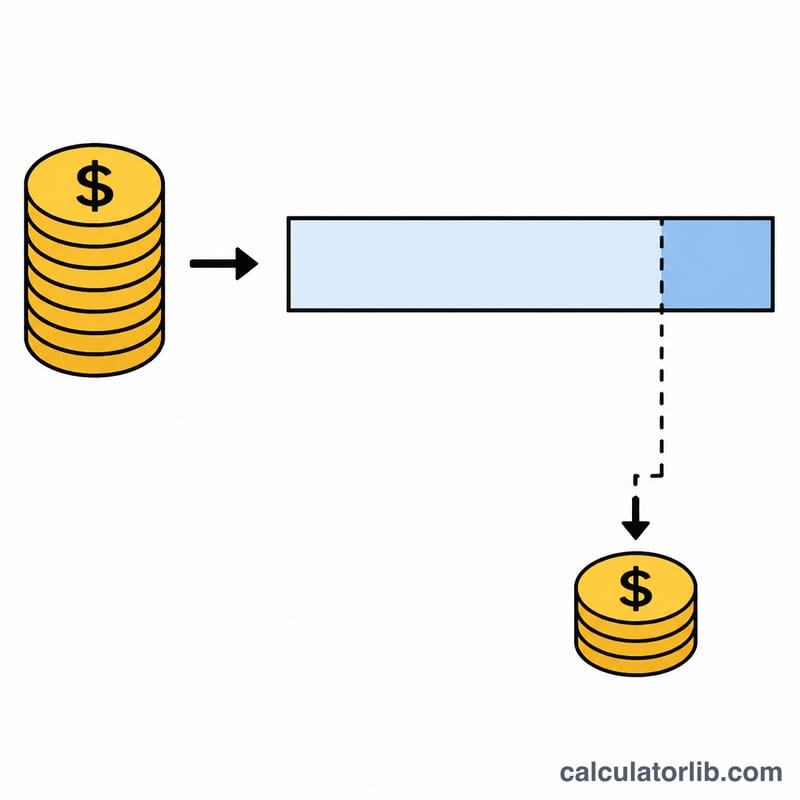
Enter the full amount for a complete period (for example, a monthly salary, an annual bonus, or a yearly benefit), the total number of days in that period, and the number of days the person actually worked or the entitlement was active. The calculator returns the prorated amount owed, the daily rate, and the remaining unearned balance.
Worked Example
Suppose an employee earns $5,000 for a full 30-day month but leaves after working 18 days. The daily rate is:
$$\text{Daily Rate} = \frac{5000}{30} = 166.67$$The prorated final settlement is:
$$\text{Prorated} = 166.67 \times 18 = 3000$$So the employee is owed $3,000, leaving $2,000 of the full amount unearned.
Proration Across Common Scenarios
Proration splits a full-period amount evenly across every day in the period, then pays only for the days actually worked (or used). The daily rate is \(A / D_t\), the prorated amount owed is \(\frac{A}{D_t} \times D_w\), and the unearned remainder is \(A - \text{Prorated}\). The table below uses a consistent calendar-day basis for each period (30-day month, 365-day year, 31-day billing month). All figures are gross, before taxes or adjustments.
Worked example (row 2), showing the full substitution:
$$\text{Prorated} = \frac{\$5{,}000}{30} \times 18 = \$166.67 \times 18 = \$3{,}000.00$$| Full Amount (A) | Total Days (Dt) | Days Worked (Dw) | Daily Rate (A/Dt) | Prorated Owed | Unearned Remainder |
|---|---|---|---|---|---|
| $5,000 | 30 | 10 | $166.67 | $1,666.67 | $3,333.33 |
| $5,000 | 30 | 18 | $166.67 | $3,000.00 | $2,000.00 |
| $5,000 | 30 | 25 | $166.67 | $4,166.67 | $833.33 |
| $12,000 | 365 | 90 | $32.88 | $2,958.90 | $9,041.10 |
| $12,000 | 365 | 180 | $32.88 | $5,917.81 | $6,082.19 |
| $99 | 31 | 12 | $3.19 | $38.32 | $60.68 |
Daily-rate and prorated figures are rounded to the nearest cent for display; small rounding differences between the daily rate multiplied out and the exact fraction are normal. In the $99 example, the prorated $38.32 is the value of the 12 days used, and the $60.68 remainder is the amount that would be refunded for the 19 unused days.
Interpreting Your Result
The prorated amount is the earned (or owed) portion of the full period amount — the share that corresponds to the days actually worked or used. It is calculated by spreading the full amount evenly over every day in the period and then counting only the completed days:
$$\text{Prorated} = \frac{A}{D_t} \times D_w$$- Daily rate (A / Dt) — the even accrual per day. Each day in the period is treated as contributing an identical fraction of the full amount, with no weighting for weekends, holidays, or workload.
- Prorated owed — the daily rate multiplied by days worked. This is what the calculator returns as the settlement figure.
- Unearned remainder (A − Prorated) — the balance for the days not worked. Depending on the situation this is the amount forfeited, still to be earned, or (for a subscription) refundable.
All results are gross figures. They do not account for income tax, withholding, benefit or pension deductions, or any contractual or statutory adjustments such as accrued leave payouts, notice pay, deductions for advances, or minimum-payment rules. Your actual net settlement may differ once those items are applied.
How a final settlement is actually calculated — the day-count basis (calendar days vs. working days), rounding, what counts as the "full amount," and whether unused portions are owed or forfeited — can be governed by your employment contract, company policy, or local labor law, and these rules vary by country and jurisdiction. This calculator provides a general arithmetic estimate only; it is general information, not legal, tax, or financial advice. For a binding figure, check the governing contract or applicable regulations, or consult a qualified professional.
Frequently Asked Questions
Which day count should I use? Use the same basis for both fields. If you count calendar days in the period, count calendar days worked; if you use business days, be consistent on both sides.
Can I prorate a bonus or benefit? Yes. The formula applies to any amount that accrues evenly over a defined period, including bonuses, PTO payouts, and subscription refunds.
What if days worked exceeds total days? The result will exceed the full amount, which usually signals a data-entry error; double-check that both counts cover the same period.