What it does
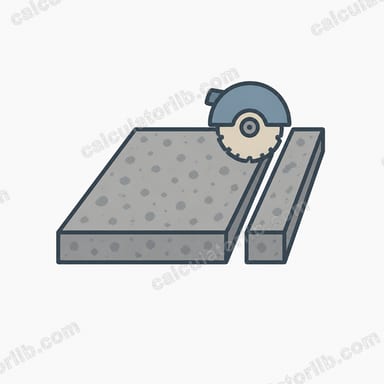
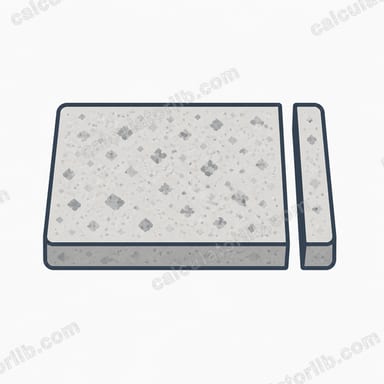
Stone and countertop suppliers often buy granite by the square meter but cut and sell it as strips of a fixed width — for splashbacks, thresholds, stair treads or facade cladding. This calculator converts a slab area into the running length of strip you can produce, which is the number that actually drives cutting layout and pricing.
The formula
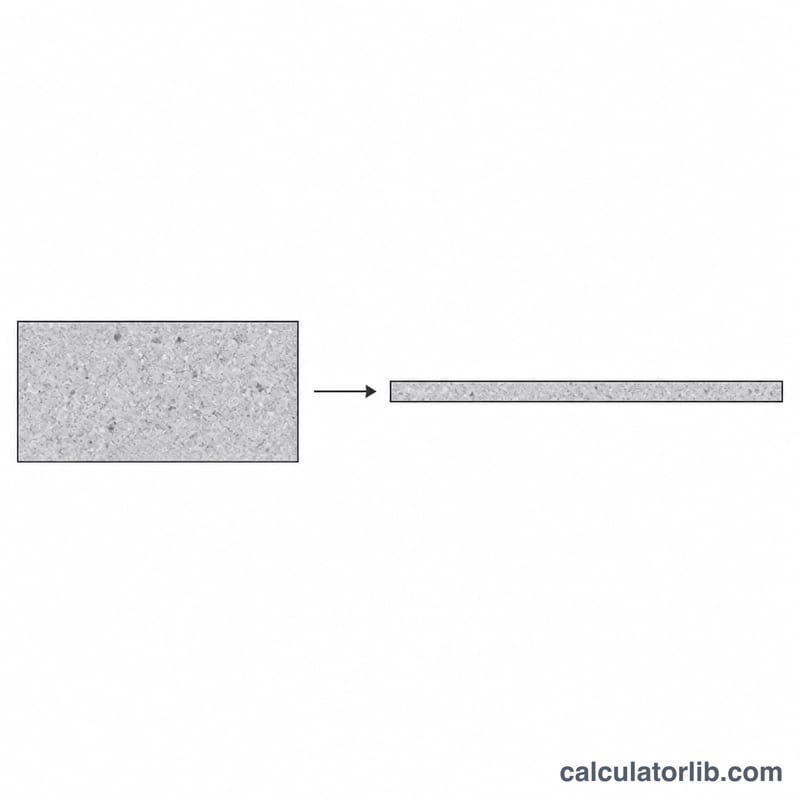
If a slab covers area \(A\) (in square meters) and you cut it into strips of width \(W\) (in meters), the total linear length \(L\) is the area divided by the width:
$$L = \frac{A}{W}$$Here \(A\) = slab area in m², \(W\) = strip width in m, and \(L\) = linear meters produced. If you enter a price per linear meter \(P\), the order cost is \(C = L \times P\).
How to use it
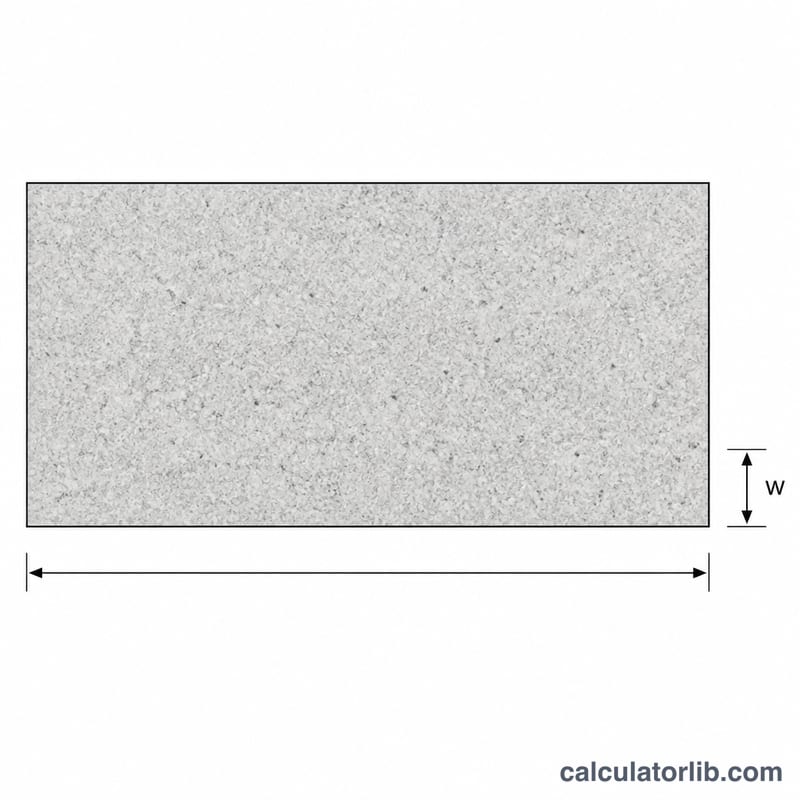
Enter the slab area in square meters, the strip width you plan to cut in meters (for example \(0.6\) m for a standard worktop depth), and optionally the price per linear meter. The calculator returns the running length and an estimated cost.
Worked example
Suppose you have a \(20\ \text{m}^2\) slab and cut \(0.5\ \text{m}\) wide strips at a price of 25 per linear meter:
$$L = \frac{20}{0.5} = 40\ \text{m}$$$$C = 40 \times 25 = 1000$$So the slab yields 40 linear meters and the order is priced at 1000.
Strip Width Comparison
Linear meters (running length) are found by dividing the slab area by the strip width: \( \text{Linear Meters} = \dfrac{A}{W} \). Holding the slab area fixed at \(A = 20\ \text{m}^2\) and varying the strip width \(W\) shows a clear pattern — the narrower the strip, the more running length you get from the same area. The order cost below uses a sample price of $45 per linear meter (substitute your own supplier quote).
| Strip Width \(W\) (m) | Linear Meters \(L = A / W\) | Order Cost at $45 / linear m |
|---|---|---|
| 0.4 | \( 20 / 0.4 = 50.00 \) | $2,250.00 |
| 0.5 | \( 20 / 0.5 = \) 40.00 | $1,800.00 |
| 0.6 | \( 20 / 0.6 = 33.33 \) | $1,500.00 |
| 0.8 | \( 20 / 0.8 = 25.00 \) | $1,125.00 |
| 1.0 | \( 20 / 1.0 = \) 20.00 | $900.00 |
The relationship is inversely proportional: halving the strip width doubles the linear meters. Because the total area (and therefore the raw stone quantity) is unchanged, the price per linear meter would normally be adjusted to reflect the actual area consumed — use the running length here for cutting layout and quotes stated per linear meter.
Ordering Tips
Use the calculated linear meters as a starting point, then adjust it for real-world cutting before you place the order:
- Add a 5–10% waste allowance. Saw kerf (the material removed by the blade), trimming, and offcuts all consume stone. If the calculator returns 40 linear meters, plan for roughly \( 40 \times 1.05 = 42 \) to \( 40 \times 1.10 = 44 \) linear meters so a slightly imperfect cut or a wasted end piece doesn't leave you short.
- Round up to what you can actually buy. Stone is sold in whole slabs, not in exact running meters. Convert your padded linear-meter figure back into the number of slabs or strips the supplier stocks and round up — a partial slab still costs a full slab.
- Confirm the supplier's usable slab dimensions. A long continuous strip may be physically impossible to cut from a slab that is too short or irregularly shaped, even if the total area is sufficient. Ask for the actual usable length and width, and check whether joins/seams are acceptable if the strip must be pieced together.
- Verify the strip width is in meters. The formula \( L = A / W \) only works when area and width use consistent units. A width entered in centimeters or millimeters instead of meters will produce a linear-meter figure that is off by a factor of 100 or 1000, so double-check the value before ordering.
This is a geometric area-to-length conversion and is not tied to any national standard; slab sizes, kerf and pricing conventions vary by supplier and region, so treat the numbers as planning estimates and confirm details with your fabricator.
FAQ
Does this account for saw kerf or offcut waste? No. It gives the ideal geometric length. Add a waste allowance (typically 5–10%) for real cutting.
What if my width is in centimeters? Convert to meters first — divide centimeters by 100, so 60 cm becomes \(0.6\) m.
Can I reverse it? Yes: to find the area needed for a target length, use \(A = L \times W\).