What this calculator does
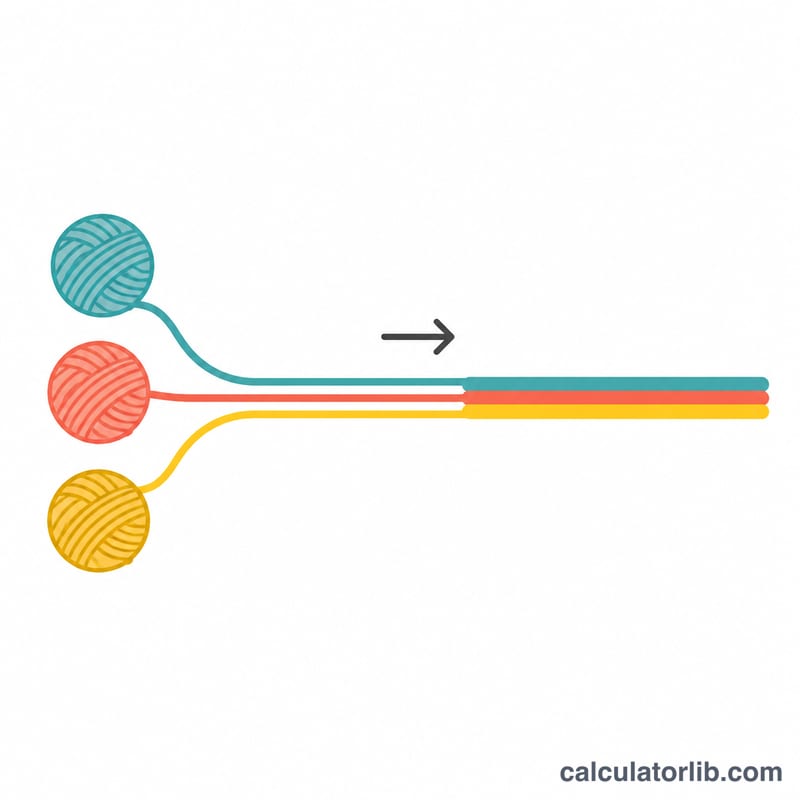
When you knit or crochet with two or more strands held together, the combined yarn behaves like a single thicker yarn. This tool estimates that thicker, equivalent yarn weight from the wraps-per-inch (WPI) of one strand and how many strands you plan to hold together, then names the closest standard yarn-weight category.
The formula explained
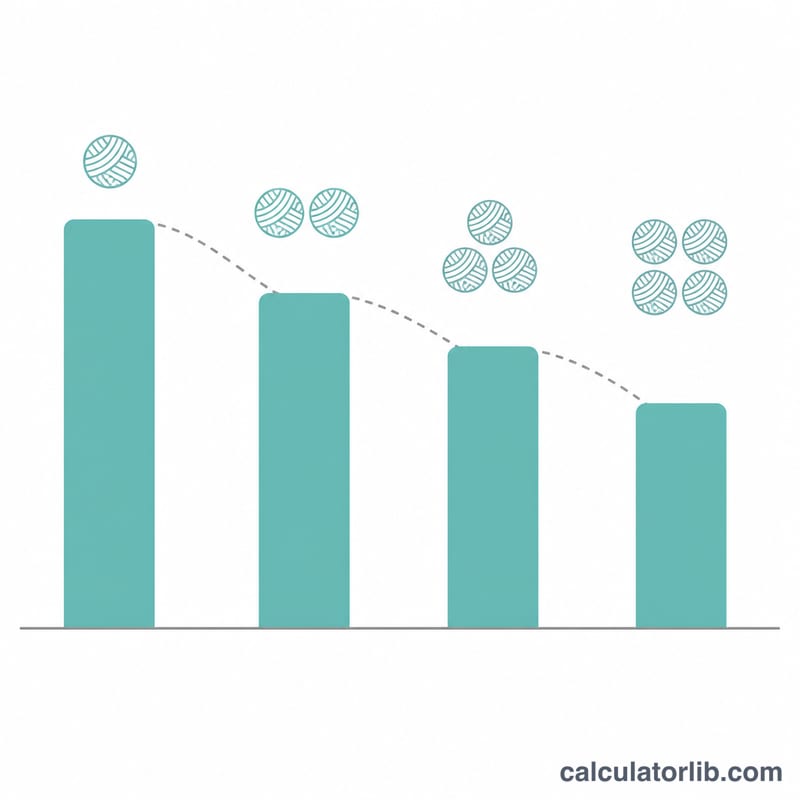
WPI measures how many wraps of yarn fit in one inch, so it is inversely related to the yarn diameter. Holding \(n\) identical strands together adds their cross-sectional areas, and since area grows with the square of diameter, the bundle diameter scales with \(\sqrt{n}\). The combined wraps per inch is therefore:
$$\text{WPI}_{c} = \frac{ \text{WPI}_{s}}{\sqrt{n}}$$
where \(\text{WPI}_{s}\) is the single-strand wraps per inch and \(n\) is the number of strands held together.
How to use it
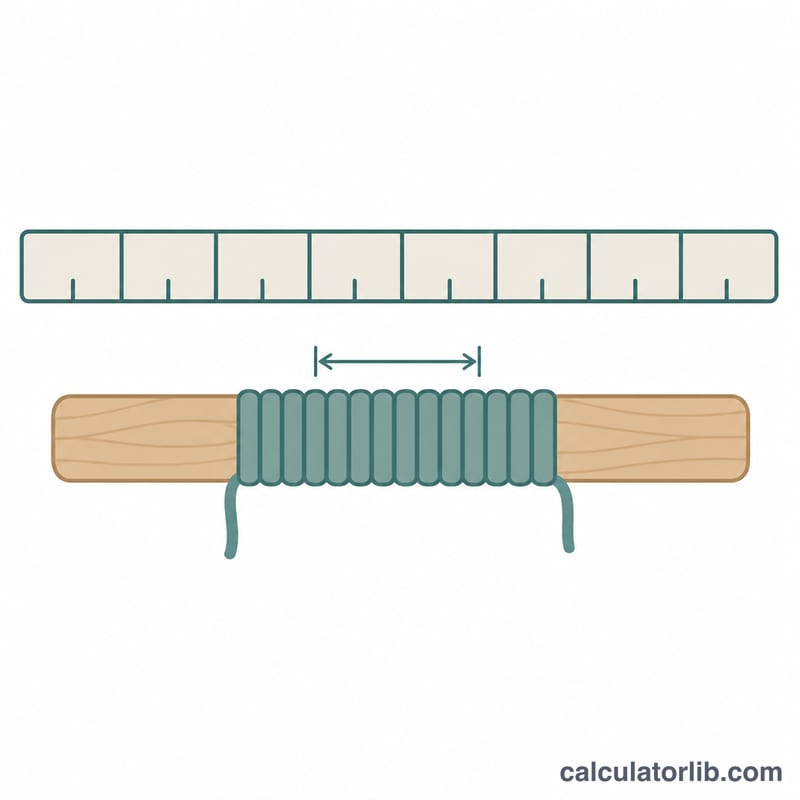
Wrap one strand snugly around a ruler for one inch and count the wraps to get \(\text{WPI}_{s}\). Enter that value and the number of strands. The calculator returns the combined WPI and maps it to a category: Lace, Fingering, Sport, DK, Worsted, Bulky, or Super Bulky.
Worked example
Suppose you hold two strands of fingering-weight yarn (about 14 WPI) together:
$$\text{WPI}_{c} = \frac{14}{\sqrt{2}} = 9.9$$
A combined WPI near 9.9 falls in the Worsted range, which matches the common rule that two strands of fingering knit up roughly like worsted-weight yarn.
FAQ
Does this work for different yarns held together? The square-root rule assumes identical strands. For mixed yarns it is a rough estimate; convert each to yards-per-pound for more accuracy.
Why square root and not simple addition? Because thickness depends on diameter, and diameter grows with the square root of the combined area, not linearly with strand count.
How accurate is the category? WPI ranges overlap between brands, so treat the category as a starting point and always knit a gauge swatch.