What is the Beef Yield Calculator?
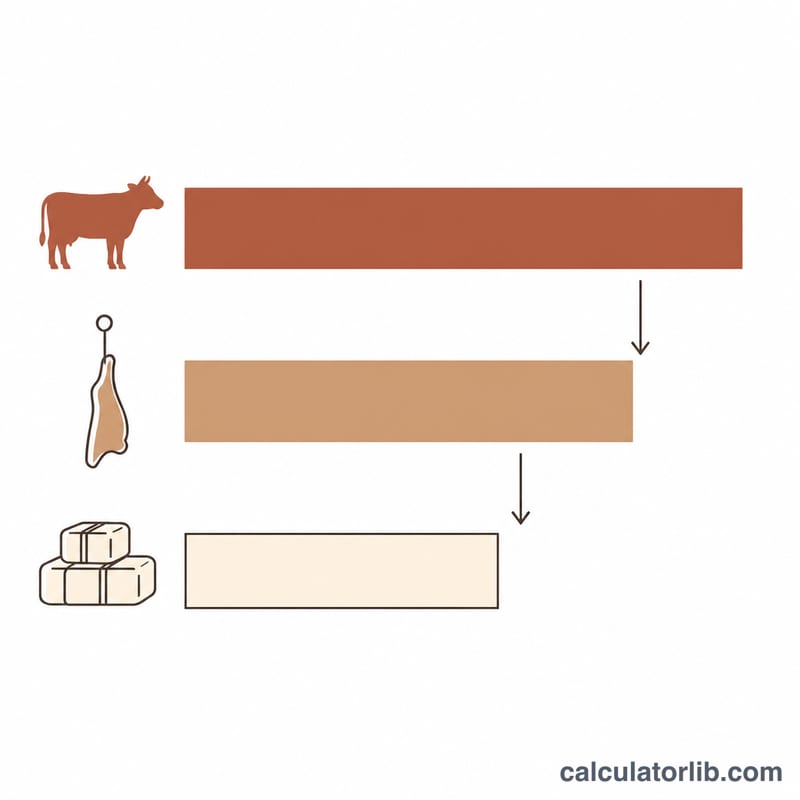
When you buy beef by the whole, half, or quarter animal, the number on the scale at purchase is rarely the amount of meat that ends up in your freezer. This calculator estimates the packaged, take-home weight of beef starting from either the live animal weight or the hanging (carcass) weight, so you can plan freezer space and understand the true cost per pound.
How to use it
Choose whether your starting number is a live weight or a hanging weight. Enter the weight in pounds. If you start from live weight, set the dressing percentage \(D\) (typically 60-64% for beef). Set the cutting yield \(Y\) (typically 60-70%), which accounts for bone, trim, and moisture loss during processing.
The formula explained
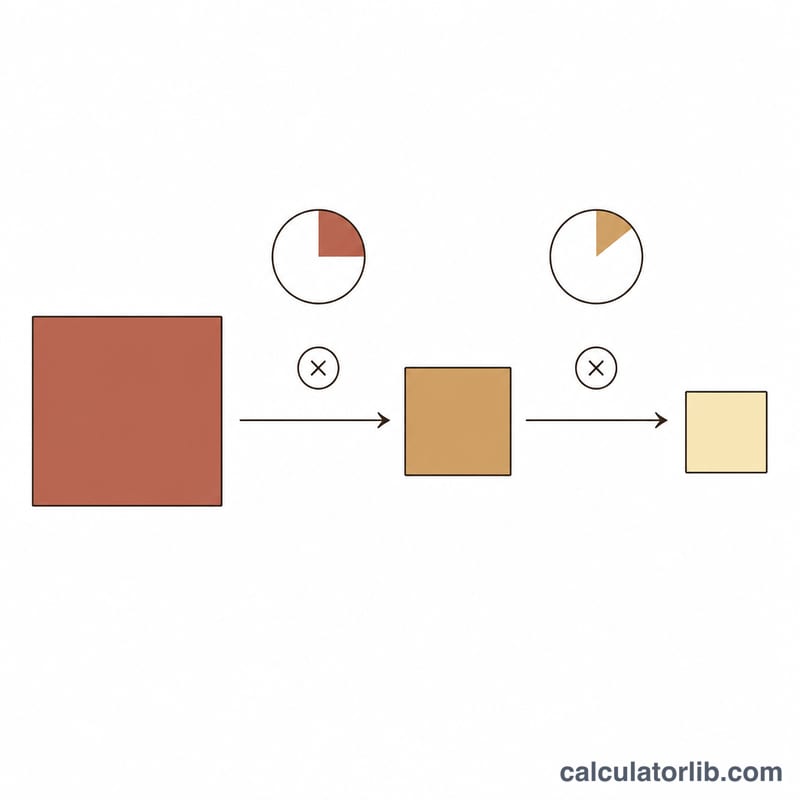
Two multiplications convert live weight to packaged weight. First the dressing percentage converts live weight to carcass weight, then the cutting yield converts carcass weight to packaged meat:
$$\text{Packaged} = \text{Live} \times \frac{D}{100} \times \frac{Y}{100}$$
Here \(D\) = dressing percentage and \(Y\) = cutting yield percentage. If you already know the hanging weight, only the second step applies.
Worked example
Take a 1,200 lb live steer with a 62% dressing percentage and a 65% cutting yield. The hanging weight is:
$$1200 \times \frac{62}{100} = 744\,\text{lbs}$$
and the packaged weight is:
$$744 \times \frac{65}{100} = 483.6\,\text{lbs}$$
That is an overall yield of \(\frac{483.6}{1200} \times 100 = 40.3\%\) of the live weight.
FAQ
Why is the packaged weight so much less than the live weight? Hide, head, organs, bone, and trim are all removed, and the meat loses moisture during aging.
What dressing percentage should I use? Beef cattle usually dress out between 60% and 64%; 62% is a common default.
What cutting yield is realistic? Boneless cuts yield less (around 60%), while bone-in orders yield more (up to 70%).