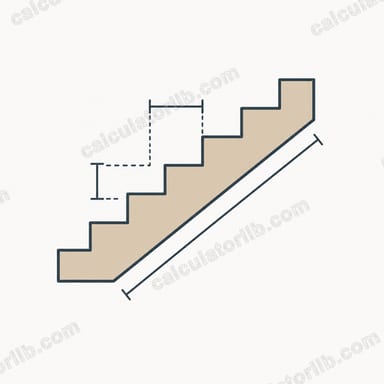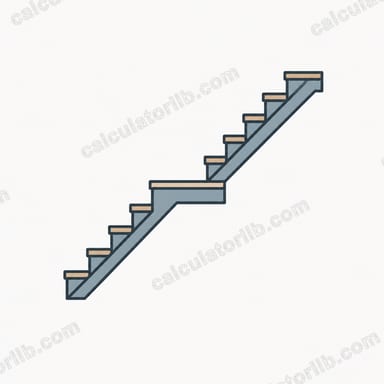
What This Calculator Does
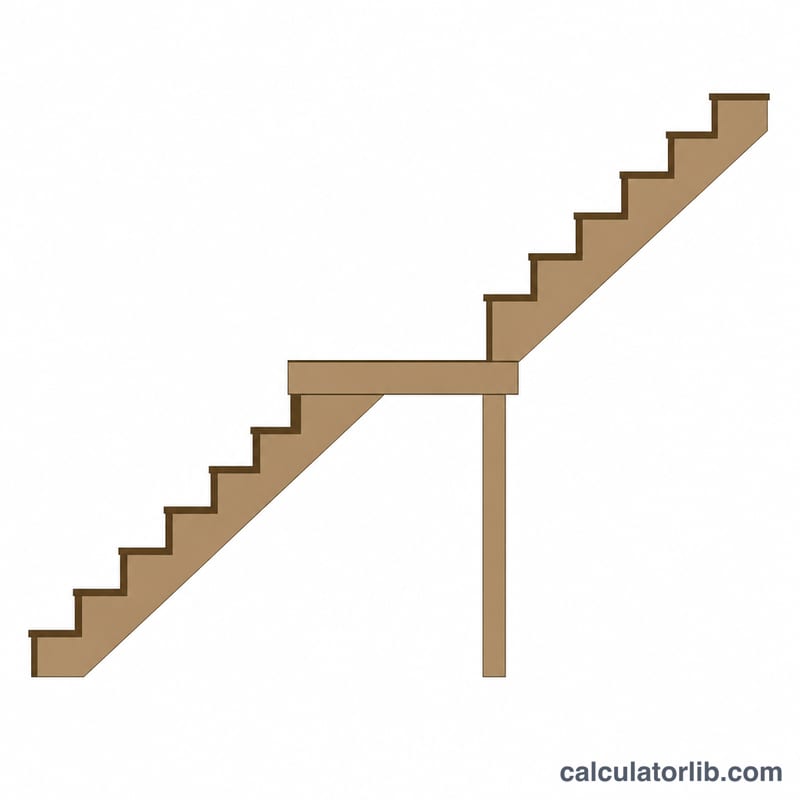
A staircase that is too tall for a single flight is usually broken into two flights joined by a flat landing. This calculator sizes the two cut stringers for such a staircase. It first works out a code-friendly riser height, splits the risers between the two flights around the landing, and then returns the diagonal length of each stringer plus the combined total.
The Formula
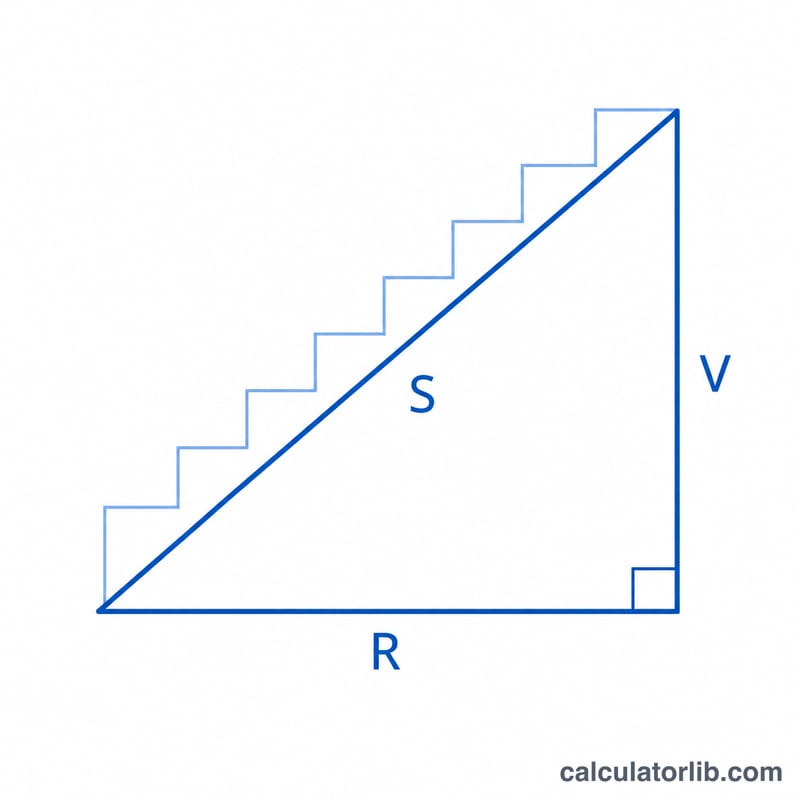
First the number of risers is chosen so each riser is close to your target height: \(N = \operatorname{round}(\tfrac{\text{Total Rise}}{\text{Target Riser}})\), giving an actual riser height \(R = \tfrac{\text{Total Rise}}{N}\). Each flight has \(n_r\) risers and \(n_t = n_r - 1\) treads, and its stringer length follows the Pythagorean theorem:
$$L = \sqrt{(n_r \times R)^2 + (n_t \times \text{Tread})^2}$$Here \(R\) = riser height in inches, \(\text{Tread}\) = tread depth in inches, \(n_r\) = risers in the flight, and \(n_t\) = treads in the flight. The two flight lengths are added for the total stringer material.
How To Use It
Enter the total vertical rise floor-to-floor, your target riser height (7 in is typical), the tread depth, and how many risers sit in the first flight before the landing. The rest are assigned to the second flight automatically.
Worked Example
With a total rise of 108 in and a 7 in target, \(N = \operatorname{round}(108/7) = 15\) risers and \(R = 108/15 = 7.2\) in. Putting 8 risers in flight one (7 treads at 10 in):
$$L_1 = \sqrt{(8 \times 7.2)^2 + (7 \times 10)^2} = \sqrt{57.6^2 + 70^2} = 90.65\,\text{in}$$Flight two has 7 risers and 6 treads:
$$L_2 = \sqrt{50.4^2 + 60^2} = 78.36\,\text{in}$$The total stringer length is \(90.65 + 78.36 = 169.01\) in.
FAQ
Does the landing count as a step? The landing acts as an oversized tread and platform between the flights; each flight's treads are its risers minus one, and the landing itself is framed separately.
Why round the riser count? Rounding to a whole number of risers keeps every riser identical in height, which building codes require for safety.
What tread depth should I use? Many codes require at least 10 in of tread depth; adjust the input to match your local requirements.