What this calculator does
The Buffer Solution Recipe Calculator tells you exactly how much weak acid and its conjugate base to combine to hit a target pH at a chosen volume. It is built on the Henderson-Hasselbalch equation, the standard model for buffer behavior in analytical chemistry, biochemistry, and molecular biology labs.
The formula explained
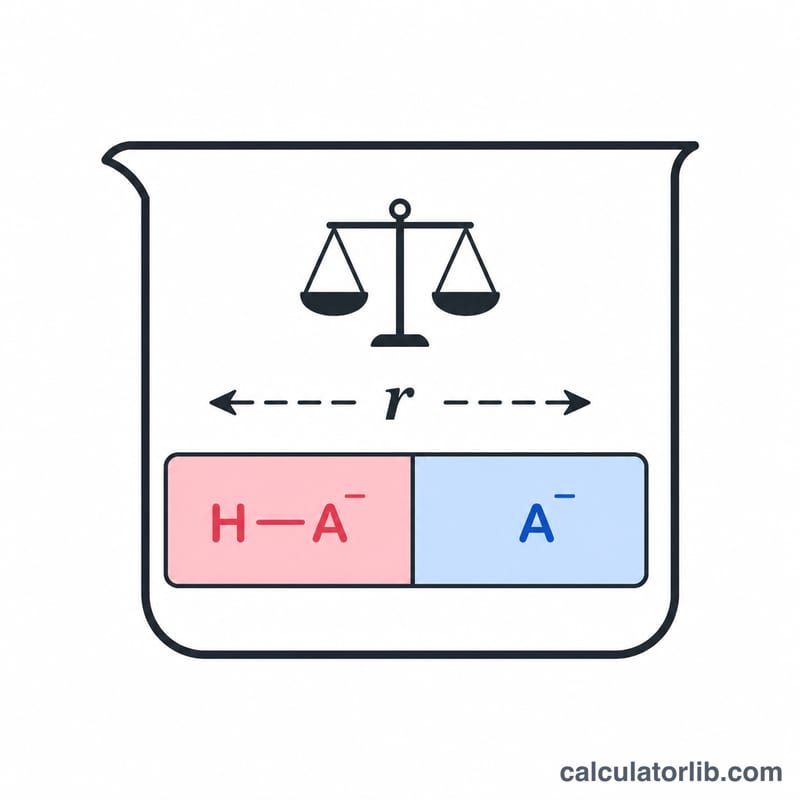
A buffer resists pH change because it contains comparable amounts of a weak acid \(\text{HA}\) and its conjugate base \(\text{A}^-\). Their ratio sets the pH:
$$\text{pH} = \text{p}K_a + \log_{10}\left(\frac{[\text{A}^-]}{[\text{HA}]}\right)$$Rearranging gives the base-to-acid ratio \(r\), which we then use to split the total buffer concentration \(C_\text{total}\):
$$r = 10^{(\text{pH}-\text{p}K_a)}, \qquad [\text{A}^-] = C_\text{total}\cdot\frac{r}{1+r}, \qquad [\text{HA}] = C_\text{total}\cdot\frac{1}{1+r}$$Multiplying each concentration by the volume \(V\) (in liters) yields the moles of acid and base to weigh out.
How to use it
Enter the target pH, the \(\text{p}K_a\) of your acid, the total buffer concentration in mol/L, and the final volume in liters. The calculator returns the base-to-acid ratio, the concentration of each component, and the moles of acid and conjugate base you need to prepare the buffer.
Worked example
Suppose you want a 0.2 mol/L acetate buffer at \(\text{pH}=5.76\) with \(\text{p}K_a=4.76\), in a 0.5 L volume. First the ratio:
$$r = 10^{(5.76-4.76)} = 10^{1} = 10$$Then the concentrations and moles:
$$[\text{A}^-] = 0.2\times\frac{10}{11} = 0.1818\ \text{mol/L},\quad [\text{HA}] = 0.2\times\frac{1}{11} = 0.0182\ \text{mol/L}$$$$n_{\text{A}^-} = 0.1818\times 0.5 = 0.0909\ \text{mol},\quad n_{\text{HA}} = 0.0182\times 0.5 = 0.0091\ \text{mol}$$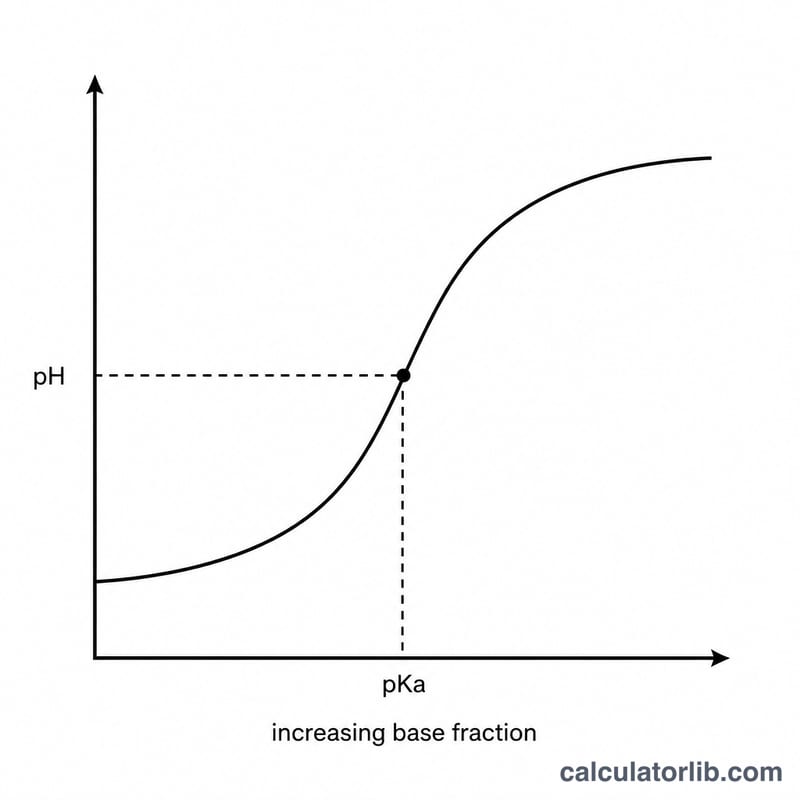
FAQ
Does this account for ionic strength? No. It uses the ideal Henderson-Hasselbalch form; for high-precision work adjust the \(\text{p}K_a\) for activity effects.
What is the best buffering range? Buffers work best within \(\text{p}K_a \pm 1\), where the ratio stays between about 0.1 and 10.
Can I convert moles to grams? Yes, multiply the moles of each component by its molar mass.