Veterinary Drug Dose Calculator

Veterinary Drug Dose Calculator

Popular AI Skill PRO

Enter Calculation

If the label gives a daily dose, divide it by the doses per day.

Formula

D=Body Weight (kg)×Dosage Rate (mg/kg)D = \text{Body Weight (kg)} \times \text{Dosage Rate (mg/kg)}

Example

D=10×5=50D = 10 \times 5 = 50
Show calculation steps (2)
  1. Volume per Dose (mL)

    V=Body Weight (kg)×Dosage Rate (mg/kg)Concentration (mg/mL)V = \frac{\text{Body Weight (kg)} \times \text{Dosage Rate (mg/kg)}}{\text{Concentration (mg/mL)}}

    Volume = dose per administration divided by drug concentration; returns 0 if concentration is not greater than 0

  2. Total Daily Dose (mg)

    Ddaily=Body Weight (kg)×Dosage Rate (mg/kg)×Doses per DayD_{\text{daily}} = \text{Body Weight (kg)} \times \text{Dosage Rate (mg/kg)} \times \text{Doses per Day}

    Daily dose = dose per administration x doses per day

Usage stats

Advertisement

Results

Dose per Administration
50
mg per dose
Volume to Administer 1 mL
Total Daily Dose 100 mg/day

For reference only — follow your veterinarian's advice.

Report an error on this page

What this calculator does

The Veterinary Drug Dose Calculator turns a prescribed per-kilogram dosage rate into a practical, ready-to-give dose for a specific animal. Vets and technicians usually receive a drug's dosing as milligrams per kilogram of body weight. This tool converts that rate into the exact milligram dose, the liquid volume to draw into a syringe, and the total amount given across a full day.

The formula explained

The core relationship is the mass of drug per unit of body weight:

$$\text{Dose} = W \times R$$

where \(W\) = body weight in kilograms and \(R\) = dosage rate in mg/kg. To convert the dose into a liquid volume, divide by the product concentration \(C\) in mg/mL:

$$V = \frac{\text{Dose}}{C}$$

The total daily dose multiplies the per-administration dose by the number of doses per day \(f\): \(\text{Daily} = \text{Dose} \times f\).
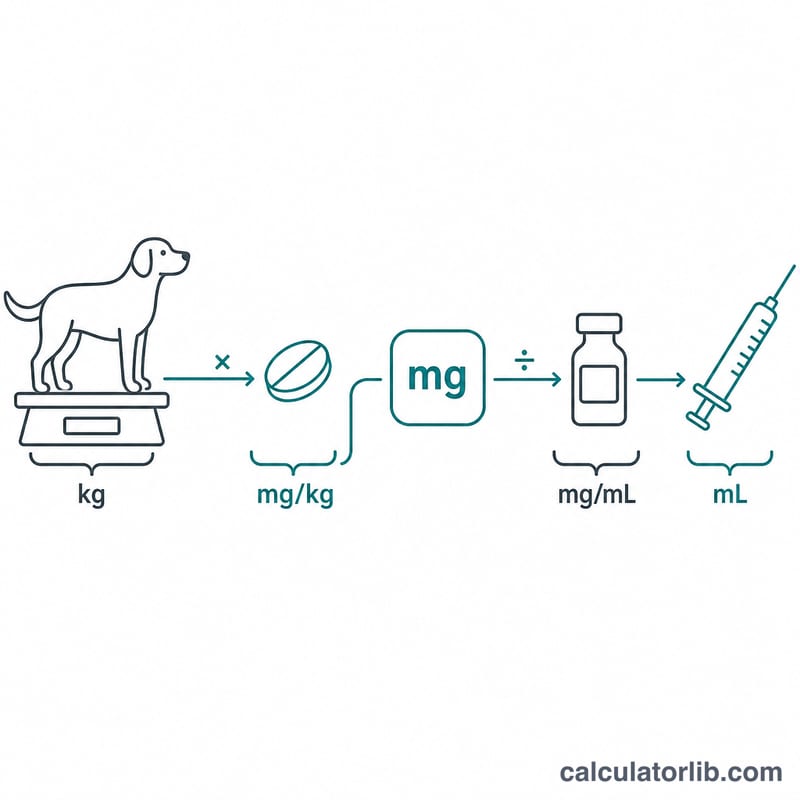
Flow diagram: body weight times dosage rate gives total dose in milligrams, divided by concentration gives volume in millilitres
Body weight × dosage rate gives the dose in milligrams; dividing by the liquid's concentration converts it to millilitres.

How to use it

Enter the animal's weight in kilograms, the dosage rate from the drug label or protocol, the concentration of the formulation, and how many times per day the drug is given. The calculator returns the milligram dose, the volume in millilitres, and the daily total.

Advertisement

Worked example

A \(10\,\text{kg}\) dog needs a drug at \(5\,\text{mg/kg}\), supplied at \(50\,\text{mg/mL}\), given twice daily:

$$\text{Dose} = 10 \times 5 = 50\,\text{mg}$$$$V = \frac{50}{50} = 1\,\text{mL}$$$$\text{Daily} = 50 \times 2 = 100\,\text{mg}$$
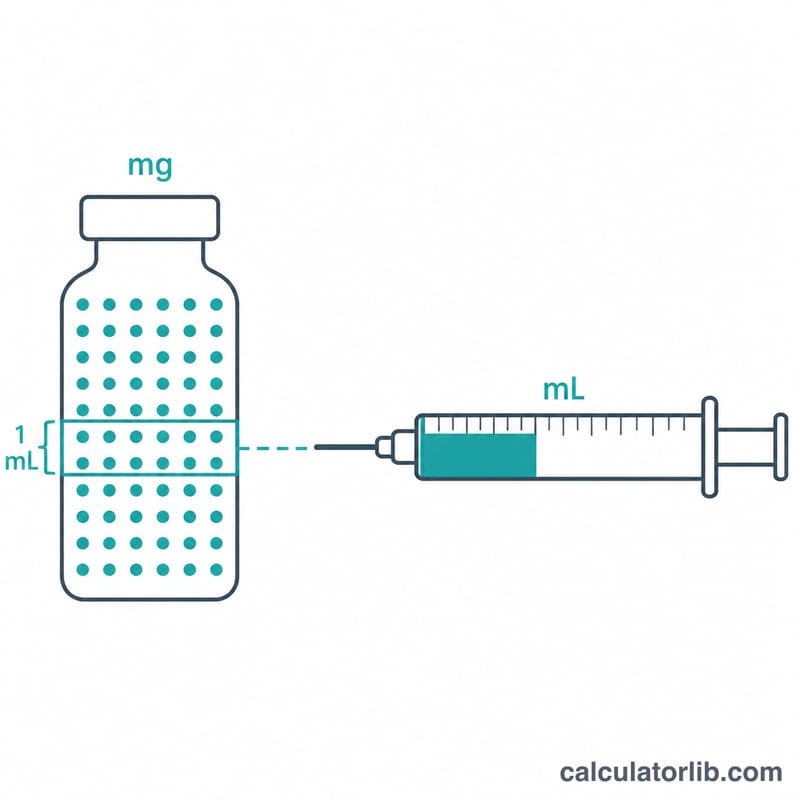
Vial showing drug particles per millilitre next to a graduated syringe drawn to the measured volume
Concentration tells you how many milligrams sit in each millilitre, which sets the mark you draw the syringe to.

FAQ

Does it work for cats and other species? Yes. The math is species-independent as long as you enter the correct weight and the dosage rate appropriate for that species.

What if the weight is in pounds? Convert first by dividing pounds by 2.2046 to get kilograms before entering the value.

Is this a substitute for veterinary judgement? No. Always confirm doses against the product label and clinical guidance; this tool is an arithmetic aid only.
Sources & References

  • BAYTRIL- enrofloxacin tablet, chewable — Elanco US Inc.; FDA-approved animal drug label on DailyMed (NLM), setid 606b1dd3-24ed-4f8c-8885-6b22fd7b8883. Label dose is mg/kg x body weight with mg/lb equivalent (5 mg/kg = 2.27 mg/lb) and a weight-band tablet chart (9.1 kg = 20 lb; 27.2 kg = 60 lb) · Verified 2026-11-07
  • CERENIA- maropitant citrate injection — Zoetis Inc.; FDA-approved animal drug label on DailyMed (NLM), setid 6aeda328-97c9-4868-8ecb-b3a4dcdbc0a0. Label converts a mg/kg dose to mL with the 10 mg/mL strength: 1 mg/kg (0.45 mg/lb) = 0.1 mL/kg, for dogs and for cats · Verified 2026-11-07
  • Cephalosporins and Cephamycins Use in Animals — Merck Veterinary Manual (Merck & Co.), Pharmacology / Antibacterial Agents. Cephalexin cats 15-35 mg/kg PO q6-12h, dogs 15-45 mg/kg PO q6-12h · Verified 2026-11-07

Checked against these sources on . Not reviewed by a clinician. For general information only, not veterinary advice. Ask a veterinarian about your animal's health and before giving it any medicine.

Last updated:

Most popular in Pet Care

View all Pet Care calculators