

What Is the Current Ratio?
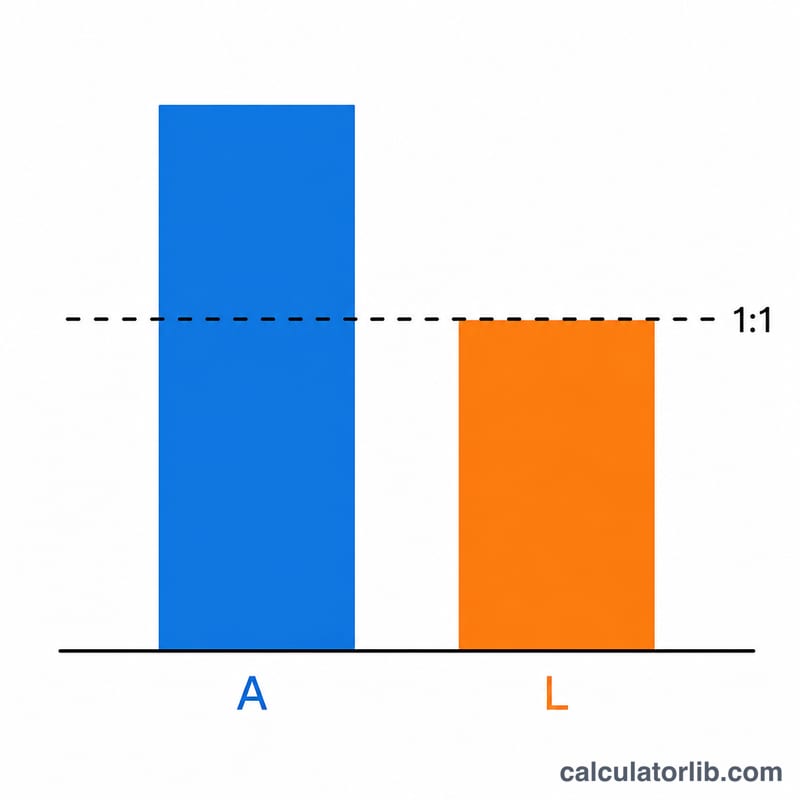
The current ratio is a liquidity ratio that measures a company's ability to pay off its short-term obligations (those due within one year) with its short-term assets. It is one of the most widely used metrics in financial analysis because it gives a quick, intuitive read on whether a business can cover its near-term bills. A ratio of 1.0 means current assets exactly equal current liabilities; above 1.0 suggests a comfortable cushion, while below 1.0 can signal liquidity stress.
How to Use This Calculator
Enter your total current assets — cash, accounts receivable, inventory, marketable securities, and prepaid expenses — and your total current liabilities — accounts payable, short-term debt, accrued expenses, and the current portion of long-term debt. The calculator instantly returns the current ratio plus your working capital (the dollar surplus or shortfall). Both figures come straight from the balance sheet.
The Formula Explained
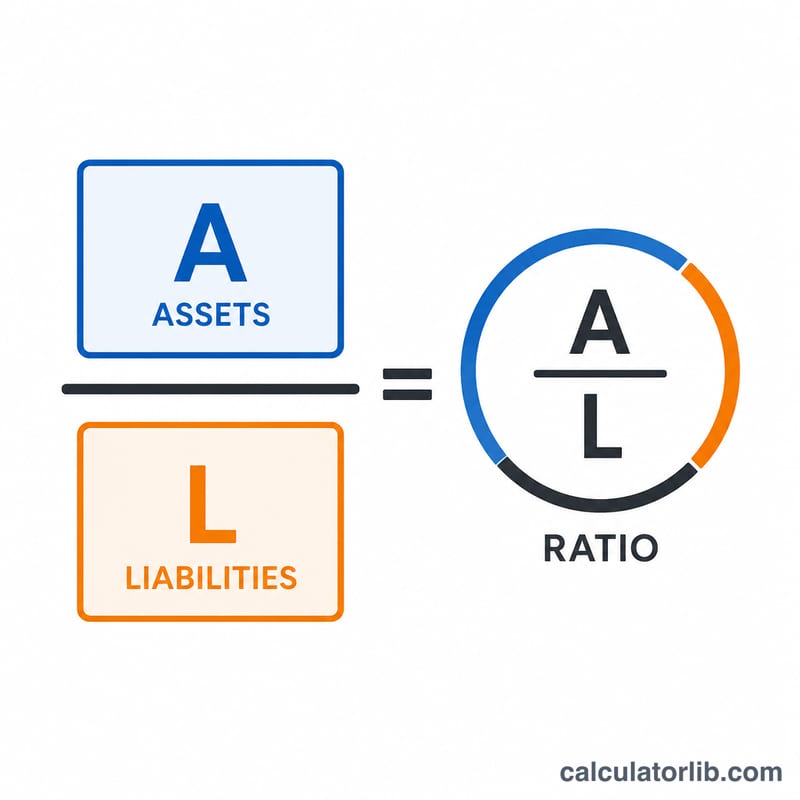
The formula is simply $$\text{Current Ratio} = \frac{\text{Current Assets}}{\text{Current Liabilities}}$$ Because it divides two figures measured at the same point in time, no time period or interest rate is involved. Working capital is the related absolute measure: \(\text{Current Assets} - \text{Current Liabilities}\).
Worked Example
Suppose a company reports $150,000 in current assets and $100,000 in current liabilities. The current ratio is $$150{,}000 \div 100{,}000 = \mathbf{1.5}$$ and its working capital is $$150{,}000 - 100{,}000 = \mathbf{\$50{,}000}$$ This means the firm has $1.50 of current assets for every $1.00 of current liabilities — a generally healthy position.
FAQ
What is a good current ratio? Many analysts view a ratio between 1.5 and 3.0 as healthy, though the ideal varies by industry. Too high may indicate idle assets.
What does a ratio below 1 mean? It means current liabilities exceed current assets, which can warn of potential difficulty meeting short-term obligations.
How does the current ratio differ from the quick ratio? The quick ratio excludes inventory and other less-liquid current assets, giving a more conservative liquidity measure.