

What Is EBIT?
EBIT stands for Earnings Before Interest and Taxes. It is a measure of a company's operating profitability that strips out the effects of financing decisions (interest) and tax rates. Because it ignores capital structure and tax jurisdiction, EBIT lets you compare the core operating performance of different companies on an apples-to-apples basis. It is also commonly called operating income.

How to Use This Calculator
Enter three figures from the income statement: total revenue (sales), cost of goods sold (COGS), and other operating expenses such as salaries, rent, marketing, depreciation, and administrative costs. The calculator subtracts every operating cost from revenue to give EBIT and also returns the EBIT margin so you can gauge profitability relative to sales.
The Formula Explained
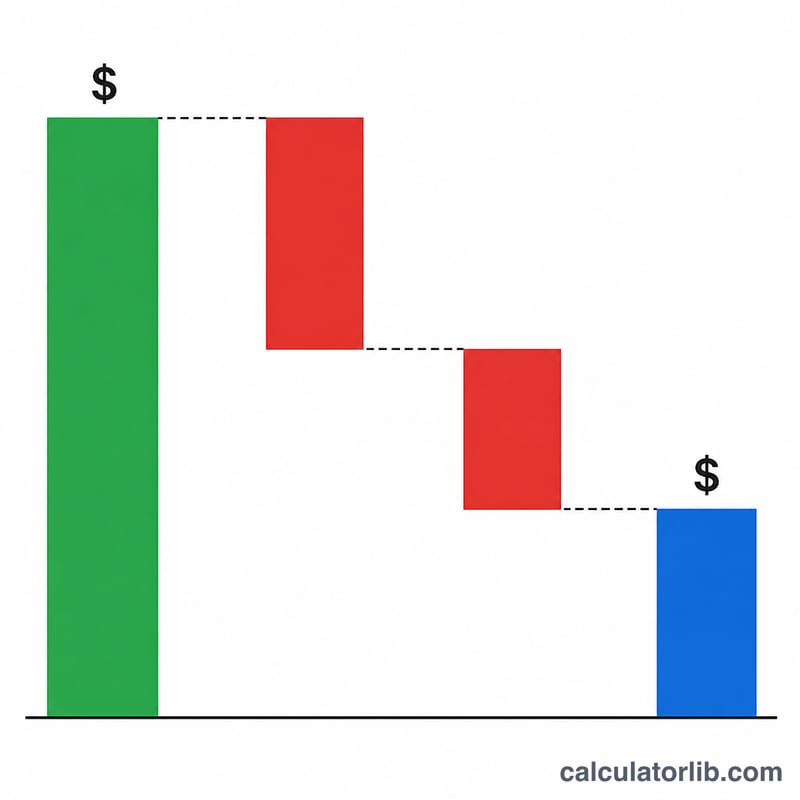
The core equation is simply $$\text{EBIT} = \text{Revenue} - \left( \text{COGS} + \text{Operating Expenses} \right)$$ The two cost terms together make up total operating expenses. Note that interest expense and income tax are deliberately excluded — that is what makes the metric "before interest and taxes." The EBIT margin is then EBIT divided by revenue, expressed as a percentage.
Worked Example
Suppose a business records $1,000,000 in revenue, $600,000 in COGS, and $150,000 in operating expenses. Total operating expenses are $$\$600{,}000 + \$150{,}000 = \$750{,}000$$ $$\text{EBIT} = \$1{,}000{,}000 - \$750{,}000 = \mathbf{\$250{,}000}$$ The EBIT margin is \(\$250{,}000 \div \$1{,}000{,}000 = 25\%\).
FAQ
Is EBIT the same as operating income? In most cases yes — both reflect profit from core operations before interest and taxes, though EBIT can sometimes include small non-operating items.
How is EBIT different from EBITDA? EBITDA adds back depreciation and amortization to EBIT, removing the effect of non-cash charges.
What is a good EBIT margin? It varies by industry, but a higher margin generally indicates stronger operating efficiency. Compare against industry peers rather than a fixed benchmark.